

Professor takes the plunge to protect Kuwait’s coral reefs

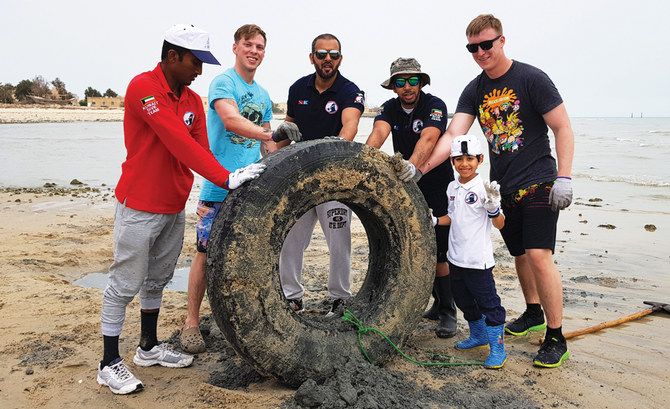
The Kuwait Dive Team takes regular trips to monitor the corals and clear sea debris, removing sunken boats, ghost nets and beach trash from the waters in efforts to protect Kuwait’s marine environment. (Supplied)
Short Url
Updated 13 March 2020
Follow

Professor takes the plunge to protect Kuwait’s coral reefs

  • Dari Alhuwailan has been volunteering with the Kuwait Dive Team in his spare time for 13-years
  • The team comprises diving professionals committed to protecting the marine ecosystem through salvage operation

KUWAIT:  Dr. Dari Alhuwail is a true modern-day hero. When he is not working as an assistant professor at Kuwait University’s Department of Information Science, he is with the Kuwait Dive Team, plunging deep into the sea to protect the country’s marine environment.

“I am saying this in all honesty and without the tiniest bit of cheesiness or corniness: we are ‘Team Mission Impossible’,” he said with the unmistakable pride of someone who has been associated with the volunteer diving team for close to 13 years now.

The Kuwait Dive Team is a group of diving professionals committed to protecting the marine ecosystem through salvage operations.

Officially, Alhuwail handles international relations, communicating with associations such as Project AWARE and Ocean Conservancy, but he also takes regular trips to monitor the corals and clear sea debris.

Alhuwail’s relationship with the team goes back to his high-school days, when he saw press releases of the Dive Team’s initiatives for picking up marine debris, sunken boats and beach trash.

“For me, their efforts symbolized something greater,” he said.


Dr. Dari Alhuwail, an assistant professor at Kuwait University’s Department of Information Science, has been a part of the Kuwait Dive Team since his high school days. (Supplied)

“All of the work that we undertake essentially involves protecting Kuwait’s coral reefs because the reefs are one of the most important elements in the marine world.” Alhuwail said.

“For example, on a regular day, we lift sunken boats and vessels, move debris and ghost nets from the waters and moor buoys to safeguard the reefs so that the boats don’t anchor there.”

In 2010, Kuwait experienced its worst coral bleaching season, with almost 80 percent of its reefs affected. Alhuwail says they are now recovering, but more effort is needed to reclaim what is lost.

“We have a coral transplantation project in place where we try and build new homes for the reefs, and we have artificial reef installations around Kuwait.”

Alhuwail cites amateur diving and spearfishing around the reefs as some of the human activities that can damage these areas.

“Amateur divers have lesser control over their buoyancy, and sometimes when you swim too close your fin breaks off a coral — it might have taken 10 or 20 years for that bit to grow.”

“No, we are not your regular 911,” said Alhuwail trying to explain the range of work he undertakes as part of the Dive Team.

However, the members do respond to some calls, for example about sunken boats that pose a threat to passing vessels. Even then, many factors need to be considered before the team sets out.

“The sea has certain rules that need to be observed — high tide, low tide, wind speed and direction, wave height, and add to that the things we need to do our homework on — location of the operation, threat to life, additional resources requirement and so on.”


• This report is being published by Arab News as a partner of the Middle East Exchange, which was launched by the Mohammed bin Rashid Al Maktoum Global Initiatives and the Bill and Melinda Gates Foundation to reflect the vision of the UAE prime minister and ruler of Dubai to explore the possibility of changing the status of the Arab region.


Sudan hospital welcomes first patients after war forced it shut

Women walk outside Bahri Teaching Hospital after it resumed services in the Sudanese capital Khartoum on January 18, 2026. (AFP)
Updated 5 sec ago
Follow

Sudan hospital welcomes first patients after war forced it shut

  • The Bahri Teaching Hospital, which, before the conflict, treated around 800 patients a day in its emergency department, was repeatedly attacked and looted

KHARTOUM: At a freshly renovated hospital in Khartoum, the medical team is beaming: Nearly three years after it was wrecked and looted in the early days of Sudan’s war, the facility has welcomed its first patients.
The Bahri Teaching Hospital in the capital’s north was stormed by the paramilitary Rapid Support Forces in April 2023, soon after fighting broke out between the RSF and Sudan’s army.
Bahri remained a war zone until an army counteroffensive pushed through Khartoum last year, recapturing the area from the RSF in March.

FASTFACT

Around 40 of Khartoum’s 120 hospitals, shut during the war, have resumed operations, according to the Sudan Doctors’ Network, a local medical group.

“We never thought the hospital would reopen,” said Dr. Ali Mohammed Ali, delighted to be back in his old surgical ward.
“It was completely destroyed; there was nothing left,” he said. “We had to start from scratch.”
Ali fled north from Khartoum in the early days of the war, working in a makeshift medical camp with “no gloves, no instruments, and no disinfectant.”
According to the World Health Organization, the conflict has forced the shutdown of more than two-thirds of Sudan’s health facilities and caused a world record number of deaths from attacks on health care infrastructure.
Tens of thousands of people have been killed across Sudan since the war began, while 11 million have been left displaced, triggering the world’s largest hunger crisis.
But with the RSF now driven out of Khartoum, Sudan’s government is gradually returning, and the devastated city is starting to rebuild.
Around 40 of Khartoum’s 120 hospitals, shut during the war, have resumed operations, according to the Sudan Doctors’ Network, a local medical group.
The Bahri Teaching Hospital, which, before the conflict, treated around 800 patients a day in its emergency department, was repeatedly attacked and looted.
“All the equipment was stolen,” said director Galal Mostafa, adding that about 70 percent of its buildings were damaged and the power system was destroyed.
“We were fortunate to receive two transformers just days ago,” said Salah Al-Hajj, the hospital’s chief executive.
During the first five days of fighting, Al-Hajj — an affable man with a sharp grey moustache — was trapped inside one wing of the hospital.
“We couldn’t leave because of the heavy gunfire,” he said, saying that anyone “who stepped outside risked being detained and beaten” by the RSF.
Patients were rushed to 
safety in dangerous transfers to hospitals away from the fighting across the Nile.
“Vehicles had to take very complicated routes to evacuate patients safely, avoiding shells and bullets,” Al-Hajj said. On April 15, 2023, as the first shots rang out in the capital, RSF fighters seized Ali on his way into surgery.
They held him for two weeks at Soba, an RSF-run detention center in southern Khartoum whose former inmates have shared testimony of torture and inhumane conditions.
“When I was released, the country was in ruins,” he said.
Hospitals were “destroyed, streets devastated, and homes looted. There was nothing left.”
Almost three years on, taxis now drop patients at the hospital’s entrance, while new ambulances sit parked in a courtyard that until recently was strewn with rubble and overgrown weeds.
Inside, refurbished corridors smell of fresh paint.
The renovations and new equipment were funded by the Sudanese American Physicians Association and Islamic Relief USA at a cost of more than $2 million, according to the association.
Services have resumed in newly fitted emergency, surgical, obstetrics, and gynaecology rooms.
Doctors, nurses, and administrators hustle through the halls, the administrators fretting over covering salaries and running costs.
“Now it’s much better than before the war,” said Hassan Alsahir, a 25-year-old intern in the emergency department.
“It wasn’t this clean before, and we were short on beds — sometimes patients had to sleep on the floor.”
On its first day reopened, the hospital received a patient from the Kordofan region — the war’s current major battleground — for urgent surgery.
“The operation went well,” said Ali.