



PESHAWAR: When the US-Taliban peace agreement was signed on Feb. 29 in Qatar, it was expected to face some hurdles. But not, as it turned out, within 72 hours.
A wave of Taliban attacks on March 3 resulted in the deaths of 20 Afghan soldiers and police officials along with several civilians, according to authorities in Kabul.
The US retaliated the next day by carrying out an airstrike against Taliban fighters preparing to attack Afghan government forces in Helmand province.
Since then, some steps have been taken to control the damage and clear the uncertainty about the agreement’s future.
President Donald Trump called the Qatar-based Taliban deputy leader Mullah Abdul Ghani Biradar to tell him that Mike Pompeo, the US Secretary of State, had been instructed to talk to Afghan President Ashraf Ghani in an attempt to resolve the issues hindering implementation of the Doha deal.
Meanwhile, Zalmay Khalilzad, the US Special Representative for Afghanistan Reconciliation, raced to Kabul to make clear Washington’s commitment to facilitating an exchange of prisoners and thrash out the differences that are holding up intra-Afghan talks.
However, in a development that makes the government look divided in the run-up to the intra-Afghan talks, two politicians declared themselves president at rival inauguration ceremonies in Kabul on Monday.
The electoral commission has said incumbent Ashraf Ghani won September’s shambolic poll, but Abdullah Abdullah, his long-time rival, has dismissed the result as fraudulent.
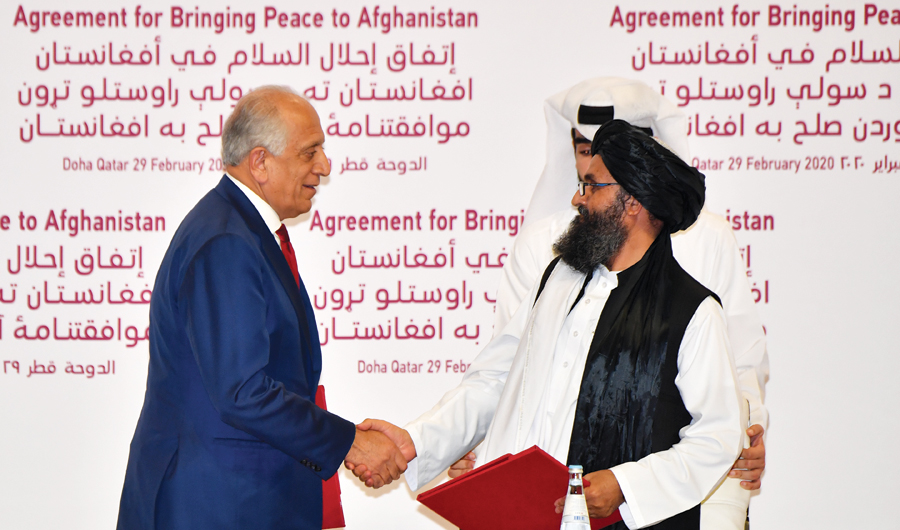
US representative Zalmay Khalilzad and Taliban co-founder Mullah Abdul Ghani Biradar after the agreement. (AFP)
All this comes against a backdrop of continuing violence, high unemployment and deep-seated distrust between the warring sides.
The conditions-based US- Taliban agreement was hammered out after about 18 months of tortuous negotiations marked by several false starts and little reduction in conflict.
In theory, the deal paves the way for the full withdrawal of American and allied security forces from Afghanistan in just over a year, starting with a drop in troop levels to 8,600 in the first 135 days.
The text of the agreement also says that up to 5,000 Taliban prisoners and up to 1,000 “prisoners of the other side will be released by March 10, 2020, the first day of intra-Afghan negotiations.”
There was understandable worry that turning the words into action would be challenging. The Taliban, after all, are no ordinary armed group.
The US attacked Afghanistan in October 2001 in a bid to oust the Taliban, who were harboring Osama bin Laden and other al-Qaeda figures linked to the Sept. 11, 2001 terror attacks.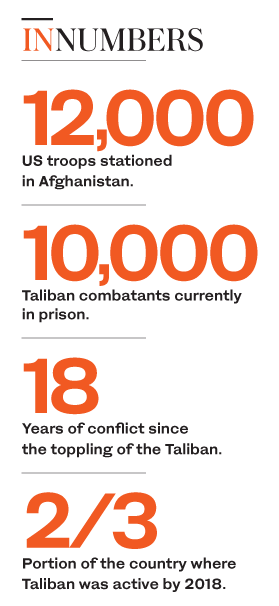
The Taliban were toppled from power in Kabul and replaced by an internationally recognized government, but they quickly became an insurgent force.
By 2018, Taliban fighters were active in more than two-thirds of Afghanistan.
The Afghan government had been kept out of the protracted negotiations in Qatar because of Taliban objections. In the circumstances, it was a foregone conclusion that implementation of the agreement would be problematic.
President Ghani fired the first salvo when he said that his government had made no pledge to free 5,000 Taliban prisoners as part of the swap mentioned in the agreement.
He argued that such a concession could not be a prerequisite to intra-Afghan dialogue, but instead be part of the agenda of the talks.
Evidently, Ghani is hoping to use the prisoners’ release as a bargaining chip when the time comes to demand a permanent cease-fire before what is likely to be difficult negotiations with the Taliban regarding Afghanistan’s future.
For a few weeks in February, there was a palpable reduction in attacks claimed by the Taliban. However, Ghani’s tough stance on the issue of prisoners’ release triggered a chain of events that made Afghans feel they were back to square one.
The Taliban announced resumption of operations against the government. They argued that since they had reached the agreement with the US, the onus was on the former to get the 5,000 fighters released from Afghan prisons.
The Taliban had promised not to attack the US-led international force and honor its commitment to a “reduction in violence” for one week, which it had given in the lead-up to the signing of the peace agreement.
However, the US felt it could not stay aloof after the Taliban attacks against Afghan forces. The March 4 airstrike was meant to be reaffirmation of American support to the beleaguered Afghan government.
It also was a warning to the Taliban that they would pay a price if violence did not abate.
The fast-moving developments, coupled with the Ghani-Abdullah face-off, have predictably raised fresh questions about the viability of the US-Taliban agreement.
The deal with the Taliban has not been popular with US politicians as it is, with even some Republican leaders criticizing the sidelining of the Afghan government.
Trump pulled out all stops to ensure the negotiations’ success, mindful of a failed deal’s potential for hurting him politically in the run-up to the November elections.
There are plenty of reasons for US voters to be tired of the war. More than 3,500 American and NATO troops have been killed since the US military intervention in Afghanistan in October 2001, and tens of thousands have been wounded.
The financial cost for the US alone has been estimated at more than $2 trillion, excluding care for veterans with long-term medical needs or disabilities.
On the Afghan side, more than 100,000 people, including perhaps 32,000 civilians and 58,000 security personnel, have been killed, and millions more have been displaced.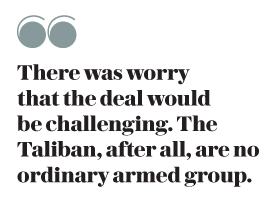
There are considerations for the Taliban leaders, too. Getting the deal implemented would enable them to achieve their main goal of “ending” Afghanistan’s occupation by ensuring withdrawal of the US-led NATO forces; securing freedom for Taliban prisoners; and having a say in deciding Afghanistan’s future.
With all this in mind, Taliban negotiators for the first time agreed to meet an Afghan government delegation, which had been waiting in Qatar for more than a week to discuss the agenda of the intra-Afghan dialogue.
Though the militants said that the meeting would discuss only the issue of the prisoners’ swap, this was still a breakthrough. With luck, it could lead to a change in the Taliban’s approach of refusing to directly engage with the Afghan government on the pretext that it is a “puppet” of the US.
For their part, both the Taliban and the US made compromises to reach the Qatar agreement.
The fighters agreed to give the US 14 months to withdraw troops from Afghanistan (after having long insisted on a shorter period), promised to cut ties with al-Qaeda and other militant groups, offered guarantees disallowing the use of Afghan soil for attacks against the US and its allies, and vowed to dial down violence.
The group also declined to make the latest US airstrike against its fighters an issue.
The US, too, conceded the Taliban demand for holding direct talks without involving the Afghan government, gave up its insistence on a permanent cease-fire by opting for a “reduction in violence,” and offered support for the striking off of Taliban members’ names from the UN Security Council “black list.”
Some of the deadlines, including the March 10 date for the release of prisoners and the start of intra-Afghan talks, may yet be missed. Even so, if the two sides, along with the Afghan government, agree to make further compromises, a lasting accommodation need not be viewed as totally out of reach.


