Middle East travel and tourism fair in Dubai postponed over coronavirus

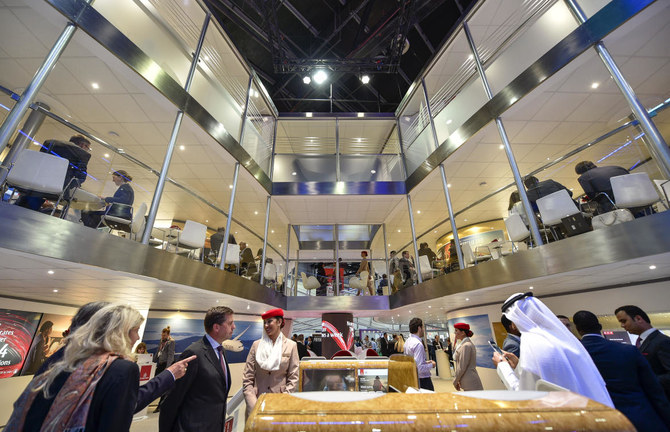
The Arabian Travel Market (ATM) attracts thousands of people from around the world. (File/AFP)
Short Url
Updated 09 March 2020
Follow

Middle East travel and tourism fair in Dubai postponed over coronavirus

  • The ATM was due to take place in Dubai in April
  • The ATM attracts thousands of people from around the globe

DUBAI: A regional travel and tourism exhibition in Dubai in April has been postponed to late June due to the coronavirus outbreak, organizers said on Monday.
Arabian Travel Market, one of the Middle East’s biggest travel fairs, will now take place from June 28 to July 1 instead of April 19 to 22, due to the coronavirus outbreak.
“The announcement has been made at the earliest opportunity to give as much notice as possible to all stakeholders enabling them to make the necessary arrangements to reschedule their plans, and ensure even stronger attendance in June.”
The outgoing president of the airline Emirates, Tim Clark, was due to give one of his last interviews at the event before stepping down in June. The United Arab Emirates has reported 45 coronavirus cases, which has led to major events across the country being canceled or postponed.


Building bridges: Saudi Arabia leads Gulf-Asia tech leap

Updated 01 January 2026
Follow

Building bridges: Saudi Arabia leads Gulf-Asia tech leap

ALKHOBAR: Saudi Arabia is forging new academic connections with Asia as the Kingdom’s Vision 2030 accelerates reforms in education and innovation.

Two academics — Prof. Eman AbuKhousa, a data science professor at the University of Europe for Applied Sciences in Dubai, and Prof. Hui Kai-Lung, acting dean of the HKUST Business School in Hong Kong —emphasize that the Kingdom’s transformation is reshaping the development of artificial intelligence and fintech talent across the region.

For AbuKhousa, responsible AI is not just about technology; it is fundamentally about intention. “It is about aligning technology with human values: ensuring fairness, transparency, and accountability in every system we build.”

She highlighted that the Middle East’s heritage of trust and ethics gives the region a competitive advantage. “Institutions should embed ethics and cultural context into AI education and create multidisciplinary labs where engineers collaborate with social scientists and ethicists,” she said.

At the University of Europe for Applied Sciences in Dubai, AbuKhousa trains students to question data, identify bias, and integrate integrity into innovation. 

Asian universities like HKUST play a growing role in cross-border education partnerships with Saudi institutions.

“Educators must model responsible use by explaining how data is sourced and decisions are made,” she explained. “Ultimately, responsible AI is less about algorithms than about intention; teaching future innovators to ask not only ‘Can we?’ but ‘Should we?’”

She further noted:“Saudi Arabia’s Vision 2030 has turned digital education into a national movement placing technology and innovation at the heart of human development.”

AbuKhousa emphasized the transformative opportunities for women in the Kingdom: “Today, Saudi female students are designing models, leading AI startups, and redefining what digital leadership looks like.”

Prof. Hui views this transformation through the lens of fintech. “Fintech is deeply embedded in Vision 2030, serving as a key enabler of its three pillars: a vibrant society, a thriving economy, and an ambitious nation,” he said.

Hui stressed that Saudi Arabia’s investment capacity and modern regulatory framework “create a conducive environment for innovation.” Having collaborated with Aramco, The Financial Academy, and Prince Mohammed Bin Salman College of Business and Entrepreneurship, he highlighted the strategic potential of the Kingdom’s young population. “The Kingdom has one of the youngest populations in the world, with a median age below 30,” he said. 

Opinion

This section contains relevant reference points, placed in (Opinion field)

“This demographic presents a tremendous opportunity for higher education to shape future leaders, and our collaborations in Saudi Arabia are highly targeted to support this goal.”

AbuKhousa argued that universities must lead innovation rather than follow it. “Universities must evolve from teaching institutions into innovation ecosystems,” she said. “The real bridge between research and industry lies in applied collaboration: joint labs, shared data projects, and co-supervised capstones where students solve live industry challenges.”

“At UE Dubai, we’ve introduced an Honorary Senate of Business Leaders to strengthen that bridge, bringing decision-makers directly into the learning process,” she added.

DID YOU KNOW?

Vision 2030 has made digital education central to Saudi Arabia’s development strategy.

Women in Saudi Arabia are now designing AI models and leading startups.

Universities are transforming into innovation ecosystems bridging research and industry.

Cross-border collaborations with Hong Kong and Dubai are accelerating fintech and AI growth.

Hui noted that cross-border cooperation between Hong Kong and Saudi Arabia is growing rapidly. “Saudi Arabia’s scale, strategic location, and leadership in the Arab world offer Hong Kong an ideal partner,” he said. “Hong Kong’s academic and regulatory experience can help the Kingdom fast-track its digital transformation.”

He highlighted lessons from Hong Kong’s fintech journey. “Hong Kong’s fintech journey offers critical lessons for Saudi Arabia, particularly in creating a balanced ecosystem for innovation,” he said. “Education and regulation are both important. We need education at all levels and beyond schools to expose people to these ideas; having diverse and rich experiences also helps, as the education needs to be supplemented by real-life implementation and usage experience. That is what Hong Kong can offer.”

AbuKhousa emphasized that women’s participation in technology must extend beyond access to influence. “Empowering women in technology begins with reimagining representation: from inclusion to influence,” she said. “We need more women not only learning tech, but leading teams, designing systems, and shaping AI policy. Institutions must normalize women’s presence in decision-making spaces and provide visible mentorship networks to counter imposter syndrome.”

Both experts agreed that innovation must remain human-centered and accountable. “As AI becomes integral to financial systems, governments must strike a careful balance between innovation, data ethics, and compliance,” Hui said. “Establishing clear regulatory frameworks and transparency standards is crucial.”

AbuKhousa concurred, emphasizing the role of education in AI adoption: “Educators must position generative AI as a thinking partner, not a shortcut. The goal is to teach students how to use AI critically, not merely that they can.”

Hui predicts that “AI, blockchain, and cybersecurity will be transformative forces in the region’s financial sector.” AbuKhousa sees a similar momentum in education: “The Gulf is entering a defining phase where AI becomes the backbone of education and workforce development.”

The experts concluded that the Kingdom’s digital transformation, anchored in Vision 2030, is connecting classrooms, industries, and continents through human-centered innovation.