

Philippines mulls declaring health emergency over coronavirus 

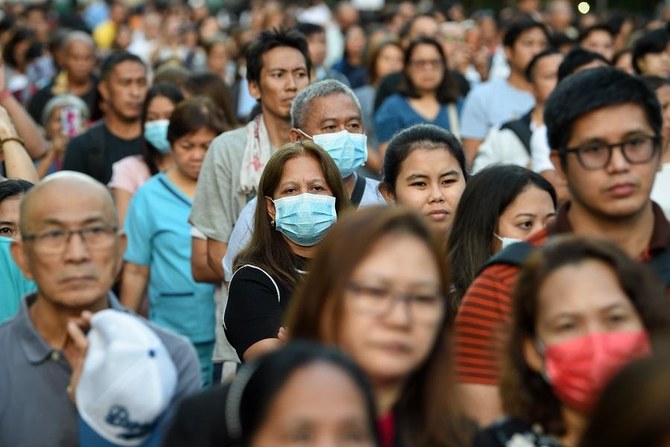
The health ministry recommended that President Rodrigo Duterte declare a public health emergency. (File/AFP)
Short Url
Updated 07 March 2020
Follow

Philippines mulls declaring health emergency over coronavirus 

  • Alert level raised to code red
  • The coronavirus has spread to more than 90 countries, infecting more than 100,000 people and killing over 3,400 people worldwide

MANILA: Philippines health officials on Saturday recommended declaring a public health emergency following the first local transmission of the novel coronavirus (COVID-19).

It follows the Department of Health (DOH) raising the COVID-19 alert level to Code Red “in anticipation of a possible sustained community transmission” of the disease.

Health Secretary Francisco Duque III confirmed in a news conference that the fifth COVID-19 case  - of a 62-year-old male Filipino with pre-existing hypertension and diabetes mellitus - had been reported in the Philippines on Friday. He has no history of recent travel outside the country.

Duque added that the patient’s 59-year-old wife had also tested positive for the disease, bringing the country’s confirmed number of cases to six.

Both have been admitted to the Research Institute of Tropical Medicine. Authorities say that while the man is suffering from severe pneumonia, his wife is in a stable condition.

“The DOH is currently exhausting all its efforts to identify others who may have come in contact with the confirmed cases to ensure that this localized transmission does not progress to community spread,” Duque said.

In raising the COVID-19 alert status to Code Red sublevel 1, Duque explained that it was a preemptive call to ensure that authorities and health care providers could prepare for a possible increase in suspected and confirmed cases.

“The DOH has recommended to the Office of the President for the declaration of a State of Public Health Emergency which will facilitate mobilization of resources, ease processes, including procurement of critical logistics and supplies, and intensifying reporting.”

The secretary also reminded people to practice hand hygiene, maintain cough etiquette, avoid unnecessary travel and postpone mass gatherings as he stressed that it was every individual's responsibility “to protect ourselves and the people around us.”

Duque said that once there was sustained community transmission, or an increasing number of local cases whose links could not be established, the strategy would move from intensive contact tracing to the implementation of community-level quarantine and or the suspension of work or school.

Health care providers, institutions, and stakeholders were also reminded to exercise the utmost prudence in sharing sensitive information about suspected or confirmed cases.

“Our objectives for sharing information are two-pronged: ensure the public's health and safety by facilitating contact tracing and ensure that the individual’s right to privacy has not impinged. Hence, we appeal to all to coordinate closely with the DoH when disseminating information to the public and within their respective institutions,” Duque said.


Trump insists he struck Iran on his own terms

Updated 04 March 2026
Follow

Trump insists he struck Iran on his own terms

  • “We are now a nation divided between those who want to fight wars for Israel and those who just want peace and to be able to afford their bills and health insurance,” Marjorie Taylor Greene posted on X.
  • Rubio himself doubled down on Tuesday after meeting with US House and Senate members, while insisting that “No, I told you this had to happen anyway”

WASHINGTON, United States: President Donald Trump and his team scrambled Tuesday to reclaim the narrative on why he decided to attack Iran, after his top diplomat suggested the US struck only after learning of an imminent Israeli strike.
Secretary of State Marco Rubio alarmed Democrats — who say only Congress can declare war — as well as many of Trump’s MAGA supporters on Monday when he said: “We knew that there was going to be an Israeli action.”
“We knew that that would precipitate an attack against American forces, and we knew that if we didn’t pre-emptively go after them before they launched those attacks, we would suffer higher casualties,” Rubio told reporters.
Administration officials quickly backpedalled, insisting Trump authorized the strikes because Tehran was not seriously negotiating an accord on limiting its nuclear ambitions, and the United States needed to destroy Iran’s missile capabilities.
“No, Marco Rubio Didn’t Claim That Israel Dragged Trump into War with Iran,” White House Press Secretary Karoline Leavitt posted Tuesday on X.
At an Oval Office meeting later with Germany’s chancellor, Trump went further, saying that “Based on the way the negotiation was going, I think they (Iran) were going to attack first. And I didn’t want that to happen.”
“So, if anything, I might have forced Israel’s hand.”

- Had to happen? -

Rubio himself doubled down on Tuesday after meeting with US House and Senate members, while insisting that “No, I told you this had to happen anyway.”
“The president made a decision. The decision he made was that Iran was not going to be allowed to hide... behind this ability to conduct an attack.”
Critics seized on the muddied messaging to accuse Trump of precipitating the country into a war without a clear rationale, without informing Congress — and without a clear idea of how it might end.
They noted that just two weeks ago, Israel Prime Minister Benjamin Netanyahu pressed Trump again in Washington to take a hard line, in their seventh meeting since Trump’s return to power last year.
Some Republican allies rallied behind the president, with Senator Tom Cotton, chairman of the Senate Intelligence Committee, insisting that “No one pushes or drags Donald Trump anywhere.”
“He acts in the vital national security interest of the United States,” Cotton told the “Fox & Friends” morning show.
But as crucial US midterm elections approach that could see Republicans lose their congressional majority, Trump risks shedding supporters who had welcomed his pledge to end foreign military interventions.
“We are now a nation divided between those who want to fight wars for Israel and those who just want peace and to be able to afford their bills and health insurance,” Marjorie Taylor Greene, a top former Trump ally and a major figure in the populist and isolationist hard right, posted on X.