

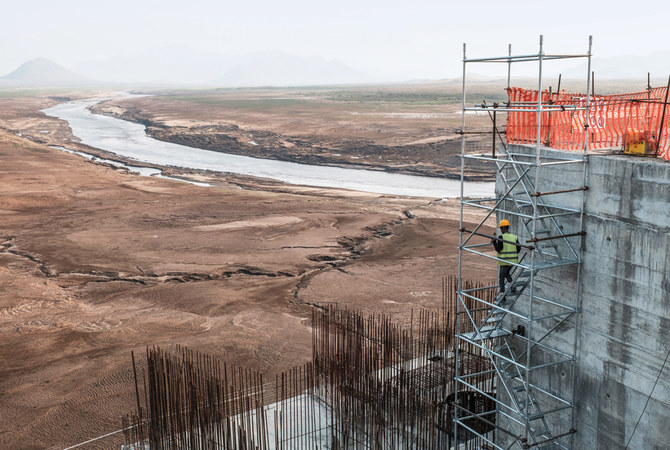

CAIRO: The Grand Renaissance Dam, being built on the Nile river by Ethiopia, has become a matter of great concern in the North African region as tensions between Ethiopia and Egypt mount, with Sudan caught in between.
This follows a series of developments, most notably the refusal of the Ethiopian government to take part in the Feb. 27 to 28 talks in Washington, that were intended to produce a final agreement with Egypt and Sudan on the filling and operation of the dam.
In response to Ethiopia’s stance, Egypt has launched an international diplomatic offensive to shore up its position with regard to its Nile water rights.
The Ethiopian side stands accused of dragging its feet after it skipped the latest round of talks. The decision left the Egyptians angry and the Americans, who had drafted an agreement with the technical input of the World Bank, disappointed.
Egypt relies on the Nile for 90 percent of its water. It contends that having a stable flow of the Nile waters is a matter of survival in a country where water is scarce.
FASTFACT
S4.2 billion
Cost of mega-dam on which Ethiopia bets to become a manufacturing power
A 1929 treaty (and a subsequent one signed in 1959) gave Egypt and Sudan rights to nearly all of the Nile’s waters. The document also gives Egypt veto powers over any infrastructure projects by upstream countries that would affect its share of the river’s resources.
Ethiopia launched construction in 2011 on the Blue Nile in the northern Ethiopian highlands, from where 85 percent of the Nile’s waters flow.
One of Egypt’s main worries is that if the water flow diminishes, it could affect Lake Nasser, the reservoir further downriver, behind Egypt’s Aswan Dam.
For more than four years, three-way talks between Egypt, Sudan and Ethiopia over operating the dam and filling its reservoir had made no progress until the US took up the role of mediator.
According to a US Treasury Department statement, the latest plan builds on the previous seven years of technical studies and consultations between the three countries and provides for the resolution of all outstanding issues concerning the filling and operation of the dam.
The statement expressed appreciation for the Egyptian side, which was described as relying on negotiations as the sole means of resolving the dispute and prepared to acknowledge Ethiopian interests, provided Ethiopia acknowledged its vital interests.
It said: “We also note the concern of downstream populations in Sudan and Egypt due to unfinished work on the safe operation of the GERD, and the need to implement all necessary dam safety measures in accordance with international standards before filling begins.”
Egypt’s position is to make sure the upcoming structure – Africa’s biggest hydroelectric power plant – does not cause significant harm to downstream countries and the final testing and filling of the dam does not take place without an agreement.
Egypt has proposed a longer period – so that the level of the river does not dramatically drop, especially in the initial phase of filling the reservoir. The longer it takes to fill the reservoir, the less impact there will be on the level of the Nile.
For its part, the Ethiopian Ministry of Foreign Affairs has issued a statement reflecting the truth of the country’s position on the project.
It said the countries still had to discuss major issues related to the final agreement, and that Ethiopia was committed to continuing consultations with Egypt and Sudan to reach a final agreement regarding the filling and operation of the dam.
The statement made clear Ethiopia’s intention to start filling the dam as construction proceeded, even without reaching an agreement.
Such a course of action would constitute a violation of international law and article n.5 of the 2015 Declaration of Principles.
FASTFACT
90%
Reliance of Egypt on the Nile for its water
Things were not in favor of Egypt as long as Ethiopia was successful in portraying itself as the victim. But today, the shoe is on the other foot.
Ethiopia is in denial regarding the rules of geography and international laws and customs when it claims it has the absolute right to the Blue Nile because it runs through Ethiopian territory.
This is a clear violation of international law that stipulates equitable sharing of downstream benefits on international rivers, including the Nile River. The law gives Egypt a strong bargaining position in diplomatic or legal disputes.
In addition to a phone call between Egyptian President Abdel Fattah El-Sisi and US President Donald Trump, the Egyptian diplomatic mission has been in touch with African countries with a view to winning their support.
Egypt’s Minister of Foreign Affairs Sameh Shoukry held a meeting with the ambassadors of African countries in Cairo, where he reviewed the latest developments in the Grand Renaissance Dam issue and highlighted Cairo’s efforts at reaching a fair and equitable agreement that advances the interests of all three parties.
Shoukry further briefed the envoys on Egypt’s efforts and achievements during its one-year presidency of the African Union and its commitment to pursue efforts to promote joint African work.
Egypt has also sought support in the Arab League, by presenting a draft resolution that stresses Cairo and Khartoum’s rights to the Nile waters.
The Arab League has extended full support to the draft resolution and rejected any unilateral measures by Ethiopia. Egypt’s draft resolution welcomed the agreement prepared by the US government as “a fair and equitable agreement that fulfills the interests of the three countries.”
Many in Egypt think it is no longer useful to stay silent in the face of Sudan’s unabashed and inexplicable pro-Ethiopian stance.
Rather the differences with Sudan should be addressed through high-level and honest dialogue, which would make the Sudanese transitional government aware of its responsibilities and extent of the damage it is causing to Egyptian interests.
Sudan’s expression of reservations over the Egyptian draft resolution came as a shock to everyone in attendance at the Arab League meeting.
Some of the attendees said while the strength of Arab support for the resolution was palpable, the Sudanese side, instead of showing enthusiasm, requested that the country’s name not be included in the resolution.
It argued that the resolution did not serve its interests and that the Arab League should not be dragged into the matter. The Sudanese also expressed fears about an Arab-Ethiopian confrontation emanating from the dispute.
Against this tense backdrop, the Ethiopian government has shown no sign of changing its tune. It recently launched the third round of its fund-raising program to complete the construction of the dam and fill the reservoir, even though no international agreement has been reached.
The six-month program, launched by Ethiopia’s President Sahle-Work Zewde, aims to involve citizens in the dam’s construction.
Amid the furor over the dam, it is tempting to forget that the riparian states share a culture with similar features, the same destiny and one river.
They ought to bear in mind that negotiation is the fastest route to reach a solution for any crisis.
Direct communication between Cairo, Addis Ababa and Khartoum is arguably the best guarantee for prevention of any attempt by other parties to take advantage of the tense situation.


