ISLAMABAD: Pakistan’s Council of Islamic Ideology said on Friday that it would support Aurat March, the country’s largest women’s rights event, if its participants adhere to social norms and values.
“We fully support our women in their struggle for due rights granted to them by Islam and the constitution,” Dr. Qibla Ayaz, chairman of the council, told Arab News. “But we cannot support lewd slogans and placards under the garb of the movement, which are against our values and culture.”
“Women should march to seek their due rights in jobs, education and inheritance, instead of stirring new controversies in the society through indecent slogans,” he said.
The council is a constitutional body that advises the legislature on whether or not a certain law is in accordance with Islamic principles.
Aurat March is organized across the country to mark International Women’s Day on March 8. The event, first held in 2018, has generated much controversy by sporting bold messages against patriarchy, which some have perceived as targeting the family system and social values. Court petitions were filed against the march, claiming it is an “anti-state activity.”
The Lahore High Court earlier this week gave a go-ahead to the march but requested that its organizers adhere to “decency and moral values,” and avoid hurting sentiments of “any sect and community through objectionable slogans, placards, banners and hate speeches.”
“Peaceful protest is right of every citizen,” Dr. Firdous Ashiq Awan, Special Assistant to Prime Minister Imran Khan on Information and Broadcasting, said on Friday while addressing a function in Islamabad.
She added, however, that some women were sporting “objectionable slogans.”
“We should demand our rights without crossing social and religious limits,” Awan said.
Leaders of the country’s religio-political parties say they also support the women’s movement against harassment at workplace, acid attacks, forced marriage and domestic violence, but urge participants to respect religious and social limits.
“We have been organizing women rallies and walks for the past 25 years for their due rights in the society,” Dr. Samia Raheel Qazi, former lawmaker and senior member of Jamat-e-Islami, told Arab News, adding that her party strongly believed in “strong women, strong nation” and equal opportunities in all fields.
“Our activists should struggle for genuine rights of women … and avoid slogans like ‘my body, my choice’ which do nothing but divert the focus to non-issues,” she said.


![]()
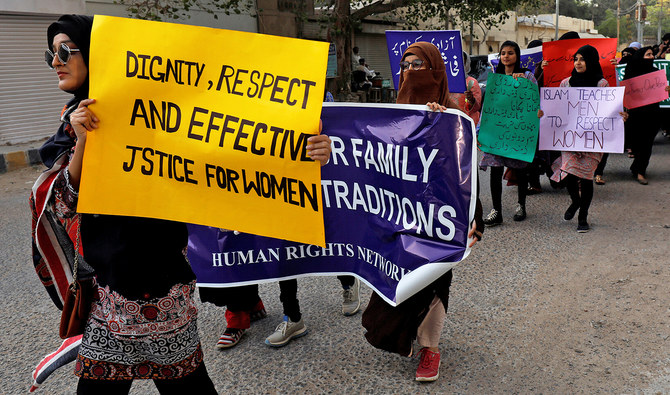
Pakistan’s top religious body throws weight behind women’s march

Short Url
https://arab.news/cy4yg
Pakistan’s top religious body throws weight behind women’s march
- Council of Islamic Ideology says supports women’s struggle for rights but rejects “lewd slogans and placards“
- Aurat March is scheduled for March 8 to mark international women’s day
Latest updates


© 2026 SAUDI RESEARCH & PUBLISHING COMPANY, All Rights Reserved And subject to Terms of Use Agreement.