BEIRUT: Lebanon’s financial prosecutor has frozen the assets of 20 Lebanese banks, their top bosses and board members, state media and judicial sources said on Thursday.
Judge Ali Ibrahim gave notice to the central bank and the banking association, state news agency NNA said without naming the banks or giving details of the assets.
The move to freeze assets is part of an ongoing investigation, a senior judicial source said without elaborating.
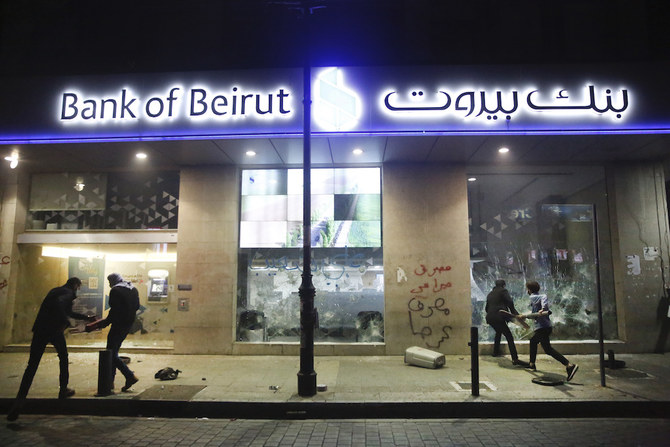
The source said the decision involved some of Lebanon’s biggest banks, including Blom Bank, Bank Audi , Byblos Bank, Bank of Beirut and SGBL (Societe Generale De Banque Au Liban SAL).
The Association of Banks in Lebanon (ABL), which represents the nation’s lenders, could not be reached for immediate comment.
Local banks are at the heart of a financial crisis crippling the country as the clock runs down on its looming debt maturities, including a $1.2 billion Eurobond due on March 9.
The government will meet on Saturday to take a decision, after Parliament Speaker Nabih Berri said a majority of MPs oppose paying even if that leads to default, compounding doubts over whether Lebanon will meet the March repayment.
The economic and financial strains came to a head last year as capital inflows slowed and protests erupted against a political elite that has dominated Lebanon since the 1975-1990 civil war and steered it into crisis.
The crisis is rooted in decades of waste and corruption which landed the country with one of the world’s biggest public debt burdens. Domestic banks, which for years funneled deposits to the state, hold the bulk of the sovereign debt.
Lebanon is probing the sale of Eurobonds by local banks to foreign investors though the practice is not illegal, a judicial source said last month.
Berri, one of the country’s most influential leaders, blamed local banks on Wednesday for diluting the local holding. Critics say this has weakened Lebanon’s position in talks with foreign bondholders.
Some politicians have criticized the banking sector recently as public anger turned to the banks, which have severely curbed people’s access to their savings and blocked transfers abroad.
The head of the banking association, Salim Sfeir, has said those measures aim to keep Lebanon’s wealth in the country.
Sfeir said on Wednesday that the sector was being targetted with rumors and that banks had suffered losses to secure liquidity.
The central bank has asked banks to review transfers of funds abroad by politicians and government employees between October and December.
The government separately approved a draft law on Thursday aimed at lifting banking secrecy. The information minister said the law, which will go to parliament, would apply to ministers, MPs and a range of public officials.


Lebanon’s financial prosecutor freezes assets of 20 banks
https://arab.news/6jft3
Lebanon’s financial prosecutor freezes assets of 20 banks


Saudi Arabia merges National Competitiveness Center and Saudi Business Center
RIYADH: Saudi Arabia has merged the National Competitiveness Center and the Saudi Business Center under a unified entity named the Saudi Competitiveness and Business Center to streamline business reforms.
The decision was announced during the Cabinet session held in Jeddah on Feb. 24 and chaired by Crown Prince Mohammed bin Salman.
Majid Al-Kassabi, minister of commerce and chairman of the boards of both centers, praised the leadership’s continued support for the private sector, saying the merger will enhance Saudi Arabia’s competitiveness and elevate its ranking in relevant international indicators and reports.
He said the decision will enhance the Kingdom’s competitiveness and elevate its ranking in relevant indicators and reports. It will also facilitate procedures for starting and conducting economic businesses and provide all related services and work by adopting the best international methods and practices.
Al-Kassabi said the Saudi Competitiveness and Business Center will continue delivering more than 6,000 government services to the business sector, in integration with relevant government entities, at the highest levels of quality and innovation. Services will be provided through the unified business platform and 20 branches across 15 cities.
He said the merger will unify channels for monitoring challenges facing the private sector and implement targeted reforms to facilitate business, adding that it will enhance the Kingdom’s global competitiveness and maximize the benefits of partnerships with local and international entities and organizations, especially in knowledge transfer and the exchange of expertise.
He said the center will work with the public and private sectors to place the Kingdom among the world’s most competitive countries and make its business environment a global model for the quality, smoothness and efficiency of government services directed to the business sector.


