

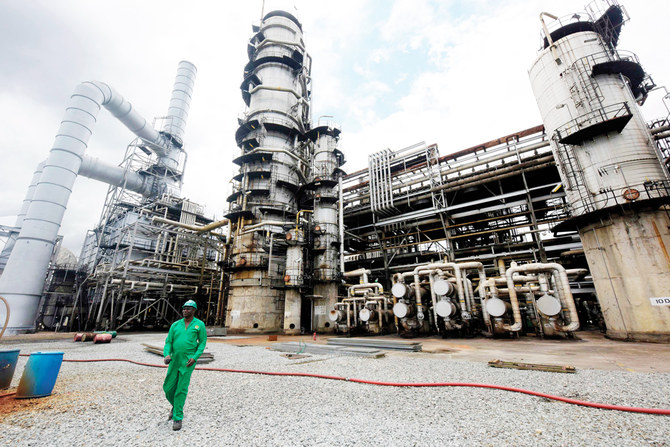
Oil rises as OPEC, allies work on big output cut

A technical panel of several representatives from OPEC states, Russia and other producers recommended on Tuesday cutting output by between 0.6-1.0 million barrels per day (bpd) during the second quarter only. (AFP)
Short Url
Updated 05 March 2020
Follow

Oil rises as OPEC, allies work on big output cut

  • Producers are seeking to persuade Russia to join them in efforts to prop up prices

LONDON: Brent oil prices rose on Wednesday on expectations that major producers have moved closer to an agreement to enact deeper output cuts aimed at offsetting the slump in demand caused by the coronavirus outbreak.

Brent crude was up by 91 cents, or 1.7 percent, at $52.77 a barrel at 1442 GMT.

US West Texas Intermediate (WTI) was up by $1.03, or 2.2 percent, at $48.21 a barrel.

Saudi Arabia and other members of the Organization of the Petroleum Exporting Countries (OPEC) are seeking to persuade Russia on Wednesday to join them in large additional oil output cuts to prop up prices which have tumbled because of the coronavirus outbreak.

“With demand-side uncertainties having already dragged Brent futures about 19 percent lower since the start of the year ... oil’s upside appears significantly capped amid persistent concerns over the coronavirus outbreak,” said Han Tan, a market analyst at FXTM.

A technical panel of several representatives from OPEC states, Russia and other producers recommended on Tuesday cutting output by between 0.6-1.0 million barrels per day (bpd) during the second quarter only.

Iran’s Oil Minister Bijan Zanganeh said the market was facing a surplus.

“There is no doubt that there is an imbalance in the supply and demand of oil. Right now, the supply in the market is greater than demand,” Zanganeh said. “It’s necessary for OPEC and non-OPEC to make all their efforts to balance the market.”

Goldman Sachs again cut its Brent price forecast, to $45 a barrel in April, while expecting Brent gradually recovering to $60 a barrel by the year-end.

The bank said while an output cut by OPEC “will help normalize oil demand and inventories later this year, they can’t prevent an already started large oil inventory accumulation.”

Morgan Stanley also cut its second quarter 2020 Brent price forecast to $55 per barrel and its WTI outlook to $50 on expectations that China’s 2020 oil demand growth would be close to zero and that demand elsewhere may weaken because of the virus.

The US Federal Reserve cut interest rates on Tuesday in a bid to shield the world’s largest economy from the impact of the coronavirus, but the decision offered only limited support for crude.

“Yet far from easing virus anxieties, the surprise move had the opposite effect. Market players fretted over the suddenness of the Fed’s decision," said Stephen Brennock of oil broker PVM.

US crude oil inventories rose in the most recent week, while gasoline and distillate stocks fell, data from industry group the American Petroleum Institute showed on Tuesday.

Crude inventories rose by 1.7 million barrels in the week to Feb. 28 to 446.6 million barrels, compared with analysts’ expectations for a build of 2.6 million barrels.


Egypt–Saudi power link set to boost regional energy integration, minister says 

Updated 22 February 2026
Follow

Egypt–Saudi power link set to boost regional energy integration, minister says 

RIYADH: Electricity interconnection projects between Egypt and Saudi Arabia will strengthen regional energy cooperation and economic integration, Egypt’s minister of electricity and renewable energy said during a visit to a key cross-border power facility. 

Mahmoud Esmat made the remarks while inspecting the Egypt–Saudi electricity interconnection station linking the two countries’ power grids, where he reviewed construction progress and equipment testing ahead of trial operations expected in the coming weeks, according to a statement from the Egyptian State Information Service. 

The project is described as the first of its kind in the Middle East in terms of scale, manufacturing technology, operation, and application in grid interconnection lines. 

The initiative supports the state’s broader vision to implement sustainable solutions aimed at ensuring the stability of the national unified grid and enhancing the reliability and quality of electricity supply. 

It also aligns with Egypt’s allocation of 136.3 billion Egyptian pounds ($2.8 billion) to the electricity and renewable energy sector in its 2025–26 development plan, nearly double the 72.6 billion pounds set aside the previous year. 

The plan focuses on diversifying energy sources, expanding renewable capacity, and strengthening the national grid to meet rising demand. 

The statement said: “The minister toured the station’s departments and control and operation center, following up on the completion of testing for all equipment and components in preparation for launching operations and synchronizing the project with the unified power grids of Egypt and Saudi Arabia in the coming weeks.” 

It added: “Esmat reviewed the implementation rate of the project and testing works, as well as the project’s timeline. He highlighted finalization of operational tests at the Badr transformer station and the Sakakin Taba 2 station, as well as the 500 kilovolts overhead transmission line extending approximately 320 km.”  

The minister said the project forms part of broader efforts to build an integrated power network connecting the two countries, facilitating efficient and flexible electricity exchange and laying the groundwork for a unified Arab electricity market. 

He added that the initiative reflects a clear vision and comprehensive strategy to strengthen the efficiency of the energy system while delivering both immediate and long-term solutions to safeguard grid stability and enhance service quality.