



ISLAMABAD: Islamabad hopes India will “desist” from using Afghan soil against Pakistani interests after United States forces withdraw from neighboring Afghanistan in light of a recently signed peace accord, Pakistan’s foreign minister said on Sunday.
The pact, signed in the Qatari capital of Doha by US special envoy Zalmay Khalilzad and Taliban political chief Mullah Abdul Ghani Baradar, could pave the way toward a full withdrawal of foreign soldiers from Afghanistan in 14 months. In return, the Taliban have pledged to renounce violence and sever ties with militant organizations threatening the United States and its allies.
“What we object is not India having a bilateral relationship with Afghanistan,” Foreign Minister Shah Mehmood Qureshi told Arab News in an interview after his return from Doha on Sunday, referring to India’s role in post-US withdrawal Afghanistan. “What we are objected to is: India using Afghan soil against Pakistan.”
Pakistan has long accused India of supporting separatists in the resource-rich Balochistan province, as well as militants fighting the state from the northwestern tribal areas. Both Pakistani regions share a border with Afghanistan.
When asked if India continued to use Afghan soil to destabilize Pakistan, the foreign minister said: “Well, we hope that they will desist from doing that.”
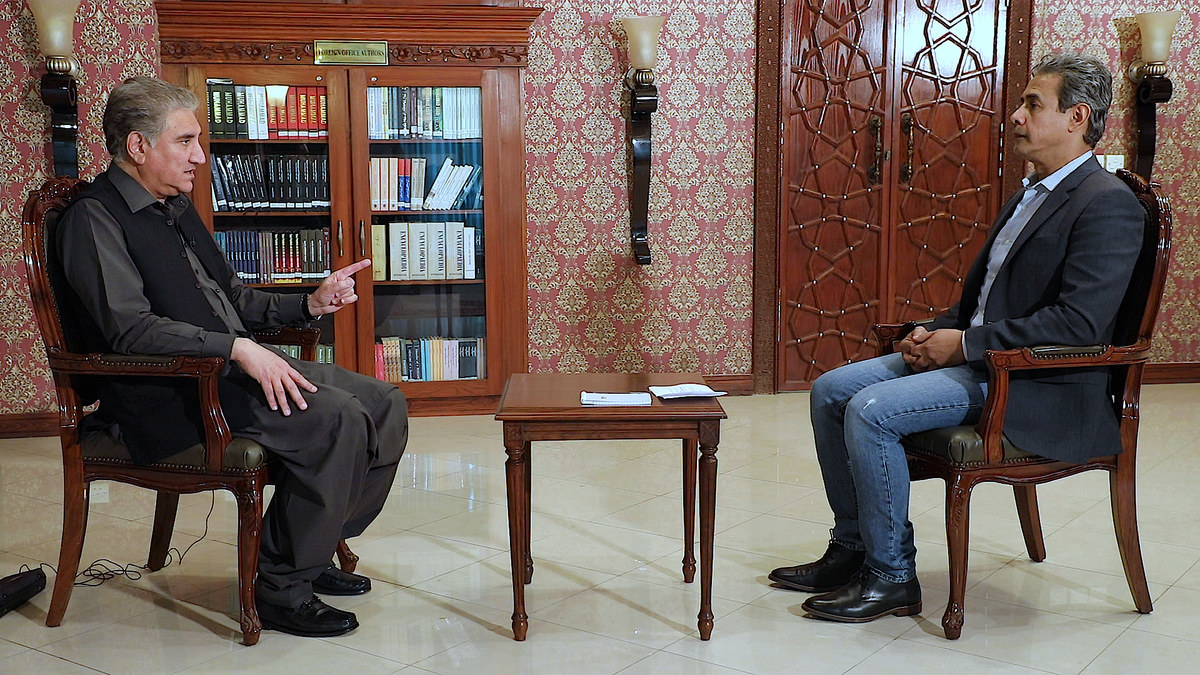
Foreign Minister Shah Mehmood Qureshi during an interview with Arab News at the Ministry of Foreign Affairs in Islamabad on Sunday, March 01, 2020.(AN photo)
India denies any such interference and in turn accuses Pakistan of backing militants fighting Indian security forces in its part of the divided Kashmir region, of helping militants to launch attacks elsewhere in India and backing the Taliban in Afghanistan.
Qureshi said while India had used aid and reconstruction projects as a strategy to cosy up to Afghanistan in recent years, Islamabad did not see a major role for New Delhi in Afghanistan after the withdrawal of US troops.
“India is not an immediate neighbor of Afghanistan, nor do they share their language, culture, and religion. So in my view, their role will remain limited,” Qureshi said.
After being ousted from power in 2001 in a US-led invasion following the September 11 attacks on the United States engineered by Al-Qaeda forces harbored by the Taliban, Taliban forces have led a violent insurgency. The Afghan war has been a stalemate for more than 18 years, with Taliban forces controlling or contesting more territory, yet unable to capture and hold major urban centers.
Speaking about concerns that a US withdrawal could drive some diehard Taliban fighters into the arms of the Islamic State, or Daesh, militant group, Qureshi admitted there were “concerns” about their presence.
The Afghan affiliate of Daesh, known as Islamic State Khorasan (Daesh-K), after an old name for the region, first appeared in eastern Afghanistan in 2014, and has since made inroads into other areas, particularly the north.
The US military estimates their strength at 2,000 fighters. Some Afghan officials estimated the number is higher, and could be about to get a boost after US forces withdraw.
“There are concerns about Daesh [Daesh] and their presence; and everybody recognizes that,” Qureshi said. “Yes, we have to address this issue. We do not want to see the footprint of Daesh grow in Afghanistan or anywhere.”
Qureshi warned that the United States needed to ensure a planned withdrawal from Afghanistan as neither the war-torn country, nor the region, could afford civil war or anarchy created by a “vacuum.”
“I hope we have learnt lessons from history … and the international community does not repeat the same mistakes,” he said, referring to the chaos that followed the US and Soviet withdrawal from Afghanistan decades ago.
“Because if you withdraw without a plan, then obviously, there will be a vacuum. And then, that vacuum will get filled in by all kinds of forces — like we saw after the Soviet [Union] withdrawal, there was a vacuum created, and after that, we saw a period of turmoil, civil war.”
Speaking about Pakistan’s role in the signing of the peace pact, Qureshi said Pakistan had facilitated the accord by convincing the world that a “political settlement” was the only solution in Afghanistan.
In October 2019, while the Doha talks were off, Washington’s chief negotiator Khalilzad, and the Taliban political delegation held talks in Islamabad in a meeting that was not publicly acknowledged.
Listing Pakistan’s contributions to the accord, Qureshi said: “Convincing the Taliban that there is a huge opportunity that they should seize and come to the negotiating table; convincing them to put together an authoritative delegation so that the Americans can engage with them; convincing the Americans that engaging with Taliban is important.”
The next step in the peace process, the foreign minister said, was holding intra-Afghan talks.
“Obviously, the next logical step is the intra-Afghan dialogue,” Qureshi said. “The mechanism [for talks]; what needs to be on the agenda; how to go about it — everything has to be discussed and sorted out among Afghans themselves … It is up to them what kind of a political roadmap do they want for themselves.”
But experts see challenges ahead for US negotiators as they shepherd intra-Afghan talks as well as negotiations between Ashraf Ghani’s government and the Taliban.
When asked about the implications of the United States accepting to sign an agreement with the Taliban as the Islamic Emirates of Afghanistan and not as a movement, Qureshi said: “The Taliban insisted on that … So, that is the compromise that they [United States] made, catering to their [Taliban] demand, and also being sensitive to the NUG [Afghan National Unity Government] point of view.”
The militant group has so far refused to negotiate with the Afghan government.
Talking about Pakistan’s role in the future of Afghanistan, Qureshi said Islamabad did not want to interfere in Afghanistan’s internal affairs but instead wanted to focus on beefing up trade ties.
“Pakistan wants to contribute in their [Afghanistan’s] reconstruction,” Qureshi said. “We feel that there is a huge potential for bilateral trade between Afghanistan and Pakistan.”
“Because of the war, we could not fully, optimally utilize the opportunities that existed. Pakistan feels that through peace in Afghanistan, we can get access into the Central Asian Republics, and we can develop better regional connectivity — from Pakistan through Afghanistan right up to Central Asian Republics, and create a situation that everybody benefits from,” the foreign minister said.




