

Greek riot police repel 13,000 migrants trying to cross to Europe from Turkey

1 / 5
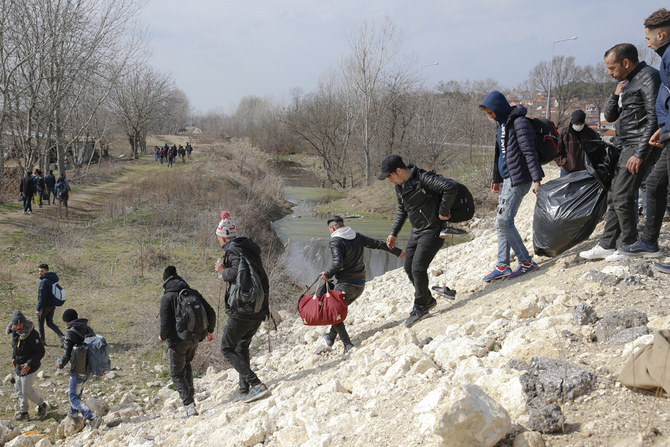
Migrants head for Greece near the Pazarakule border crossing in Edirne, Turkey, on March. 1, 2020, after Turkey opened its western borders to migrants and refugees hoping to head into the European Union. (AP Photo/Darko Bandic)
2 / 5
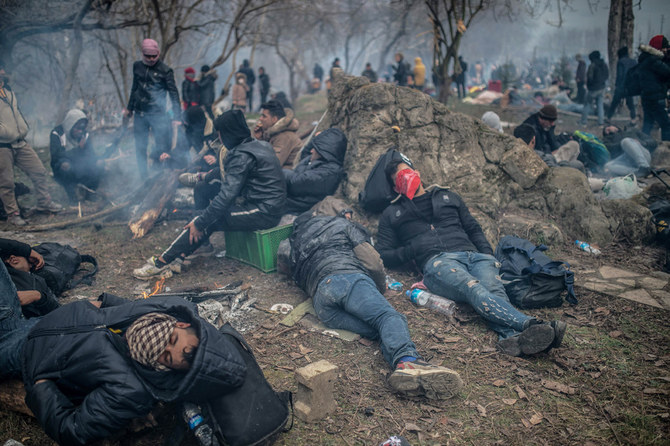
Migrants wait near the buffer zone at Turkey-Greece border, at Pazarkule, in Edirne district, on Feb. 29, 2020. (AFP / BULENT KILIC)
3 / 5
Migrants walk on the railway tracks heading for Greece near the Pazarakule border crossing in Edirne, Turkey, on March. 1, 2020 after Turkey opened its western borders to migrants and refugees hoping to head into the European Union. (AP Photo/Emrah Gurel)
4 / 5
Greek soldiers fire teargas canisters during clashes with migrants near the Kastanies border gate at the Greek-Turkish border on March 1, 2020. Migrants and refugees were trying to enter Greece by land and by sea after Turkey officially declared its western borders open to those hoping to head into the European Union. (AP Photo/Giannis Papanikos)
5 / 5
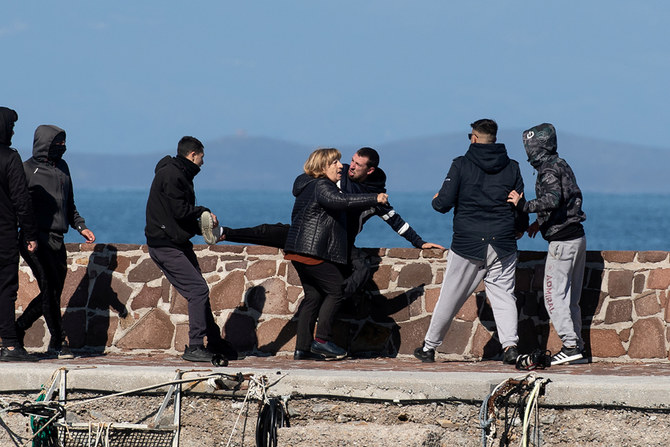
A woman tries to stop locals from beating up a journalist trying to report on their effort to prevent migrants on a dinghy from disembarking at the port of Thermi on the island of Lesbos, Greece, on March 1, 2020. (REUTERS)
Short Url
Updated 02 March 2020
Follow

Greek riot police repel 13,000 migrants trying to cross to Europe from Turkey

  • Erdogan tears up 2016 refugee deal with EU
  • Turkey launches new offensive in Idlib

ANKARA: Greek security forces fired tear gas on Sunday to stop up to 13,000 migrants from crossing the border from Turkey amid a growing crisis over the bloody Assad regime offensive in northwest Syria.

The violence in Idlib province has sent hundreds of thousands of civilians fleeing north toward Turkey, which already hosts more than 3.5 million Syrian refugees and says it can accommodate no more.

Turkish President Recep Tayyip Erdogan has responded on two fronts. First, after an air strike killed 33 Turkish soldiers in Idlib, Turkey launched an offensive to halt the advance of Assad regime forces backed by Russian air power. On Sunday, Turkey shot down two Syrian fighter jets over Idlib and destroyed a military airport in Aleppo, and ground forces exchanged fire.

Second, Erdogan has torn up a 2016 agreement with the EU to halt the flow of refugees from Turkey into Europe, and thrown open the border with Greece. The Turkish president says the EU has not kept to its side of the deal, to pay 6 million euros in aid to Ankara to cope with the influx of migrants.

The announcement triggered an instant rush of thousands of migrants to the border with Greece, which placed crossing points on maximum security alert and deployed riot police at the Kastanies border post.

At least 500 people fled to the Greek islands of Lesbos, Chios and Samos, close to the Turkish coast. On the mainland border, some waded across a shallow section of the Evro River to the Greek side. Authorities in Athens said some migrants prevented from crossing had thrown metal bars and tear-gas canisters at police on the Greek side.

UN refugee agency spokesman Babar Baloch called for “calm and easing of tensions on the border,” and urged countries to “refrain from the use of excessive and disproportionate force.”

Kenneth Roth, executive director of Human Rights Watch, said that instead of being concerned about the relatively few refugees trying to enter Greece, the EU should press Russian President Vladimir Putin to halt the indiscriminate bombing of millions of civilians in northwest Syria.

“If the only alternative is a bloodbath in Idlib, the Turkish government will undoubtedly open its border with Syria, but it is already hosting 3.6 million Syrian refugees so we can expect many people who flee the slaughter to continue on to Greece,” he told Arab News.

The Syrian military was incapable of carrying out this slaughter without the support of Russian bombers, and Putin had the key to end it, Roth said.

“He may well want a refugee crisis in Europe, since his far-right allies would profit. European governments should change Putin’s calculations by imposing targeted sanctions on the Russian officials who are directing these war crimes unless they stop immediately,” he said.

Dr. Christina Bache, visiting fellow at the London School of Economics, said the EU and Turkey should have invested every ounce of influence available to promote an inclusive political settlement when the Syrian war began.

“Syrians have become victims of an increasingly authoritarian Turkey and its failing relationship with the EU,” she told Arab News. “As long as the EU fails to address its own institutional deficiencies in migration management, President Erdogan will exploit rising anti-immigrant sentiment in Europe for the sake of political opportunism.”

Bache said Ankara’s plans to relinquish its responsibility to protect asylum seekers could be violations of the international law principle of non-refoulement, which prevents the return of such migrants to a country where they would be in danger of persecution.

 “A political solution remains the most viable path to reconciliation, justice, and sustainable peace in Syria,” she said.


UN warns clock ticking for Sudan’s children

Updated 31 min 26 sec ago
Follow

UN warns clock ticking for Sudan’s children

  • UNICEF says in parts of North Darfur, more than half of all children are acutely malnourished
  • World Health Organization’s representative in Sudan says the country is facing multiple disease outbreaks

GENEVA: The United Nations warned Tuesday that time was running out for malnourished children in Sudan and urged the world to “stop looking away.”
Famine is spreading in Sudan’s western Darfur region, UN-backed experts warned last week, with the grinding war between the army and paramilitary forces leaving millions hungry, displaced and cut off from aid.
Global food security experts say famine thresholds for acute malnutrition have been surpassed in North Darfur’s contested areas of Um Baru and Kernoi.
Ricardo Pires, spokesman for the UN children’s agency UNICEF, said the situation was getting worse for children by the day, warning: “They are running out of time.”
In parts of North Darfur, more than half of all children are acutely malnourished, he told a press conference in Geneva.
“Extreme hunger and malnutrition come to children first: the youngest, the smallest, the most vulnerable, and in Sudan it’s spreading,” he said.
Fever, diarrhea, respiratory infections, low vaccination coverage, unsafe water and collapsing health systems are turning treatable illnesses “into death sentences for already malnourished children,” he warned.
“Access is shrinking, funding is desperately short and the fighting is intensifying.
“Humanitarian access must be granted and the world must stop looking away from Sudan’s children.”
Since April 2023, the conflict between Sudan’s army and the paramilitary Rapid Support Forces has killed tens of thousands, displaced 11 million and triggered what the UN calls one of the world’s worst humanitarian crises.
Shible Sahbani, the World Health Organization’s representative in Sudan, said the country was “facing multiple disease outbreaks: including cholera, malaria, dengue, measles, in addition to malnutrition.”
At the same time, health workers and health infrastructure are increasingly in the crosshairs, he told reporters.
Since the war began, the WHO has verified 205 attacks on health care, leading to 1,924 deaths.
And the attacks are growing deadlier by the year.
In 2025, 65 attacks caused 1,620 deaths, and in the first 40 days of this year, four attacks led to 66 deaths.
Fighting has intensified in the southern Kordofan region.
“We have to be proactive and to pre-position supplies, to deploy our teams on the ground to be prepared for any situation,” Sahbani said.
“But all this contingency planning... it’s a small drop in the sea.”