Swarm of drones to light up AlUla’s skies as part of aerial art display

1 / 4
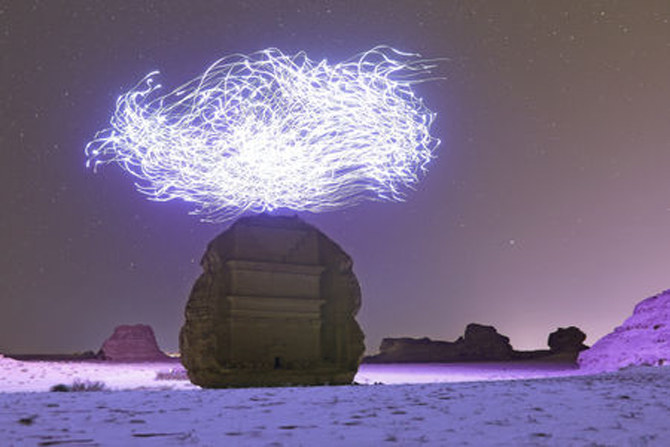
The aerial presentation by Franchise Freedom explores the relationship between humanity, nature and technology. (Supplied photo)
2 / 4
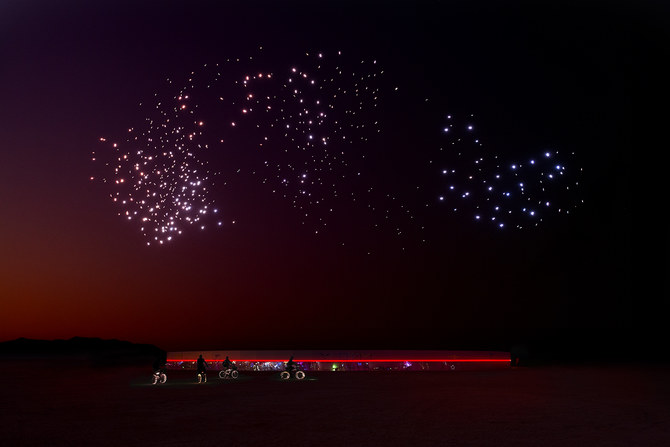
The aerial presentation by Franchise Freedom explores the relationship between humanity, nature and technology. (Supplied photo)
3 / 4
The aerial presentation by Franchise Freedom explores the relationship between humanity, nature and technology. (Supplied photo)
4 / 4
The aerial presentation by Franchise Freedom explores the relationship between humanity, nature and technology. (Supplied photo)
Short Url
Updated 28 February 2020
Follow

Swarm of drones to light up AlUla’s skies as part of aerial art display

  • International artwork explores links between nature, technology and humanity at Saudi festival

ALULA: A swarm of drones will light up the skies over AlUla during a spectacular international artistic display as part of the Winter at Tantora festival.

The aerial presentation by Franchise Freedom, a performance arts initiative created by Studio Drift, explores the relationship between humanity, nature and technology.

Formed from an autonomously flying swarm of hundreds of drones, based on research into the flight behavior of starlings, the work aims to question the concept of freedom and social construct.

Underlining the harmony between humans and their surroundings, the artistic display, which runs until Feb. 28, uses the sky as its canvas to poetically illustrate how an individual can remain free, while operating within the safety of a community.

Through a variety of international events, the Winter at Tantora festival, organized by the Royal Commission for AlUla (RCU), seeks to highlight culture and heritage.

Noura Al-Dabal, the RCU’s culture and arts manager, said: “Winter at Tantora strives to keep pace with the evolution of humanity and the mix between the arts and technical development that the world has seen today, while preserving the heritage of AlUla.

“Franchise Freedom is a living embodiment of this goal and we are proud to host this distinguished international artwork in AlUla.”

Over the course of 12 weeks, the festival will present a variety of activities merging Eastern and Western cultures, embodying AlUla’s heritage as a meeting point for different civilizations from around the world throughout history.

The festival takes place every weekend until March 7.


Japanese researchers hope to restore coral from Saudi-made structures

Updated 05 January 2026
Follow

Japanese researchers hope to restore coral from Saudi-made structures

  • Coral skeletons made for Saudi Pavilion at Japan expo last year
  • Results of Japanese study to be revealed at Riyadh Expo 2030

TOKYO: Japanese universities are seeking to restore coral reefs and marine ecosystems after receiving artificial structures that Saudi Arabia made and showcased at last year’s Osaka-Kansai Expo.

The coral skeletons were donated to the University of the Ryukyus in Okinawa and Kansai University in Osaka Prefecture, Kyodo News reported at the weekend.

The structures are made from calcium carbonate, a material on which corals are believed to grow more easily compared to artificial alternatives such as concrete or metal.

The skeletal structures were created using 3-D printers, with one piece produced a day during the expo, and displayed across an entire wall in the Saudi Arabia Pavilion, which had an area focusing on sustainable marine environments.

Coral reefs serve as habitats for much marine life, but over 40 percent of the world’s 892 species face possible extinction, according to the International Union for Conservation of Nature.

The University of the Ryukyus, which received about 150 of the artificial coral skeletons, will place them in waters off the eastern coast of Okinawa’s main island and then examine their impact on the ecosystem.

Kansai University has placed theirs in the sea around Kagoshima Prefecture’s Yoron Island to observe their growth after transplanting coral polyps onto the structures.

The results of the research are expected to be revealed at the Riyadh Expo in 2030.

“I had never imagined that Japan and Saudi Arabia would cooperate on coral research,” said Masato Ueda, a professor specializing in regenerative medicine at Kansai University.

Ueda said he wants to demonstrate to children that “humanity is attempting to restore the environment.”