

Turkey’s casualties in Libya stir debate among public

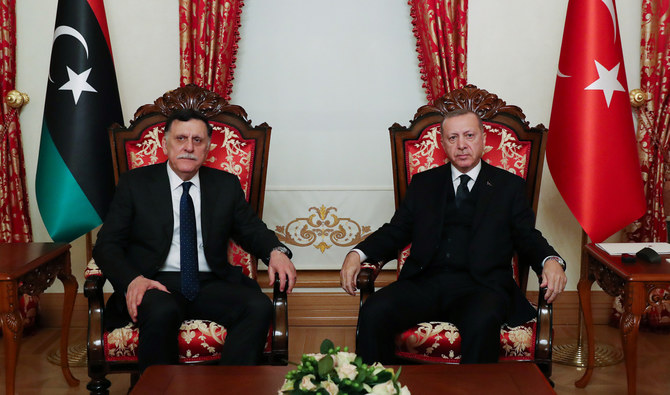
President Recep Tayyip Erdogan with head of Libya's Government of National Accord (GNA) Fayez Al-Sarraj. Erdogan announced several Turkish soldiers had been killed in the north African country. (AFP)
Short Url
Updated 25 February 2020
Follow

Turkey’s casualties in Libya stir debate among public

  • Sustained tensions between Russia and Turkey in Syria’s rebel-held Idlib province is thought to be influencing Ankara’s decision to involve itself in Libya

JEDDAH: The announcement of Turkish military casualties in war-torn Libya has prompted a mixed response from the public.
President Recep Tayyip Erdogan revealed several Turkish soldiers had been killed in the North African country, as well as confirming the presence of Syrian National Army militants in the country.
“We have several martyrs, but in return we neutralized nearly 100 legionaries,” Erdogan said during a speech on Feb. 22.
On Feb. 23, 16 Turkish soldiers were reported to have been killed in the port city of Misrata over the past few weeks, according Khalid Al-Mahjoub, spokesman for Libyan National Army.
Howard Eissenstat, a Turkey expert at St. Lawrence University, New York, and senior nonresident fellow at the Project on Middle East Democracy, said he wasn’t surprised that Turkish soldiers had been killed, but added it could be unpopular at home.  “The surprise is that so many were in active combat,” he told Arab News.
“Traditionally, Turkey’s military actions abroad have been focused on a relatively small band of interests. The Libyan operations are a real leap for Turkey and, under normal circumstances, would likely be quite unpopular,” he said.
 The Turkish public overwhelmingly opposes the deployment of Turkish troops to Libya, according to a recent poll conducted by an Istanbul-based research institute. Fifty-eight percent of the respondents opposed sending Turkish forces to Libya. Turkey supports the Tripoli-based Government of National Accord (GNA) against the forces of Khalifa Haftar.
 On Jan. 2, the Turkish Parliament ratified a motion authorizing the government to send military training personnel to Libya. But Ankara committed to only sending troops to provide technical support and military training, in addition to supplying the GNA with weaponry.

BACKGROUND

Turkey supports the Tripoli-based Government of National Accord against the forces of Khalifa Haftar.

 In late January, French President Emmanuel Macron urged Ankara to stop deploying militants from the Syrian National Army to Libya.
Eissenstat, though, said it was anybody’s guess what the response to Turkish casualties would be, given the government’s stranglehold over the mainstream media.  
“These casualties would traditionally have been considered unacceptable. Today, however, the range for debate and dissent are so curtailed, it may not have a measurable effect at all,” Eissenstat added.
Sustained tensions between Russia and Turkey in Syria’s rebel-held Idlib province is thought to be influencing Ankara’s decision to involve itself in Libya.
 The two sides have been at odds over the Middle East region, whilst Erdogan previously warned that the presence of Russia-tied mercenaries in North Africa was a justification for Turkish military presence in Libya.
 “I am not sure Turkey has a Libya policy. It is mainly wishful thinking. As such, it will be prone to changes and shifts depending on developments,” Wolfango Piccoli, co-president of Teneo Intelligence in London, told Arab News.
 For Piccoli, resolving Idlib issue is much more important for Ankara than Libya.
 “If Libya is the price to pay for Russian help in dealing with Idlib, Erdogan will swallow it,” he noted.


Fledgling radio station aims to be ‘voice of the people’ in Gaza

Updated 15 February 2026
Follow

Fledgling radio station aims to be ‘voice of the people’ in Gaza

  • The electricity crisis is one of the most serious and difficult problems in the Gaza Strip, says Shereen Khalifa Broadcaster

DEIR EL-BALAH: From a small studio in the central city of Deir El-Balah, Sylvia Hassan’s voice echoes across the Gaza Strip, broadcast on one of the Palestinian territory’s first radio stations to hit the airwaves after two years of war.

Hassan, a radio host on fledgling station “Here Gaza,” delivers her broadcast from a well-lit room, as members of the technical team check levels and mix backing tracks on a sound deck. “This radio station was a dream we worked to achieve for many long months and sometimes without sleep,” Hassan said.

“It was a challenge for us, and a story of resilience.”

Hassan said the station would focus on social issues and the humanitarian situation in Gaza, which remains grave in the territory despite a US-brokered ceasefire between Israel and Hamas since October.

“The radio station’s goal is to be the voice of the people in the Gaza Strip and to express their problems and suffering, especially after the war,” said Shereen Khalifa, part of the broadcasting team.

“There are many issues that people need to voice.” Most of Gaza’s population of more than 2 million people were displaced at least once during the gruelling war.

Many still live in tents with little or no sanitation.

The war also decimated Gaza’s telecommunications and electricity infrastructure, compounding the challenges in reviving the territory’s local media landscape. “The electricity problem is one of the most serious and difficult problems in the Gaza Strip,” said Khalifa.

“We have solar power, but sometimes it doesn’t work well, so we have to rely on an external generator,” she added.

The station’s launch is funded by the EU and overseen by Filastiniyat, an organization that supports Palestinian women journalists, and the media center at the An-Najah National University in Nablus, in the occupied West Bank.

The station plans to broadcast for two hours per day from Gaza and for longer from Nablus. It is available on FM and online.

Khalifa said that stable internet access had been one of the biggest obstacles in setting up the station, but that it was now broadcasting uninterrupted audio.

The Gaza Strip, a tiny territory surrounded by Israel, Egypt, and the Mediterranean Sea, has been under Israeli blockade even before the attack on Oct. 7, 2023, which sparked the war. Despite the ceasefire, Israel continues to strictly control the entry of all goods and people to the territory.

“Under the siege, it is natural that modern equipment necessary for radio broadcasting cannot enter, so we have made the most of what is available,” she said.