Filipino-Americans ‘fired up’ as Tagalog added to Nevada ballot

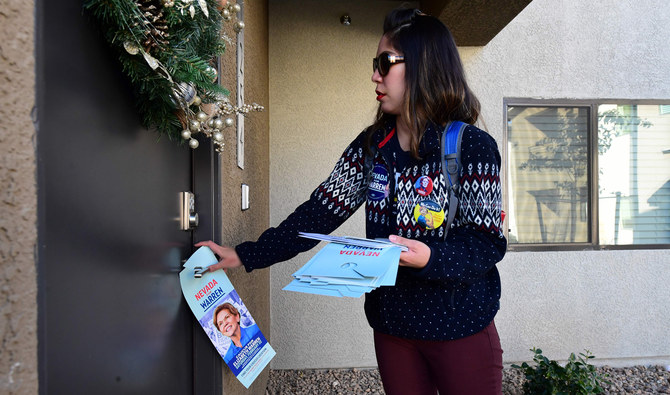
Elizabeth Warren supporter Ninna Diaz leaves a flyer on a door as she knocks on doors of registered Democrats and Independents to make sure people are registered to vote on February 21, 2020 in Las Vegas, Nevada. (AFP)
Short Url
Updated 22 February 2020
Follow

Filipino-Americans ‘fired up’ as Tagalog added to Nevada ballot

  • For the first time, the Tagalog language will be used on voting cards along with English and Spanish at the Democratic caucuses

LAS VEGAS: Manny Pacquiao, roast pig dinners and prayer services: Activists are using every tool possible to get the booming Filipino-American community in Las Vegas to the polls for Saturday’s Democratic nomination vote.
Overlooked in the past, Filipinos have rapidly become the western desert state’s largest Asian-American community — almost 200,000 by some estimates, in a state of three million people — forcing candidates to take notice.
For the first time, the Tagalog language will be used on voting cards along with English and Spanish at the Democratic caucuses.
“We’re proud that they are recognizing us,” said Margie Gonzales, a Filipino community leader. “It means a lot — it means recognition.”
Gonzales, who chairs the county’s Asian American and Pacific Islanders (AAPI) commission, has also begun training politicians to speak a few Tagalog words.
“When you start knocking on doors, it helps if you greet a Filipino family opening the door in Tagalog,” she said. “That’s a way to make that person smile — you feel welcome.”
Feeling welcome is key for a minority community in which immigration and xenophobia are major concerns. Like Latinos, Filipino-Americans tend to vote Democrat.
“When Trump talks about not bringing in relatives and things like that, that same thing applies to Asians,” said Tick Segerblom, a commissioner for Clark County, where Las Vegas is located. “So Trump has really been a boon as far as organizing Asians.”
But traditionally Filipino-Americans have not voted in large numbers.
To counter that, Gonzales and her fellow activists introduced a tradition commonly found during election campaigns back in the Philippines — the Kamayan, a large communal feast.
These typically see politicians mingle at long tables covered in banana leaves, with a whole roast pig on the menu.
The feasts hosted in Las Vegas by Gonzales so far have not endorsed specific candidates. A grand Kamayan is planned once the Democratic Party settles on a nominee — but that has not stopped those in the race from reaching out.
Democratic candidate Tulsi Gabbard, who is Hawaiian, has made inroads, as have Pete Buttigieg and Elizabeth Warren.
“This is an overlooked and often ignored community and I feel like Elizabeth Warren celebrates our existence and doesn’t use us as props,” said Filipino campaign volunteer Ninna Diaz, 27.
The community is “definitely taking notice,” she added.
More recently, Gonzales has conducted Tagalog-language caucus training for campaigns including that of Bernie Sanders.
“The mere fact that a lot of politicians are calling me and other Filipino-American leaders, it shows you that we are becoming important,” she said.
“They are paying attention to us, because they know now that we vote.”
She added: “Our voice used to be like the squeak of a mouse... But we are getting fired up now.”
In a sign of the group’s growing visibility, Segerblom and others are leading a campaign to rename a stretch of eastern Las Vegas, which is home to many community restaurants and stores, Little Filipinotown.
But Gonzales turned to one of the most visible icons of all — global boxing superstar and Philippines Senator Manny Pacquiao, who was in Las Vegas for a fight in 2014.
“We were able to get to his suite — he posed with us, holding our banner,” said Gonzales, who now uses the image to boost voter registration drives.
“It gets the Filipinos excited — in fact, even non-Filipinos!”


Power outages hit Ukraine and Moldova as Kyiv struggles against the winter cold

Updated 10 sec ago
Follow

Power outages hit Ukraine and Moldova as Kyiv struggles against the winter cold

  • Outages had been caused by a technical malfunction affecting power lines linking Ukraine and Moldova
  • Blackouts were reported in Kyiv, as well as Zhytomyr and Kharkiv regions

KYIV: Emergency power cuts swept across several Ukrainian cities as well as neighboring Moldova on Saturday, officials said, amid a commitment from the Kremlin to US President Donald Trump to pause strikes on Kyiv as Ukraine battles one of its bleakest winters in years.
Ukraine’s Energy Minister Denys Shmyhal said that the outages had been caused by a technical malfunction affecting power lines linking Ukraine and Moldova.
The failure “caused a cascading outage in Ukraine’s power grid,” triggering automatic protection systems, he said.
Blackouts were reported in Kyiv, as well as Zhytomyr and Kharkiv regions, in the center and northeast of the country respectively. The outage cut water supplies to the Ukrainian capital, officials said, while the city’s subway system was temporarily suspended because of low voltage on the network.
Moldova also experienced major power outages, including in the capital Chisinau, officials said.
“Due to the loss of power lines on the territory of Ukraine, the automatic protection system was triggered, which disconnected the electricity supply,” Moldova’s Energy Minister Dorin Junghietu said in a post on Facebook. “I encourage the population to stay calm until electricity is restored.”
Weaponizing winter
The large-scale outage followed weeks of Russian strikes against Ukraine’s already struggling energy grid, which have triggered long stretches of severe power shortages.
Moscow has sought to deny Ukrainian civilians heat, light and running water over the course of the war, in a strategy that Ukrainian officials describe as “weaponizing winter.”
While Russia has used similar tactics throughout the course of its almost four-year invasion of Ukraine, temperatures throughout this winter have fallen further than usual, bringing widespread hardship to civilians.
Forecasters say Ukraine will experience a brutally cold period stretching into next week. Temperatures in some areas will drop to minus 30 degrees Celsius (minus 22 Fahrenheit), Ukraine’s State Emergency Service said.
Trump said late Thursday that President Vladimir Putin had agreed to a temporary pause in targeting Kyiv and other Ukrainian towns amid the extreme weather.
“I personally asked President Putin not to fire on Kyiv and the cities and towns for a week during this ... extraordinary cold,” Trump said during a Cabinet meeting at the White House. Putin has “agreed to that,” he said, without elaborating on when the request to the Russian leader was made.
The White House didn’t immediately respond to a query seeking clarity about the scope and timing of any limited pause.
Kremlin spokesperson Dmitry Peskov confirmed Friday that Trump “made a personal request” to Putin to stop targeting Kyiv until Sunday “in order to create favorable conditions for negotiations.”
Talks are expected to take place between US, Russian and Ukrainian officials on Feb. 1 in Abu Dhabi. The teams previously met in late January in the first known time that officials from the Trump administration simultaneously met with negotiators from both Ukraine and Russia. However, it’s unclear many obstacles to peace remain. Disagreement over what happens to occupied Ukrainian territory, and Moscow’s demand for possession of territory it hasn’t captured, are a key issue holding up a peace deal, Zelensky said Thursday.
Russian presidential envoy Kirill Dmitriev said on social media Saturday that he was in Miami, where talks between Russian and US negotiators have previously taken place.
Russia struck Ukrainian energy assets in several regions on Thursday but there were no strikes on those facilities overnight, Ukraine’s President Volodymyr Zelensky said Friday.
In a post on social media, Zelensky also noted that Russia has turned its attention to targeting Ukrainian logistics networks, and that Russian drones and missiles hit residential areas of Ukraine overnight, as they have most nights during the war.
Trump has framed Putin’s acceptance of the pause in strikes as a concession. But Zelensky was skeptical as Russia’s invasion approaches its fourth anniversary on Feb. 24 with no sign that Moscow is willing to reach a peace settlement despite a US-led push to end the fighting.
“I do not believe that Russia wants to end the war. There is a great deal of evidence to the contrary,” Zelensky said Thursday.