Oil up on slowing pace of coronavirus, Venezuela sanctions

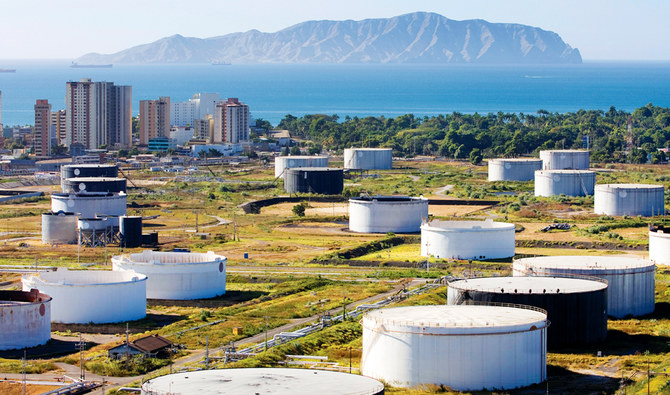
The oil market price structure is also showing signs that prompt demand for oil is picking up, as the front-month Brent futures market is moving deeper into backwardation. (Shutterstock)
Short Url
Updated 20 February 2020
Follow

Oil up on slowing pace of coronavirus, Venezuela sanctions

  • Financial analysts say epidemic is likely to deal a ‘short-term blow’ to global economy

LONDON: Benchmark Brent oil prices rose for a seventh consecutive day after demand worries eased with a slowing of new coronavirus cases in China and supply was curtailed by a US move to cut more Venezuelan crude from the market.

Brent was up 71 cents at $58.46 a barrel at 1510 GMT. The global benchmark has risen nearly 10 percent since falling last week to its lowest this year. US oil was up 53 cents at $52.58 a barrel.

“Those in doubt of the economic impact from the virus should take heed from Apple’s surprise sales warning ... Put simply, this is the surest sign yet of the coronavirus fallout on the global economy,” said PVM analysts in a note.

S&P Global Ratings said it expected coronavirus would deliver a “short-term blow” to economic growth in China in the first quarter, echoing findings by the International Energy Agency.

Official data showed new cases in China fell for a second straight day, although the World Health Organization said there was not enough data to know if the epidemic was being contained.

The oil market price structure is also showing signs that prompt demand for oil is picking up, as the front-month Brent futures market is moving deeper into backwardation, when near-term prices are higher than later-dated prices.

This week, oil prices were also buoyed by a US decision to blacklist a trading subsidiary of Russia’s Rosneft, which President Donald Trump’s administration said provided a financial lifeline to Venezuela’s government.

Hopes that the Organization of the Petroleum Exporting Countries (OPEC) and allied producers would deepen supply cuts also supported prices.

The grouping, known as OPEC+, has been withholding supply to support prices and meets next month to decide a response to the downturn in demand resulting from the coronavirus epidemic.

But in the US, which is not party to any supply cut agreements, oil production has been rising. US shale production is expected to rise to a record 9.2 million barrels a day next month, the Energy Information Administration said.


Closing Bell: Saudi main index extends gains as market opens wider to foreign investment

Updated 02 February 2026
Follow

Closing Bell: Saudi main index extends gains as market opens wider to foreign investment

RIYADH: Saudi Arabia’s Tadawul All Share Index rose on Monday, gaining 153.61 points, or 1.38 percent, to close at 11,321.09.

The total trading turnover of the benchmark index was SR5.85 billion ($1.56 billion), as 207 of the listed stocks advanced, while 55 retreated.

The MSCI Tadawul Index increased, up 21.20 points or 1.41 percent, to close at 1,524.18.

The Kingdom’s parallel market Nomu gained 278.13 points, or 1.17 percent, to close at 24,013.03. This comes as 43 of the listed stocks advanced, while 29 retreated.

The best-performing stock was Saudi Pharmaceutical Industries and Medical Appliances Corp., with its share price surging by 7.26 percent to SR28.94.

Other top performers included Rasan Information Technology Co., which saw its share price rise by 6.51 percent to SR144, and Knowledge Economic City, which saw a 6.25 percent increase to SR13.09.

On the downside, the worst performer of the day was Najran Cement Co., whose share price fell by 2.11 percent to SR6.49.

Almasane Alkobra Mining Co. and Saudi Cable Co. also saw declines, with their shares dropping by 2 percent and 1.88 percent to SR103.10 and SR166.80, respectively.

On the announcement front, Riyad Bank has announced its annual financial results for 2025, with the total income from special commission of financing reaching SR24.1 billion, while net income from special commission of financing amounted to SR12 billion.

In a statement on Tadawul, the bank said: “Net income increased by 11.7 percent mainly due to an increase in total operating income and a decrease in total operating expenses.”

The bank further noted that the rise in total operating income was primarily driven by increased revenue from fees and commissions, trading activities, special commissions, gains on non-trading investments, and other operating sources. This growth was partially tempered by declines in exchange and dividend income.

“Net provision of expected credit losses and other losses decreased by 15.8 percent due to a decrease in impairment charge of credit losses and impairment charge for other financial assets, partially offset by an increase in impairment charge for investments,” it added.

RIBL’s share price closed at SR18.18 on the main market, marking a 1.43 percent increase.