

Glencore posts first annual loss in four years as impairments bite

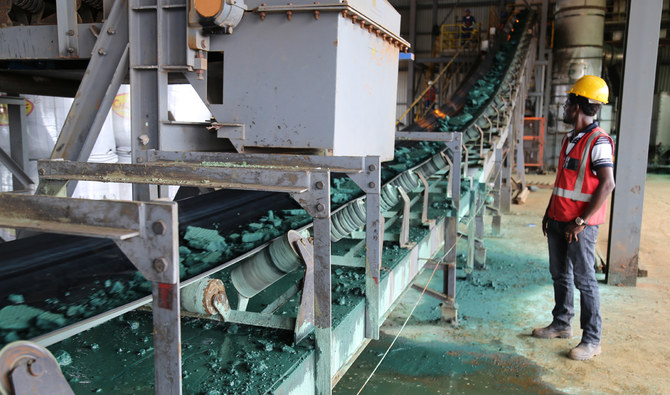
The Democratic Republic of Congo supplies about 60 percent of the world’s cobalt, most of it from large mines owned by Glencore. (AFP)
Short Url
Updated 18 February 2020
Follow

Glencore posts first annual loss in four years as impairments bite

  • Glencore has been hit by falling demand for coal and weaker prices in some of its key markets

LONDON: Glencore reported its first annual net loss since 2015 on Tuesday after writing down $2.8 billion in coal, oil and copper assets.

The world’s largest commodities trader has been hit by falling demand for coal and weaker prices in some of its key markets.

The $2.8 billion in impairments mainly related to the closure of its African copper operations, which suffered from low cobalt prices, the expiry of licenses in its Chad oil operations and weak demand for coal from Europe, which hit its Colombian operations.

“The amount of coal being consumed in the Atlantic is decreasing, right now, seaborne coal demand is about 70 million tonnes and I don’t see a big recovery and it will continue to decrease,” said Chief Executive CEO Ivan Glasenberg.

“The reserves are depleting in Colombia, by 2035, we won’t have any production in Colombia.”

Overall, the Anglo-Swiss miner reported a net loss of $404 million for 2019, compared to a profit of $3.41 billion a year earlier.

Core earnings or adjusted earnings before interest, tax, depreciation and amortisation (EBITDA) of $11.6 billion beat analysts’ estimates of $11.25 billion.

Glencore stock has underperformed its peers due to its exposure to coal and multiple corruption probes linked to its operations in Nigeria, Venezuela and the Democratic Republic of Congo. Glencore is cooperating with the investigations. The company said its legal costs jumped to $159 million from $86 million in 2018.

The company cut the value of its oil business in Chad by $538 million after some mining licenses expired. Since 2015, it has booked impairments of $2.4 billion on assets in Chad.

In Colombia, Glencore runs two coal operations through its company Prodeco and owns a third of the Cerrejon coal mine. The business has been under pressure due to low prices for coal shipped from the region.

In 2019, Prodeco’s profits were down significantly as it invests near term in mine development activities, expected to increase the operation’s medium-term volume productivity and earnings prospects.


Saudi Export-Import Bank signs reinsurance agreement with the German Export Credit Agency

Updated 11 sec ago
Follow

Saudi Export-Import Bank signs reinsurance agreement with the German Export Credit Agency

RIYADH: The Saudi Export-Import Bank has signed a reinsurance agreement with Germany’s official Export Credit Agency, managed by Euler Hermes Aktiengesellschaft, with the aim of enhancing credit risk insurance coverage to meet the needs of local exporters of capital goods and production inputs from the Federal Republic of Germany.

This agreement is part of the bank’s efforts to strengthen partnerships with international export credit agencies, ensuring the safe and sustainable flow of essential raw materials and capital goods, and enhancing the efficiency of export activities by local enterprises, according to the Saudi Press Agency.

The agreement was signed by Saad bin Abdulaziz Al-Khalb, CEO of the Saudi Export-Import Bank, and Edna Schone, board member of Euler Hermes Aktiengesellschaft and head of its Export Credit Agency.

Al-Khalb stated that the reinsurance agreement with ECA represents an important step in expanding credit risk management tools and enabling local exporters to obtain the production inputs and capital goods necessary to grow their businesses with greater confidence.

He noted that cooperation with international export credit agencies reflects the bank’s commitment to developing advanced insurance solutions that contribute to the growth of the Kingdom’s foreign trade, as part of its pivotal role in strengthening the non-oil national economy.

Through this agreement, the Saudi Export-Import Bank continues to support the growth of Saudi non-oil exports and expand its network of international partnerships, in alignment with the goals of Vision 2030 to diversify the national economy and enhance the Kingdom’s position in global trade.