

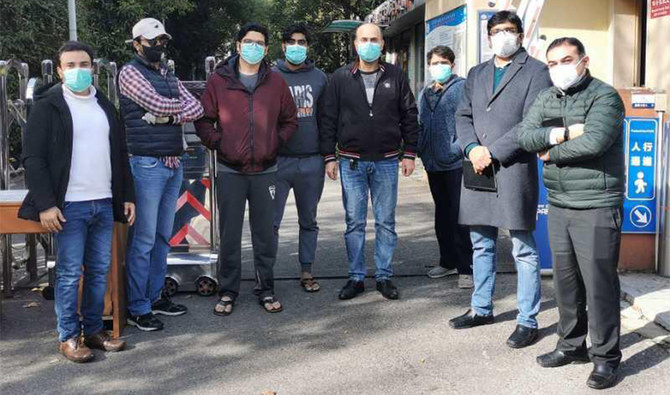
Pakistani officials meet students in virus-hit Wuhan

A two-member special task force from Pakistan Embassy Beijing visited the virus-hit Chinese city of Wuhan to meet Pakistani students. (Photo Courtesy: Pakistan Foreign Office)
Short Url
Updated 15 March 2020
Follow

Pakistani officials meet students in virus-hit Wuhan

  • A two-member task force is permanently deployed in Wuhan to coordinate with Chinese authorities, foreign office says
  • Pakistan decided not to evacuate its nationals from Wuhan after the epidemic began

ISLAMABAD: A two-member special task force from Pakistan Embassy Beijing visited the virus-hit Chinese city of Wuhan to meet Pakistani students in different universities and get first-hand information regarding their well-being and safety, the foreign office said on Tuesday. 

“The task force is permanently deployed in Wuhan and coordinating with Chinese authorities,” the foreign office statement read. “The task force would return to their homes in Beijing once the lockdown in Wuhan is lifted in its entirety and the on-ground situation is completely stabilized.”

Pakistan decided not to evacuate its students and other nationals from Wuhan after the epidemic began, making the concerned parents of locked-down students in China criticize the government and demand their children’s immediate return.

The matter was also discussed in the local media and national parliament, putting the Pakistan Tehreek-e-Insaf administration under pressure.

According to the foreign office, the two-member task force met the administrative staff in different universities to get first-hand information on the well-being and needs of the students. They also reported that all the students in the universities they visited today were safe, healthy and well looked after.

“All those in need of any medical attention are provided immediate and best available medical care,” the statement said. “Similarly, there is a provision of psychological counseling to those facing stress and depression.”

“Three Pakistani students at Guangzhou city and one in Wuhan who were infected by the coronavirus have fully recovered and discharged from the hospitals,” the foreign office press release added.

Pakistan’s diplomatic mission in China constituted an 11-member group to monitor the contagion and respond to the queries and requests of students. Among other things, it also organized a video conference of Pakistani nationals in Wuhan with relevant cabinet members in Islamabad.

“The situation in Wuhan and Hubei Province is showing increased signs of improvement,” the foreign office statement continued. “The number of daily reported infected cases is gradually decreasing, the markets and shopping places are being opened and courier services have been resumed.”


Pakistan urges pilgrims to complete Saudi biometrics as Hajj preparations gain pace

Updated 30 January 2026
Follow

Pakistan urges pilgrims to complete Saudi biometrics as Hajj preparations gain pace

  • Government warns pilgrims biometric verification is required for Hajj visas
  • Step follows tighter oversight after last year’s Hajj travel disruptions

ISLAMABAD: Pakistan’s government on Friday urged aspiring pilgrims to complete mandatory Saudi biometric verification for Hajj visas, as preparations for the 2026 pilgrimage gather pace following stricter oversight of the Hajj process.

The announcement comes only a day after Pakistan’s Religious Affairs Minister Sardar Muhammad Yousuf said regulations for private Hajj operators had been tightened, reducing their quota following widespread complaints last year, when tens of thousands of pilgrims were unable to travel under the private Hajj scheme.

“Saudi biometric verification is mandatory for the issuance of Hajj visas,” the Ministry of Religious Affairs said in a statement, urging pilgrims to complete the process promptly to avoid delays.

“Hajj pilgrims should complete their biometric verification at home using the ‘Saudi Visa Bio’ app as soon as possible,” it added.

The statement said the pilgrims who were unable to complete biometric verification through the mobile application should visit designated Saudi Tasheer centers before Feb. 8, adding that details of the centers were available on Pakistan’s official Hajj mobile application.

Pakistan has been steadily implementing digital and procedural requirements for pilgrims ahead of Hajj 2026, including mandatory training sessions, biometric checks and greater use of mobile applications, as part of efforts to reduce mismanagement.

Saudi Arabia has allocated Pakistan a quota of 179,210 pilgrims for Hajj 2026, with the majority of seats reserved under the government scheme and the remainder allocated to private tour operators.