

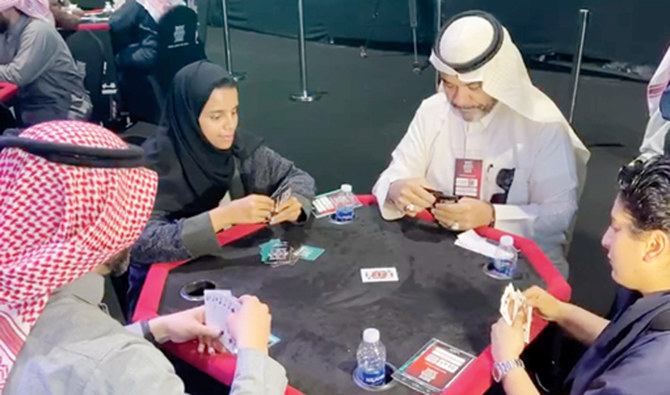

RIYADH, JEDDAH: Female Baloot players have been taking part in the second day of a tournament being held in Riyadh Front, with the inclusion of women’s rounds being seen as a boost for female enthusiasts of the card game.
Six rounds were played on day two of the Baloot Championship, 520 teams with two rounds for women.
The game is believed to have been brought to the Hijazi region from Indian immigrants through trading routes during the time of the Ottoman Empire. Its origins could also have come from France where it is known as Belote and migrated during the Ottoman expansion in the region. The objective is to outsmart and outplay your opponent.
Four players are divided into two teams, with two players on each. The rules are strict and straightforward. One player distributes 32 cards and each player gets five cards each. The two players facing each other work as a team to win as many high-ranking cards as possible. The main goal is to win the rounds in which high-ranking cards are played. The players collect cards by “eating” the cards of the opponent. Baloot uses 32 cards only, cards with numbers from 2 to 6 are excluded from the game.
--------
PHOTOS: Women join men at Saudi Arabia's Baloot Championship in Riyadh
--------
Jawaher Al-Mansoour, a 24-year-old law student, said she was excited to be taking part.
“I’ve just completed the first round, I can say that the atmosphere is a very professional one, everyone is understanding and there are no tensions between players,” she told Arab News.
She learned the game alongside her friend, Deema Al-Mutairi, six years ago and plays almost daily. “When we heard of the championship last year, we got excited but we weren’t able to participate because there were no female teams at the time,”Al-Mansour added.
“We registered as soon as we heard that females were allowed in this year’s championship and though we weren’t taken that seriously by our friends and families, we made it to the next round and are looking forward to reaching the end, hopefully the SR2 million ($533,333) prize.”
It took her two years to learn the game correctly, playing with her brothers and father to hone her skills. Al-Mansour is keen on helping to teach the game to other women who want to learn.
Her friend, Al-Mutairi, is also a law student. She learned baloot from her older sister who is an avid player and then continued learning the tricks of the game with school friends.
“I enjoy playing the game and especially with my group of friends,” she told Arab News. “We’re nine friends altogether and play rounds. This is how I perfected the game and I’m excited to participate in the championship. I’m striving for the SR2 million prize, it’s what we’re here for.”
Both players said that many young women were keen to learn how to play the game, with the duo helping them out.
Baloot has been one of the most popular games in the Gulf for decades, and Saudi Arabia in particular.


