Baloot: The No. 1 social activity in Saudi Arabia is an integral part of the culture, and popular with people of all ages

1 / 6
The screening of the Baloot Championship in Riyadh on television has illustrated the popularity of the game. (SPA)
2 / 6
The screening of the Baloot Championship in Riyadh on television has illustrated the popularity of the game. (SPA)
3 / 6
The screening of the Baloot Championship in Riyadh on television has illustrated the popularity of the game. (SPA)
4 / 6
The screening of the Baloot Championship in Riyadh on television has illustrated the popularity of the game. (SPA)
5 / 6
The screening of the Baloot Championship in Riyadh on television has illustrated the popularity of the game. (SPA)
6 / 6
Updated 02 November 2018
Follow

Baloot: The No. 1 social activity in Saudi Arabia is an integral part of the culture, and popular with people of all ages

  • With only four players and 32 cards, the objective is to outsmart and outplay your opponent.
  • Some believe the game originated in France, where it is known as “Belote,” and migrated with the Ottoman expansion

JEDDAH: The popularity of the trick-taking card game Baloot shouldn’t come as a surprise to anyone in the region, but it might to any outsider who saw the second Baloot Championship in Riyadh on television this month.

For generations, Baloot has been played exactly as it is today, and it has remained an integral part of Saudi culture. With only four players and 32 cards, the objective is to outsmart and outplay your opponent: Are you up for the challenge?

For years, Saudis have seen the male figures in their family and circle of friends lose themselves in the game, although women have been known to play too.

“I’ve been playing Baloot for over 40 years with the same people,” said engineer Esam Al-Shihry. “My friends come and go, but with this group of friends, our game plans are set, our partners are known, and we’ve been consistent for years. We’ve hardly ever missed a weekend.  Many of the guys would come and go as their jobs required them, but when they head back in town, we’d always gather in the same majlis, same teacups and same group of players.

“With this close relationship, it’s hard for your partner not to comprehend your ultimate goal in the game set, so when it does happen, let’s just say, he’ll have a hard time holding the cards for a week,” said Al-Shihry, laughing.  

“Why is that?” Arab News asked.

“Well, my child, you just can’t miss a beat.  If they do, all I could say is either run or duck.  That should teach them a lesson,” he said, clearly amused.

Some believe the game originated in France, where it is known as “Belote,” and migrated with the Ottoman expansion (it is also played in countries such as Cyprus, Armenia and Bulgaria). Others believe it migrated from India, reaching the shores of the Arabian Peninsula through trade routes.  

The rules of the Saudi version of the game are simple but strict, requiring risk-taking, strategy and skill. There are two hands to the game: Hokum and Sun, with 32 cards dealt, excluding the numbers 2-6 but including the Joker.
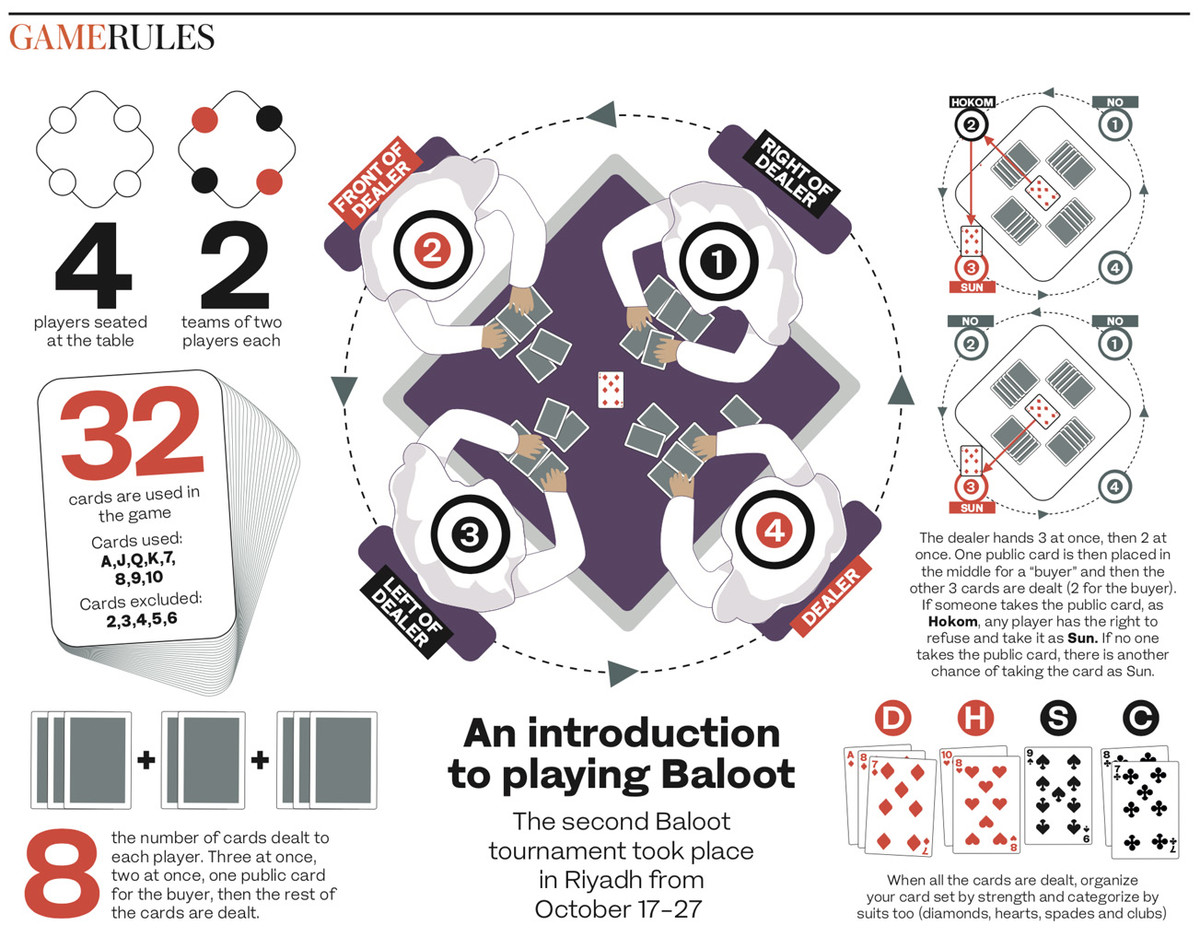
The dealer deals eight cards to each player counter-clockwise. The player on his left cuts the cards then the dealer starts dealing. This technique is used to ensure the dealer doesn’t cheat, and the left player divides the deck in half, places one half over the other then gives it back. Then the dealer gives away the cards, 3-2-public card-3 “only 2 for the buyer,” starting with his right in an order of  three at once, two at once then one single card is placed on the table, or floor, for the “buyer.”  Once the buyer takes the card, they set the game plan in motion by choosing Hokum or Sun. The buyer must be sure that the card he’s buying is his best bet to get as many points in the game.  

To properly claim it, the buyer, who is on the right of the dealer, must use the term “awal,” or first.  The rest of the cards are then dealt until all players have a set of eight each. If the player on the dealer’s right side refuses to buy the card, a “pass” is given and he uses the term “bas” to pass.  If the public card is refused by all, it’s replaced by another, and the same terminology is used for the second round.

There is a catch though: If the bought card is an ace of spades in the second round and the player wants to set the game as Hokum, you can’t use the strong cards with the spade: You have either the club or heart or diamond.  The buyer loses his chance to decide the game plan. It’s a game of strategy and whether you are willing to take a (non-monetary) gamble. Here’s where a player’s experience in the game discretely comes into play.

The key component in the game is to be vigilant. No speaking is allowed, and you must keep a poker face.  

Players must evaluate their cards by strength, and the public card is the key to winning as many points as possible. Whichever hand they’re given, the order of the cards is important by strength.  For Sun, the ace is the strongest, followed by a 10, K, Q, J, 9, 8, 7. As for Hokum, the J is strongest, 9, ace, 10, K, Q, 8 and 7. 

Once players organize their cards, each start throwing one card at a time in rounds, taking into account whichever they see fit for their set.  Again, teammates must stay vigilant and cautious: If your opponent catches whiff of which card set you’re playing, they’ll hamper your attempts every chance they get.

Here’s where some tempers could flare. Teammates could help each other if they catch a glimpse of their game plans. They could have secret codes or moves that would indicate the game is set and it is time to reveal their cards for the win.  Miss out? Then expect a reprimand, of course, all in the spirit of the game. If you miss your cue with a big game play, just watch your head.

Once a round is over and all cards are dealt, the score of each team is added as each card has a ranking: the game set Hokum differs from Sun in scoring. Here’s where the fun lies: The higher the score, the stronger the shock from the players.  The strength of the player in this trick-taking game is decided by how well they score. With no luck involved, it all falls to how smooth your posture is, maintaining a vigilant mind and a good eye.

Sheikha M, a 30-year-old interior designer and her 28-year old sister Noura, a nutritionist, gather weekly at their friend’s house for a night of Baloot. “We’ve been doing this for over three years now,” said Sheikha. “My sister and I are close as well as our friends, and I taught them how to play Baloot the same way my father taught me. An added extra would be getting his temper too, and I am now prohibited from having any dangerous items near me,” she said laughingly.

“We spend hours playing one round after another,” Noura said. “Conversations float from one topic to the next, and we all relax after a hectic work week. I don’t think I would prefer anything else, for that matter. It’s relaxing, you have a good crowd around you, and that’s what the game is all about, except for the flying objects Sheikha vents her frustration through.”

In this month’s Baloot championship, in which more than 2,000 people participated, first-place winners received a prize of one million Saudi riyals. Who said playing cards was a waste of time? Surely mothers will now think twice before scolding their children for playing.


Motherhood during Ramadan 

Updated 6 sec ago
Follow

Motherhood during Ramadan 

  • Planning ahead, flexibility, and family support helps mothers make it through the holy month 

JEDDAH: For mothers — new, working or stay-at-home, Ramadan comes with its own set of demands as they strive to balance work, house, and children of different age groups, all while fasting. 

As routines shift and energy levels fluctuate, Arab News spoke to mothers on how they manage to keep their world together. 

Elaf Trabulsi, founder and creative at Ctrl C Agency and a full-time employee, is a mother to an 18-month-old daughter. For Trabulsi, Ramadan is “controlled chaos, honestly. It’s my favorite month but it’s also the one that tests every system I’ve built — work, home, health, sleep. There’s something about fasting while managing a full schedule that forces you to be very deliberate about where your energy goes. I’ve come to appreciate that pressure.” 

Planning is a vital strategy during Ramadan, mothers said, because without a clear structure in place, the household ends up in a state of disarray. A lot of decisions have to be made professionally and domestically to hold the house together. 

“I juggle a full-time job alongside the agency, so Ramadan is really about protecting the hours that matter most and being honest about what can wait,” Trabulsi said. 

Baraa Hifni, a physical education teacher at Jeddah Campus International School, echoed similar sentiments. “I rely on planning ahead, distributing household responsibilities, and organizing my children’s time. I also make sure to take some time for myself so that I can stay in a good mood throughout the day. Balance requires calmness and clear priorities,” the mother of two young daughters said. 

Even with a schedule planned, juggling motherhood and work can often be challenging because newborns and toddlers function on their own timeline, and it is the sleep schedule that takes a hit. 

“Ramadan flips your schedule naturally — late gatherings, suhoor, staying up — and then you have a toddler operating on her own timeline regardless. That gap between when you slept and when she’s ready to start her day is where it gets hard. You learn to function on less and find energy where you can,” Trabulsi told Arab News. 

Finding pockets of peace or solitude during Ramadan for worship is also quite difficult for mothers because they cannot set or follow a rigid schedule.

For Hifni, it is usually after the chaos around iftar settles after maghrib prayer “even if it’s just a few minutes to regain my calmness and draw closer to God.”  

For Trabulsi it is “whenever and wherever I can find it … sometimes it’s the quiet after she sleeps, sometimes it’s during the drive home from a gathering.” 

Hana Barakat, an occupational therapist and mompreneur productivity coach, shares similar thoughts. 

“Allow worship to be brief and spread throughout the day. Measure productivity by consistency, not quantity. Accept fluctuating energy from day to day. Recognize that a quieter Ramadan can still be deeply spiritual,” she said.

“Achieving balance — or harmony, as I prefer — does not mean pushing the body to match spiritual intentions but adjusting expectations and practices so that the body supports the experience rather than resists it,” she said. “Realism supports well-being and allows space to experience the month with calm.”

She advises new mothers to reset their expectations by prioritizing recovery and infant care over productivity. For a new mother, this shift can feel especially intense because she is already adapting to life after childbirth — “caring for an infant whose needs are unpredictable.”

Fasting can also influence emotional regulation, particularly when combined with sleep deprivation.

“When hunger combines with lack of sleep and fatigue, the nervous system becomes more sensitive; the crying baby may make mothers feel more overwhelmed than usual,” Barakat said.

“Emotional reactions may occur more quickly, and the mother needs extra effort to calm herself. These are normal physiological responses, not a sign of being an impatient or inadequate mother.”

Barakat outlined several strategies to help new mothers navigate the month with greater ease. Reducing nonessential tasks is not neglect, it preserves the strength needed to move steadily through the month, she said. 

Choosing one meaningful task per day prevents energy from being drained by trying to accomplish everything. Waiting for an uninterrupted stretch may lead to frustration. Brief quiet moments can become restorative spiritual pauses, she added. 

Even a few minutes of true rest can help regulate the nervous system, improving patience and emotional balance. Less complexity in meals, social obligations, and routines leaves more room for spiritual presence.

Meaningful support, Barakat said, must be practical rather than merely verbal, for all mothers. 

Spouses and family members should help by taking responsibility for specific daily tasks, giving mothers uninterrupted time to rest, reducing social expectations placed upon her, and understanding fluctuations in her energy and mood.

“When responsibility is shared, the mother can experience Ramadan with greater calm, ease, and presence,” she said.