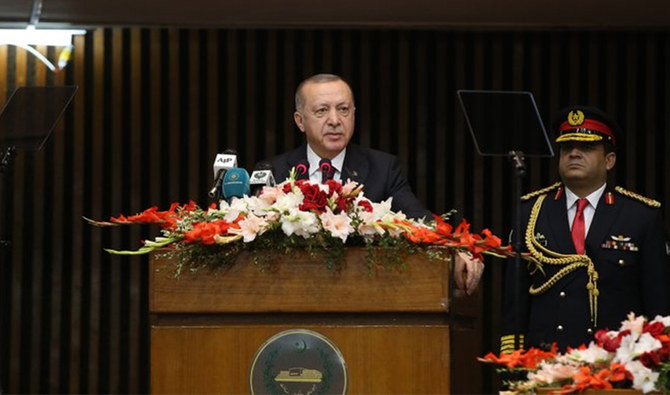
ISLAMABAD: Turkish President Recep Tayyip Erdogan on Friday addressed a joint session of Pakistan parliament, offering unflinching support on issues confronting Islamabad including Kashmir and scrutiny by Financial Action Task Force (FATF).
Erdogan arrived in Pakistan on a two-day official visit on Thursday, accompanied by his wife and a high-powered delegation of officials and businessmen.
In his address to Pakistani lawmakers, he also rejected US President Donald Trump’s Middle East peace plan to resolve the Israel-Palestine conflict.
“Today, the issue of Kashmir is as close to us as it is to you [Pakistanis],” he said while addressing the joint session of the parliament for a record fourth time in Islamabad.
“Kashmir issue can be resolved not through conflict or oppression but through justice and fairness,” he said. “Turkey will continue to stand by justice, peace and dialogue for the resolution of the Kashmir issue.”
The Kashmir dispute attracted international spotlight in August last year when India revoked the special constitutional status of Indian-administered Kashmir and placed more than eight million Kashmiris under a strict curfew to prevent any protests against the decision in the Muslim-majority state — bringing he two countries to the brink of war.
The Turkish president also lauded Pakistan’s efforts to rid the region of terrorism and the country’s contribution to the ongoing peace process in Afghanistan.
“Pakistan and Turkey are two countries that are most affected by terrorism due to their geographic location,” he said. “We will continue to cooperate with Pakistan on counter-terrorism.”
Erdogan also vowed Ankara’s support to Islamabad over FATF – an intergovernmental body responsible for combating money-laundering and terror financing – that placed Pakistan on its grey-list in June 2018 for “structural deficiencies” in financial framework. The watchdog is expected to decide next week in its plenary in Paris whether Pakistan’s name could be removed from its grey-list or further downgraded to the blacklist.
Pakistan requires at least 12 votes to get off the grey-list and three votes out of 37 to avoid blacklisting, so Turkey’s support along with other friendly countries will prove crucial to Islamabad.
“Pakistan is on the way to peace and stability: Peace and stability don’t come in a few days and require work,” he said.
During his address, the Turkish president also referred to Donald Trump’s “deal of the century” to resolve the Israel-Palestine conflict. “This is not a peace plan, but in fact a project for occupation,” he said.
“Jerusalem is our red line. We have declared to the whole world that we will not leave Haram Al-Sharif to the mercy of the occupying Israeli administration,” he added.
Recalling historic relationship with Pakistan, Erdogan thanked the South Asian nation for helping the people of Turkey in difficult times.
“We have never forgotten and will not forget the help, which the Pakistani people delivered, during our War of Independence by piling up their own bread,” he said.
During Erdogan's visit, Pakistan and Turkey signed a string agreements, including on cooperation between state-run broadcasters, customs, halal certification, and a declaration of economic framework to increase bilateral trade. They also inked memoranda of understanding in the defense and energy sectors.


![]()
![]()

Turkish president addresses Pakistan parliament, pledges support on Kashmir

Short Url
https://arab.news/gbj3a
Turkish president addresses Pakistan parliament, pledges support on Kashmir
- Erdogan is on a 2-day official visit to Islamabad
- He also rejected Trump’s ‘deal of the century’ calling it an occupation plan
Latest updates


© 2026 SAUDI RESEARCH & PUBLISHING COMPANY, All Rights Reserved And subject to Terms of Use Agreement.