

UN Security Council calls for ‘lasting cease-fire’ in Libya

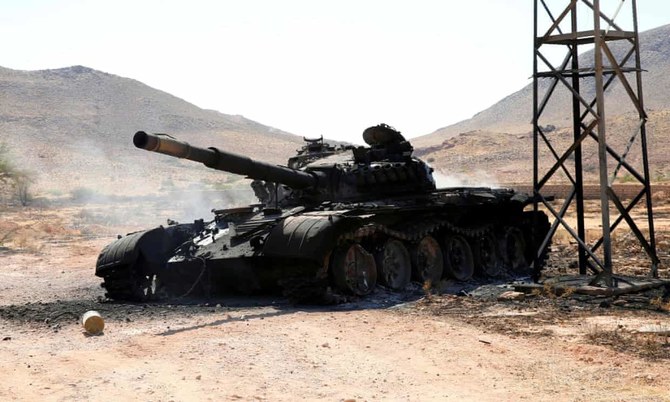
A destroyed tank south of Tripoli. A fragile truce has been in place in Libya since January. (Reuters)
Short Url
Updated 13 February 2020
Follow

UN Security Council calls for ‘lasting cease-fire’ in Libya

  • Deep international divisions over Libya despite world leaders recently agreeing to end all foreign interference in the country
  • Eastern forces loyal to Khalifa Haftar will not allow the United Nations to use the only functioning airport in the capital Tripoli

UNITED NATIONS, United States: The UN Security Council on Wednesday adopted a resolution calling for a “lasting cease-fire” in war-torn Libya, where a fragile truce has been in place since January.
The text, drafted by Britain, was approved by 14 votes out of 15, with Russia abstaining.
It was subject to weeks of discussions, reflecting deep international divisions over Libya despite world leaders recently agreeing to end all foreign interference in the country and to uphold a weapons embargo.

Meanwhile, Eastern forces loyal to Khalifa Haftar will not allow the United Nations to use the only functioning airport in the capital Tripoli which they have been trying to take in a campaign, a force spokesman said on Wednesday.
Force spokesman Ahmed Mismari told reporters the UN would have to use other airports such as Misrata because it could not guarantee the safety of flights into Tripoli Mitiga airport as Turkey was using it as base.
The UN mission to Libya earlier on Wednesday accused Haftar’s forces of blocking flights carrying UN staff to Libya.


Israeli approval of West Bank land registration draws outrage

Updated 33 min 53 sec ago
Follow

Israeli approval of West Bank land registration draws outrage

  • Israel’s government has approved a process to register land in the West Bank, drawing condemnation

JERUSALEM: Israel’s government has approved a process to register land in the West Bank, drawing condemnation from Arab nations and critics who labelled it a “mega land grab” that would accelerate annexation of the Palestinian territory.
Israel’s foreign ministry said the measure would enable “transparent and thorough clarification of rights to resolve legal disputes” and was needed after unlawful land registration in areas controlled by the Palestinian Authority.
But Egypt, Qatar and Jordan criticized the move as illegal under international law.
In a statement, the Egyptian government called it a “dangerous escalation aimed at consolidating Israeli control over the occupied Palestinian territories.”
Qatar’s foreign ministry condemned the “decision to convert West Bank lands into so-called ‘state property’,” saying it would “deprive the Palestinian people of their rights.”
The Palestinian Authority called for international intervention to prevent the “de facto beginning of the annexation process and the undermining of the foundations of the Palestinian state.”
Israeli anti-settlement watchdog Peace Now called Sunday’s measure a “mega land grab.”
According to public broadcaster Kan, land registration will be reopened in the West Bank for the first time since 1967 — when Israel captured the territory in the Middle East war.
The Israeli media reported that the process will take place only in Area C, which constitutes some 60 percent of West Bank territory and is under Israeli security and administrative control.
Palestinians see the West Bank as foundational to any future Palestinian state, but many on Israel’s religious right want to take over the land.
Last week, Israel’s security cabinet approved a series of measures backed by far-right ministers to tighten control over areas of the West Bank administered by the Palestinian Authority under the Oslo accords in place since the 1990s.
Those measures, which also sparked international backlash, include allowing Jewish Israelis to buy West Bank land directly and allowing Israeli authorities to administer certain religious sites in areas under the Palestinian Authority’s control.
Excluding Israeli-annexed east Jerusalem, more than 500,000 Israelis live in West Bank settlements and outposts, which are illegal under international law.
Around three million Palestinians live in the territory.