

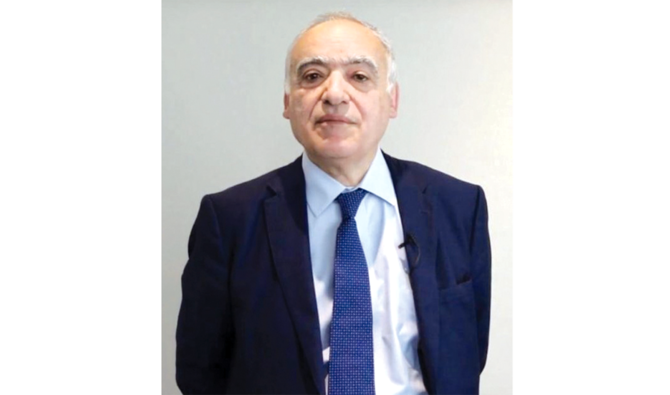

PARIS: Special Representative for the UN Support Mission in Libya Ghassan Salamé told Arab News it would not be useful for Libyan military commander Khalifa Haftar and Prime Minister Fayez Al-Sarraj to meet without carrying out the necessary preparatory work for an agreement.
“It will not solve the problem,” he said, reiterating that several leaders — including Russian President Vladimir Putin, French President Emmanuel Macron and Italian Prime Minister Giuseppe Conte — had all tried it, but in vain.
“You need to address the big issues that allow these two to sell whatever agreement they reach to their own constituencies. If this preparatory work is not done, nothing will happen,” he said.
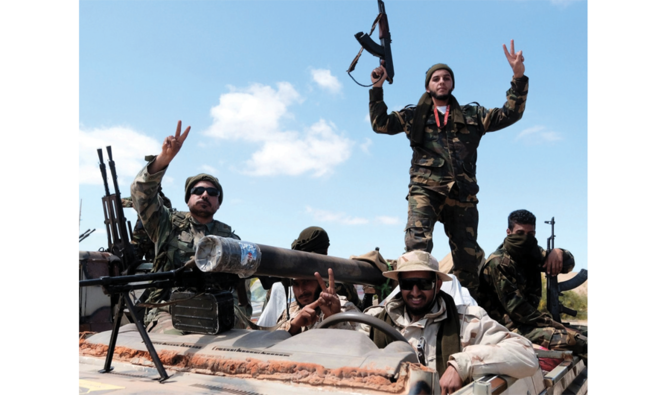
In an exclusive interview in Paris, Salamé — a former Lebanese minister — said that while the members of the 5+5 Libyan Joint Military Commission had agreed at their meeting in Geneva early this month to confirm the truce, to begin the process of disarming the militias, and to meet again soon, foreign interference in Libya was still high. He confirmed that Turkey had sent foreign fighters and equipment to Libya after the Berlin summit in January, adding that other countries are also sending equipment and fighters in support of Haftar.
On the fragility of the ceasefire, he said: “We still have a situation that is very blurred. They keep telling us that they respect the truce, but we have counted more than 130 violations since Jan. 12.”
Militias, he said, are on the payroll of the regular army and, according to the central bank, the army is paid on both sides of the divide — east and west — as are all civil servants.
On the current state of the deal between the two sides, he said: “We agreed on many issues; we agreed that the foreign fighters need to depart the country within three months of the ceasefire agreement. We agreed on the beginning of the process of disarming the militias; and we also agreed on the attempt to reunify the struggle against terrorist groups. There were, however, two or three sticking points we did not agree upon.”
Commenting on President Macron’s accusation that Turkey violated the Berlin commitment by sending arms and Syrian mercenaries to fight in Libya to help Al-Sarraj, Salamé said that both sides had violated the commitments undertaken at the Berlin summit.
That is why, he said, UN Secretary-General Antonio Guterres called the situation a “scandal.”
“There are commitments and there is a resolution but nobody is respecting them,” Salamé said. “We are therefore now in a race against time. We have launched these three tracks and I am happy the economic and financial tracks are going very well. At least 28 representatives from all the political groups and from various economic institutions in Libya met in Cairo on Feb. 9 and 10, and the next meeting will be in the first week of March.”
Regarding the oil terminals, which Haftar has blocked, Salamé said the UN-led economic dialogue in Cairo had explored a mechanism for the fair distribution of oil revenues, since Haftar believes that they are not currently equally distributed.
“Oil is often weaponized,” he said. “It happened at least twice on my watch.” Oil production is now mainly being carried out offshore, he added. “As with the two oil problems that were solved, I came to the conclusion that without a strong position (being taken) by the international community, we cannot do it on our own.
The Americans have been very much involved in the two preceding oil crises. This time I am using international pressure and I have been talking to tribal leaders in Zuwetina.
“More importantly, we put the question of redistribution of oil revenues at the top of the agenda of the economic meeting in Cairo,” he continued. “We are trying to come up with a mechanism that is satisfactory to everybody and we pushing as hard as we can.”
In response to Haftar’s complaint that oil revenues were not equally distributed, Salamé said: “This is an old issue and you have two different things here: You have the idea in the east and the south that these two provinces, even under Muammar Qaddafi, were not fairly treated by Tripoli, and that the west — where the majority of the population lives — is taking more than its fair share of the oil revenues and has been more vocal in the past few months.
On the other hand, Haftar believes that after his deployment in the south and in the west, he is, to a large extent, in control of most of the oil, but the central bank in Tripoli is the one which decides on the oil revenues. The Libyans have to understand that the National Oil Company (NOC) is not taking a penny from the revenues — we are trying to explain that the NOC is different from the central bank: The oil revenues go to the Libyan exterior bank, which gives them directly to the central bank in Tripoli.
Therefore, Haftar believes that the central bank in Tripoli is not treating him and his troops fairly. Thus, you have two combined requests: The old one from the south and east that they were never treated properly, and now Haftar saying his army is not treated properly. So for that you need a mechanism, and a number of Libyan experts on Monday created a special committee to come up with a solution for the fair distribution of oil revenues in the next few days.”
When asked why he thinks Turkey is interfering in Libya, Salamé said: “Iran is interfering in Arab countries in the eastern Arab world and Turkey is doing the same in the western part. Unfortunately, now the situation in the Arab world is very polarized … There is a combination of factors that have allowed some seven or eight countries to interfere directly — by allowing mercenaries to come, or by sending private military firms, or by sending equipment.”
The UN representative said he hoped that the escalating tension between Russia and Turkey in Syria’s Idlib region would not cause foreign fighters to enter Libya, adding that the two countries had agreed a truce in Berlin, which he described as “a positive development.”
His main concern, Salamé said, is that there are a number of parties who benefit from turmoil in Libya — and have no interest in helping to find a solution.
“What worries me in Libya is that there are groups, traders, financial people, arms dealers taking advantage of the situation and who are not in a hurry to find a solution,” he said. “A solution to Lebanon’s 1975 civil war was possible as early as 1983, but we took six extra years and lost 50,000 lives — just because we were (obstructed).
“I think time is now working against the Libyans. In the past few months, the level of foreign interference in their affairs has reached a point where they are losing their sovereignty little by little, day by day,” he continued.
“I wish they would open their eyes and see that they are becoming not only a threat to themselves but a threat to security in the entire region of the Mediterranean and the Sahel.”


