

UN-brokered Libya talks end with no formal truce deal

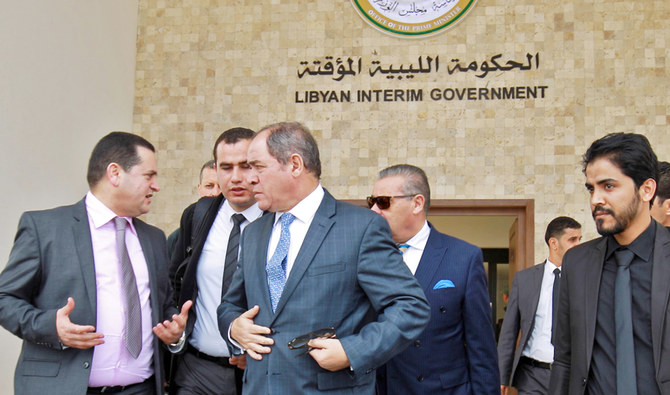
Algeria's foreign minister Sabri Boukadoum (C) leaves the headquarters of Libya's parallel eastern government after meeting with its foreign minister Abdulhadi Lahweej (L), in the coastal city of Benghazi in eastern Libya, on February 5, 2020, during a visit to discuss Algiers' efforts for a political solution to the Libyan conflict. (AFP)
Short Url
Updated 10 February 2020
Follow

UN-brokered Libya talks end with no formal truce deal

  • A UN-supported but weak administration, led by Fayez Al-Sarraj, holds only a shrinking area of western Libya, including the capital Tripoli

CAIRO: Libya’s warring sides ended several days of UN-brokered talks without reaching a deal to consolidate a provisional cease-fire in and around the capital, the UN said.
Another round of talks was proposed for later this month “as both sides agreed to the need to continue the negotiations,” according to a statement from the UN support mission in Libya released on Saturday.
The current cease-fire was brokered by Russia and Turkey on Jan. 12. It marked the first break in fighting in months, but there have been repeated violations from both sides.
Libya is split between rival governments, each backed by an array of foreign countries apparently jockeying for influence in order to control Libya’s resources.
A UN-supported but weak administration, led by Fayez Al-Sarraj, holds only a shrinking area of western Libya, including the capital Tripoli. It has been fending off an offensive since last April by forces loyal to Gen. Khalifa Haftar, who is allied with a rival government that controls much of Libya’s east and south, including key oil fields and export terminals.
Outside nations continue to break a UN arms embargo on Libya by sending equipment, weapons and even foreign fighters to both sides.

SPEEDREAD

The current cease-fire was brokered by Russia and Turkey on Jan. 12. It marked the first break in fighting in months, but there have been repeated violations from both sides.

The UN statement said there was “broad consensus” between the two sides on “the urgency for Libyans to safeguard the sovereignty and territorial integrity” and to “stop the flow of non-Libyan fighters and send them out of the country.”
Al-Sarraj is backed by Turkey, Italy and Qatar. In the latest twist, Turkey has deployed Syrian fighters affiliated with Al-Qaeda and Daesh to the Libyan battlefield.
The UN statement said there was “widespread consensus” between the two sides to continue the fight against UN-identified militant groups, such as Daesh, Al-Qaeda and Ansar Al-Sharia.
It said both sides expressed support for the exchange of prisoners, the return of the bodies of deceased fighters, and the return of displaced civilians to their homes.
The UN proposed a new round of cease-fire talks in Geneva on Feb. 18.


Israel aims to bring ‘permanent demographic change’ to West Bank, Gaza: UN

Updated 42 min 5 sec ago
Follow

Israel aims to bring ‘permanent demographic change’ to West Bank, Gaza: UN

  • UN rights chief Volker Turk says Israeli military operation in West Bank’s north has displaced 32,000 Palestinians

GENEVA: Israel’s actions in the occupied West Bank and the Gaza Strip seem aimed at creating “permanent demographic change,” UN rights chief Volker Turk said on Thursday.
“Taken together, Israel’s actions appear aimed at making a permanent demographic change in Gaza and the West Bank, raising concerns about ethnic cleansing,” Turk said in a speech before the UN’s Human Rights Council in Geneva.
Turk pointed in particular to an ongoing, year-long Israeli military operation in the West Bank’s north that has caused the displacement of 32,000 Palestinians.
Elsewhere in the West Bank, entire Bedouin herder communities have been displaced by increasing harassment and violence from Israeli settlers, including near Mikhmas to the east of Ramallah, and Ras Ein Al-Auja, in the Jordan Valley, since the start of the year.
In addition to roughly three million Palestinians, more than 500,000 Israelis live in settlements and outposts in the West Bank, which are considered illegal under international law.
Israel has approved a series of initiatives this month backed by far-right ministers, including launching a process to register land in the West Bank as “state property” and allowing Israelis to purchase land there directly, in a move condemned by several countries as well as Hamas.
Israel’s current government has accelerated settlement expansion, approving a record 54 settlements in 2025, according to Israeli settlement watchdog NGO Peace Now.
Israel has occupied the West Bank since 1967.

‘Maximum land, minimum Arabs’ 

In the Gaza Strip, most of the territory’s 2.2 million inhabitants have been displaced at least once since the start of the war sparked by Hamas’s unprecedented attack against Israel on October 7, 2023.
“Intensified attacks, the methodical destruction of entire neighborhoods and the denial of humanitarian assistance appeared to aim at a permanent demographic shift in Gaza,” the UN human rights office said in a report last week.
Israeli far-right Finance Minister Bezalel Smotrich also vowed to encourage “emigration” from the Palestinian territories in February.
“We will finally, formally and in practical terms nullify the cursed Oslo Accords and embark on a path toward sovereignty, while encouraging emigration from both Gaza and Judea and Samaria,” he said, using the Biblical term for the West Bank.
“There is no other long-term solution,” added Smotrich, who himself lives in a settlement in the West Bank.
“They want maximum land and minimum Arabs,” Fathi Nimer, a researcher with Palestinian think tank Al-Shabaka, told AFP, referring to a commonly used phrase used to describe Israeli settlement tactics.