

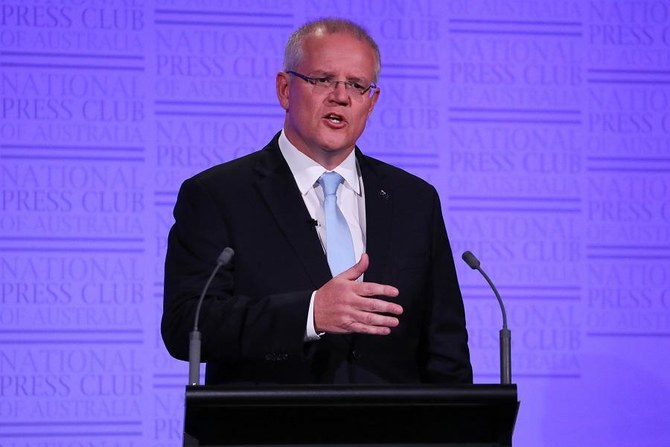
Australian prime minister announces plans to replace ‘failing’ Indigenous policy

Morrison said new Indigenous polices will be designed following consultation with its first people, with whom Australia has struggled to reconcile following hundreds of years of brutal segregation. (File/AFP)
Short Url
Updated 12 February 2020
Follow

Australian prime minister announces plans to replace ‘failing’ Indigenous policy

  • Morrison said Australia’s government is policy is failing and will be replaced
  • Unemployment in the Indigenous population is more than 25 percent higher than the rest of the country

SYDNEY: Australia is on track to meet just two of its targets aimed at improving the lives of its Indigenous people, including increasing life expectancy and improving literacy, Prime Minister Scott Morrison said on Wednesday.

In 2007, Australia introduced seven targets designed to address inequalities that see the country’s 700,000 Indigenous people track near the bottom of its 25 million citizens in almost every economic and social indicator.

But Morrison said Australia’s government is policy is failing and will be replaced.

“We perpetuated an ingrained way of thinking passed down over two centuries and more, and it was the belief that we knew better than our Indigenous peoples. We don’t,” Morrison told Australia’s Parliament.

“We also thought we understood their problems better than they did. We don’t. They live them. We must see the gap we wish to close, not from our viewpoints, but from the viewpoint of Indigenous Australians.”

Morrison said new Indigenous polices will be designed following consultation with its first people, with whom Australia has struggled to reconcile following hundreds of years of brutal segregation.

Indigenous Australians arrived on the continent at least 50,000 years before British colonists but are not recognized in the national constitution.

According to the annual report, literacy rates for Indigenous students are 20 percent are behind the national benchmark, child mortality is more than double that for non-Indigenous children, while unemployment in the Indigenous population is more than 25 percent higher than the rest of the country.

“There is more than just a gap, it is a chasm, a gaping wound on the soul of our nation,” said Pat Turner, chief executive officer at the National Aboriginal Community Controlled Health Organization.

“Collectively, we need to call this out, be truthful about the failure of governments and how we got here, so that we can chart a new and honest way forward.”


India plans AI ‘data city’ on staggering scale

Updated 56 min 27 sec ago
Follow

India plans AI ‘data city’ on staggering scale

  • ‘The data city is going to come in one ecosystem ... with a 100 kilometer radius’

NEW DELHI: As India races to narrow the artificial intelligence gap with the United States and China, it is planning a vast new “data city” to power digital growth on a staggering scale, the man spearheading the project says.

“The AI revolution is here, no second thoughts about it,” said Nara Lokesh, information technology minister for Andhra Pradesh state, which is positioning the city of Visakhapatnam as a cornerstone of India’s AI push.

“And as a nation ... we have taken a stand that we’ve got to embrace it,” he said ahead of an international AI summit next week in New Delhi.

Lokesh boasts the state has secured investment agreements of $175 billion involving 760 projects, including a $15 billion investment by Google for its largest AI infrastructure hub outside the United States.

And a joint venture between India’s Reliance Industries, Canada’s Brookfield and US firm Digital Realty is investing $11 billion to develop an AI data center in the same city.

Visakhapatnam — home to around two million people and popularly known as “Vizag” — is better known for its cricket ground that hosts international matches than cutting-edge technology.

But the southeastern port city is now being pitched as a landing point for submarine internet cables linking India to Singapore.

“The data city is going to come in one ecosystem ... with a 100 kilometer radius,” Lokesh said. For comparison, Taiwan is roughly 100 kilometers wide.

Lokesh said the plan goes far beyond data connectivity, adding that his state had “received close to 25 percent of all foreign direct investments” to India in 2025.

“It’s not just about the data centers,” he explained while outlining a sweeping vision of change, with Andhra Pradesh offering land at one US cent per acre for major investors.