

‘Changing the Script’: Red Sea film festival announces theme, honors three cinematic innovators 

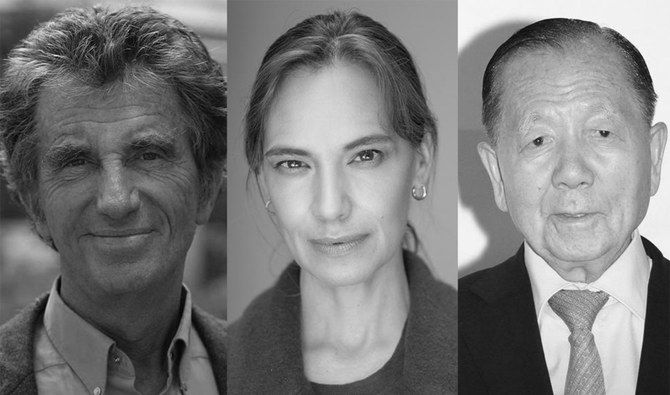
Jack Lang, left, former French minister of culture, Kim Dong-ho, right, founder of South Korea’s Busan Film Festival, and Daniela Michel, founding director of the Morelia International Film Festival in Mexico
Short Url
Updated 12 February 2020
Follow

‘Changing the Script’: Red Sea film festival announces theme, honors three cinematic innovators 

  • Three Gold Yusr awards will be presented to the trio at the opening ceremony of the Red Sea Film Festival on March 12

JEDDAH: The Red Sea International Film Festival announced on Tuesday that its inaugural session, which will be launched next month in Jeddah, will have the theme “Changing the Script.” 

The festival announced the honoring of three film innovators who have made great contributions to the industry. They are Jack Lang, former French minister of culture, Kim Dong-ho, founder of South Korea’s Busan Film Festival, and Daniela Michel, founding director of the Morelia International Film Festival in Mexico.

Festival director Mahmoud Sabbagh said: “The honoring of these three legendary figures is at the heart of the Red Sea Film Festival’s goals. An appreciation of pioneers of the film industry, who contributed to unlocking artistic capabilities of their compatriots and developing cinematic masterpieces to be enjoyed for generations.”

He said: “It coincides with the founding moment of the film industry in our country, and in honoring these individuals looks at how the introduction of similar international models can add to the dialogue establishing Saudi’s film industry.”

Lang was appointed culture minister by then-French President Mitterrand in 1981. He created a revolution in the film sector, where he worked to develop a profitable infrastructure for the French film industry. 

He redefined the state’s involvement in cinema production with the restructuring of existing funds, a strategy that paid off handsomely. He oversaw the creation of the French National Cinema Center and the Independent Film Support Fund, establishing new funds such as the Mass Production Film Fund. His innovative idea, known as the SOFICA funds — a private money funding system — was the crown jewel of his plans.

Kim Dong-ho is considered a giant of Korean cinema. He is the founder and former chairman of the Busan International Film Festival, launched in 1996. 

Throughout his career, he has made significant contributions to shaping Korea’s cultural landscape. From 1988, he was president of the Korean Motion Picture Promotion Corp. (now the Korean Film Council), contributing to the expansion of the cultural scene, deepening the base of the country’s film industry and establishing its films as a global force. 

Daniela Michel is the founding director of the International Morelia Film Festival, established in 2003 as an annual festival to support a new generation of Mexican directors, and credited with the rise of Mexican cinema internationally. 

The direct result of this is the prominence of a new generation of Mexican filmmakers, that is winning major prizes and gaining a permanent place in major film festival competitions. Collectively they have come to be known as “The Second Golden Age” of Mexican cinema.

Three Gold Yusr awards will be presented to the trio at the opening ceremony of the Red Sea Film Festival on March 12.


Threat to Kingdom’s security is ‘red line’ that will be ‘addressed and neutralized,’ Saudi envoy says

Updated 14 January 2026
Follow

Threat to Kingdom’s security is ‘red line’ that will be ‘addressed and neutralized,’ Saudi envoy says

  • Abdulaziz Alwasil tells UN Security Council the situation in southern Yemen is ‘a just cause with social and historic dimensions’ that can only be resolved through dialogue
  • Recent military activity in the south was unilateral, resulting in an escalation that harms the interests of Yemeni people and undermines efforts to address issues in the south, he said

NEW YORK CITY: Any attempt to threaten Saudi Arabia’s national security is a “red line” and will be met with decisive action, the Kingdom’s ambassador to the UN told the Security Council on Wednesday.

Speaking during a meeting of the council to discuss Yemen, Abdulaziz Alwasil said the situation in the south of the country is “a just cause with social and historic dimensions” that can only be resolved through dialogue.

“We stress that any attempt to threaten our national security is a red line, and we will not hesitate to take the necessary actions and steps to address it and neutralize it,” he added.

Alwasil reaffirmed Saudi Arabia’s support for Yemeni President Rashad Al-Alimi, the Presidential Leadership Council, and the Yemeni government in their efforts to achieve security, stability, development and peace while preserving national unity.

He said military activity by Southern Transitional Council forces in Hadramout and Al-Mahra on Dec. 2, 2025, was unilateral, did not have the approval of the Presidential Leadership Council, and was not carried out in coordination with the Coalition to Restore Legitimacy in Yemen.

It had resulted in an unjustified escalation that harmed the interests of the Yemeni people, undermined efforts to address the issues in the south, and ran counter to the coalition’s objectives, Alwasil added.

The Kingdom, working with its coalition partners, the Presidential Leadership Council and the Yemeni government, had moved to contain the situation by dispatching a military force to coordinate arrangements with the Southern Transitional Council in Aden, he said.

The aim was to ensure the return of the southern council’s forces to their previous positions outside of Hadramout and Al-Mahra, and the handover of camps to legitimate government forces and local authorities in line with agreed procedures, Alwasil added.

He expressed regret over the military operations that took place in Hadramout and Al-Mahra, close to Saudi Arabia’s southern border, which he said posed a direct threat to the Kingdom’s national security, as well as the security of Yemen and regional stability. Such steps were extremely dangerous, he added, and contradicted the principles on which the Coalition to Restore Legitimacy in Yemen had been founded.

Alwasil welcomed a prisoner and detainee exchange agreement signed in Muscat on Dec. 23, which he described as an important humanitarian measure to alleviate suffering and build confidence.

He praised Oman for hosting and sponsoring the consultations and supporting negotiations, and commended the efforts of UN’s special envoy for Yemen, Hans Grundberg, the International Committee of the Red Cross and all others that has played a part.

Regarding the political efforts to resolve the crisis, Alwasil said Saudi Arabia welcomed President Al-Alimi’s call for an inclusive conference in Riyadh to bring together all stakeholders to discuss just solutions to the situation in southern Yemen.

Preparations for the conference have begun, he added, in cooperation with the Yemeni government and southern representatives, reflecting the close ties between the two countries and their shared interests in stabilizing Yemen.

He urged all southern stakeholders to participate actively and constructively in the talks, to help find comprehensive and just solutions that meet the legitimate aspirations of the people of southern Yemen.

Alwasil called on all Yemeni forces and stakeholders to cooperate and intensify their efforts to reach a lasting political settlement that would ensure security and stability.

He described the southern issue as “a just cause with social and historic dimensions,” adding that “the only way to address it is through dialogue that leads to a comprehensive political solution” based on nationally and internationally agreed terms of reference.