

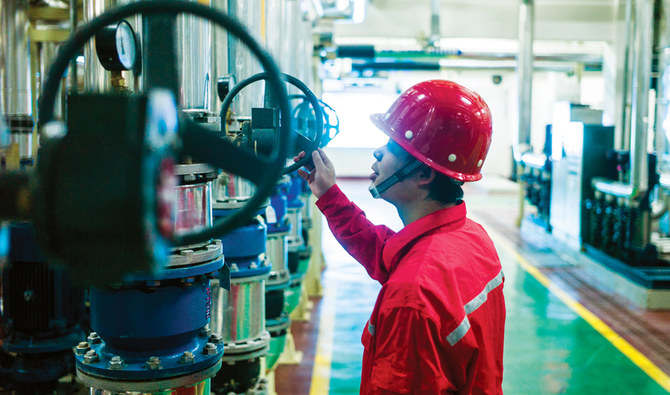
PetroChina cuts crude runs as coronavirus hits demand

Chinese state-run energy giant Sinopec, Asia’s largest refiner, is cutting its throughput by 600,000 bpd, or 12 percent of its average crude runs, its deepest reduction in more than a decade. (AFP)
Short Url
Updated 11 February 2020
Follow

PetroChina cuts crude runs as coronavirus hits demand

  • State refiner in talks with suppliers such as Saudi Arabia and UAE about deferring cargo loadings

SINGAPORE: PetroChina, China’s second-biggest state refiner, plans to reduce its crude throughput by 320,000 barrels per day (bpd) this month versus its original plan as the coronavirus hits fuel demand, a company official told Reuters on Monday.

PetroChina’s planned February cut is equivalent to about 10 percent of the refiner’s average production rate of about 3.32 million bpd.
This would bring total production scalebacks by state refiners, include Sinopec Corp. and China National Offshore Oil Company, to about 940,000 bpd for this month.

The cuts from PetroChina are likely to be deepened to 377,000 bpd in March, said the senior company official with direct knowledge of the matter. He declined to be named as he is not authorized to speak to the press.

Reuters reported last week that Sinopec Corp, Asia’s largest refiner, is cutting its throughput this month by 600,000 bpd, or 12 percent of its average crude runs, its deepest reduction in morer than a decade. Independent Chinese refiners in Shandong, meanwhile, have slashed output to below half their capacity.

“The production cuts are mostly on refineries in northeast and north China, where demand is hit harder than in the western parts of the country,” said the PetroChina official.

PetroChina started the production cuts at the beginning of the month, but deepened them on Monday, the official said.

PetroChina did not immediately respond to a request for comment.

PetroChina is talking with its key long-term suppliers such as Saudi Arabia, Kuwait and the UAE about possibly deferring cargo loadings or trimming loading volumes, the official said, without giving further details.

“We’re monitoring the market on a daily basis. But from what we’ve observed now, there seems little chance for a fuel demand recovery in March,” the official said.


Saudi Arabia, Japan trade rises 38% between 2016 and 2024, minister says

Updated 11 January 2026
Follow

Saudi Arabia, Japan trade rises 38% between 2016 and 2024, minister says

RIYADH: Trade between Saudi Arabia and Japan has increased by 38 percent between 2016 and 2024 to reach SR138 billion ($36 billion), the Kingdom’s investment minister revealed.

Speaking at the Saudi-Japanese Ministerial Investment Forum 2026, Khalid Al-Falih explained that this makes the Asian country the Kingdom’s third-largest trading partner, according to Asharq Bloomberg.

This falls in line with the fact that Saudi Arabia has been a very important country for Japan from the viewpoint of its energy security, having been a stable supplier of crude oil for many years.

It also aligns well with how Japan is fully committed to supporting Vision 2030 by sharing its knowledge and advanced technologies.

“This trade is dominated by the Kingdom's exports of energy products, specifically oil, gas, and their derivatives. We certainly look forward to the Saudi private sector increasing trade with Japan, particularly in high-tech Japanese products,” Al-Falih said.

He added: “As for investment, Japanese investment in the Kingdom is good and strong, but we look forward to raising the level of Japanese investments in the Kingdom. Today, the Kingdom offers promising opportunities for Japanese companies in several fields, including the traditional sector that links the two economies: energy.”

The minister went on to note that additional sectors that both countries can also collaborate in include green and blue hydrogen, investments in advanced industries, health, food security, innovation, entrepreneurship, among others.

During his speech, Al-Falih shed light on how the Kingdom’s pavilion at Expo 2025 in Osaka achieved remarkable success, with the exhibition receiving more than 3 million visitors, reflecting the Japanese public’s interest in Saudi Arabia.

“The pavilion also organized approximately 700 new business events, several each day, including 88 major investment events led by the Ministry of Investment. Today, as we prepare for the upcoming Expo 2030, we look forward to building upon Japan’s achievements,” he said.

The minister added: “During our visit to Japan, we agreed to establish a partnership to transfer the remarkable Japanese experience from Expo Osaka 2025 to Expo Riyadh 2030. I am certain that the Japanese pavilion at Expo Riyadh will rival the Saudi pavilion at Expo Osaka in terms of organization, innovation, and visitor turnout.”

Al-Falih also shed light on how Saudi-Japanese relations celebrated their 70th anniversary last year, and today marks the 71st year of these relations as well as how they have flourished over the decades, moving from one strategic level to an even higher one.