

German cyclist Bauhaus wins Saudi Tour 2020  

1 / 4
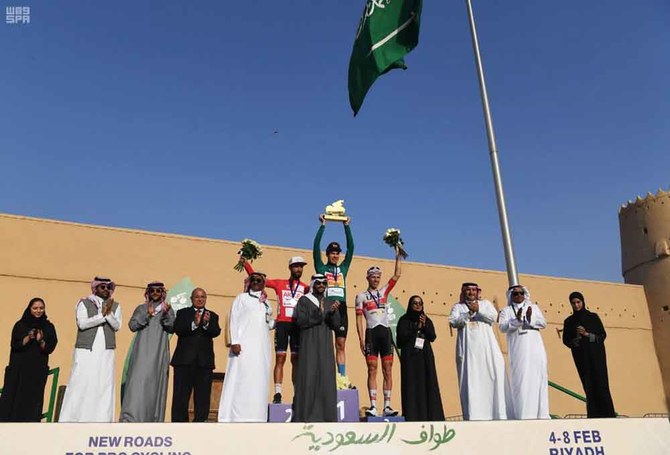
The Saudi Tour 2020 winners are pictured on stage after receiving their trophies from Saudi Cycling Federation chairman Subah bin Abdullah Al-Kraidees and International Cycling Federation vice president Wajih Azzam in Riyadh on Saturday. (SPA)
2 / 4
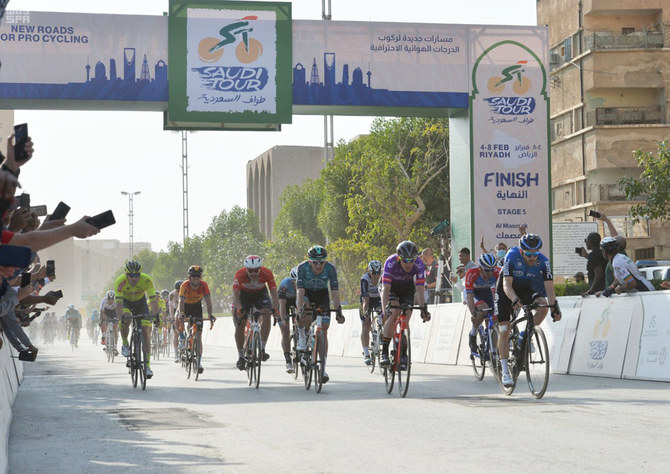
Germany's rider Phil Bauhaus of Bahrain McLaren crosses the finish line to win the third stage of the Saudi Tour in Riyadh on Saturday. (SPA)
3 / 4
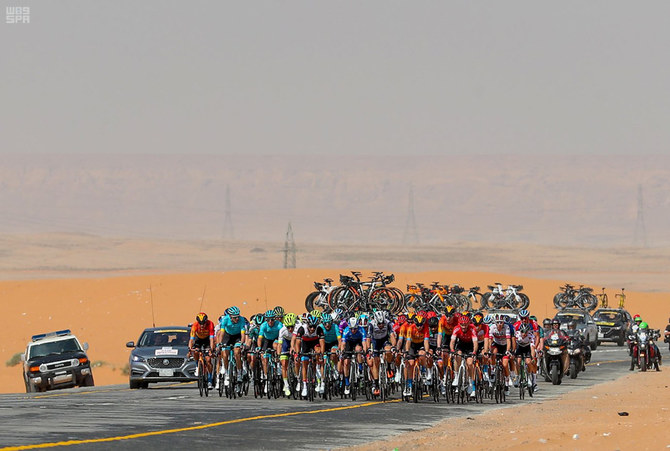
The pack rides during the fifth stage of the Saudi Tour in Riyadh on Feb. 8, 2020. (SPA)
4 / 4
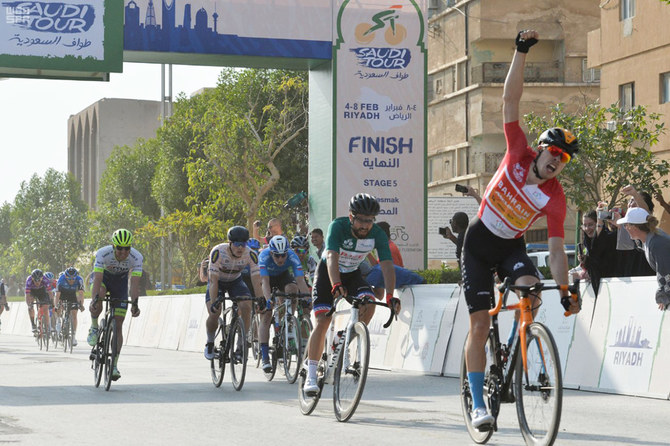
German cyclist Phil Bauhaus of the Bahrain-Mclaren team raises his hand in victory after crossing the finish line during the fifth and final stage of the Saudi Tour 2020 in Riyadh on Saturday. (SPA)
Short Url
Updated 09 February 2020
Follow

German cyclist Bauhaus wins Saudi Tour 2020  

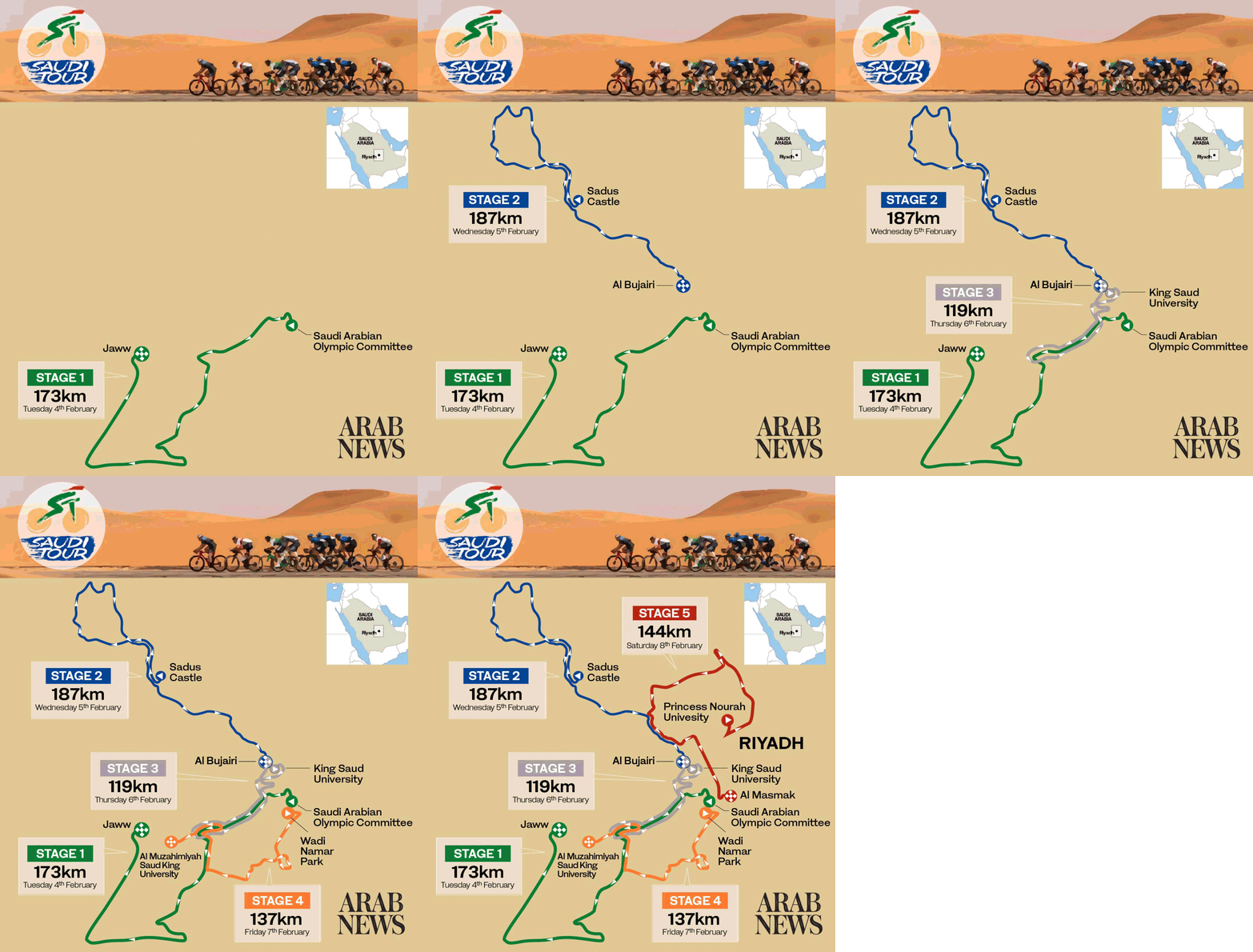
  • The final stage was a 144km run from Princess Nora Bint Abdul Rahman University to Riyadh's historic Masmak Palace

RIYADH: German cyclist Phil Bauhaus of the Bahrain-Mclaren team became the overall winner of the Saudi Tour 2020 after edging out Arkea Samsic team’s Nacer Bouhanni in a hectic finish on Saturday.

Bouhanni, who has joined the Arkea Samsic team this season, led Bauhaus by two seconds entering the fifth and last stage, a flat 144-kilometer run that started from Princess Nora Bint Abdul Rahman University and ended at the historic Masmak Palace in the heart of the capital, Riyadh.

Perfectly led out by his Bahrain team mates, the 25-year-old Bauhaus twice veered in the finishing straight leaving Bouhanni making angry gestures as he crossed the line second. 

Bauhaus gained a 10-second bonus to beat Bouhanni, who collected six seconds, by two seconds overall.
The Arkea Samsic team tweeted their disappointment.

“Two swerves by his opponent in the finish prevented Nacer Bouhanni from sprinting on this final stage @thesauditour,” they said, adding: “No demotion from the jury of referees.”

Portugal’s Rui Costa of team Emirates, who won the first stage, came in as third overall winner.

The winners were crowned by Subah bin Abdullah Al-Kraidees, chairman of the Saudi Cycling Federation, and Wajih Azzam, vice president of the International Cycling Federation. 

The fifth and last stage saw fierce competition from the beginning till the end of the race, due to the narrow time difference between cyclists. 

Bauhaus came first, completing the stage in 3:18:57, and was awarded the Green Jersey. 

Second came Bouhanni, completing the stage in 3:18:57, and was awarded the Red Jersey. 

Third came Arvid De Kleijn of the Danish team Riwal Readynez, completing the race in 3:18:57, while Andreas Lorentz Kron, of Riwal Readynez team was awarded the prize of best young cyclist and the “White Jersey.” 

Italian Cyclist Niccolo Bonifazio of the French team was awarded the “Polka Dotted Jersey.”

Riwal Readynez was awarded the prize of best team.


Fifth and final stage results
1. Phil Bauhaus (GER/BAH) 3hr 18min 57 sec 
2. Nacer Bouhanni (FRA/ARK) same time 
3. Arvid de Kleijn (NED/RIW) s.t. 
4. Timothy Dupont (BEL/CIR) s.t. 
5. Imerio Cima (ITA/GAZ) s.t.

Final overall standings
1. Phil Bauhaus (GER/BAH) 17 hr 53min 38sec
2. Nacer Bouhanni (FRA/ARK) at 2sec, 
3. Alberto Rui Faria Costa (POR/UAE) 13 sec 
4. Youcef Reguigui (ALG/TER) 22 sec 
5. Heinrich Haussler (AUS/BAH) 23 sec

(With AFP & SPA)


From Jeddah to the world stage: Bader Idrees and Saudi Arabia’s tennis rise

Updated 10 sec ago
Follow

From Jeddah to the world stage: Bader Idrees and Saudi Arabia’s tennis rise

RIYADH: As tennis continues to gain momentum throughout Saudi Arabia, several local players are beginning to emerge on the national and international scene. One of them is Saudi national team player Bader Idrees, whose journey mirrors the Kingdom’s evolving relationship with the sport.

Idrees’ first exposure to tennis came at a time when the local game was still developing. His interest began in early 2010 after watching his older sister train regularly.

“I was five years old when I used to watch my older sister playing tennis every day,” he told Arab News. “One of her coaches recommended that I try it out, and from the first hit, I fell in love with the sport.”

Now 20 years old, Idrees finds himself progressing alongside a country that is investing heavily in tennis. Over the past three months alone, Saudi Arabia has hosted the Six Kings Slam, the WTA Finals, and the Next Gen ATP Finals, an indication of its growing ambitions on the global tennis stage.

A defining moment in Idrees’ development came at the 2025 WTA Finals, where he reached a personal milestone in his role as a hitting partner for some of the world’s best players.

“It was one of the best experiences I’ve had so far,” he said. “To actually see the players and train with them was an eye-opening experience for me.”

The exposure offered by hosting elite tournaments has had a direct impact on aspiring Saudi athletes, providing valuable insight into the professional game.

“Seeing how players prepare for matches — from how they behave off the court to actually practicing on the court — was an amazing experience,” he said.

Beyond individual growth, Idrees believes the broader sporting ecosystem benefits from welcoming international events to the Kingdom.

“Hosting these events motivates every Saudi athlete,” Idrees said. “Foreign players get to know the country and the players who represent it, and it pushes us to perform better knowing that the world is watching.”

That motivation has translated into concrete goals. Idrees is planning a busy start to the year, with four international tournaments scheduled for January.

“I feel very positive about what I’ve accomplished so far, so hopefully I can kick off with a strong start in 2026.”

Despite recent progress, Idrees credits his early development at home as the foundation of his success.

“I don’t think I would be at this level if I weren’t in Saudi Arabia, and if I didn’t meet my coach Wajih there, who played a big role in my journey,” Idrees said.

To further advance his career, he later relocated to Cairo, where increased competition and exposure helped accelerate his development.

“That experience, combined with my coach’s motivation, made me believe I could truly go pro,” he said.

The journey was not without challenges. Idrees reflected on the limitations that once existed in the local tennis landscape.

“Tennis has grown massively in Saudi Arabia over the last few years,” he said. “But before that, we didn’t always have the best facilities or infrastructure. That’s why seeing the progress now makes me happy.”

Today, that transformation is happening at a rapid pace — something Idrees notices each time he returns home from international competition.

“Month by month,” as he puts it.

Whether in Riyadh, Jeddah, or Dammam, the changes are increasingly visible. Looking ahead, Idrees is optimistic about the next generation of Saudi players.

“I wouldn’t be surprised to see the kids playing at the under-10 and under-12 level find themselves in the top 500 or 300 within the next 10 years,” he said. “I see the discipline and motivation in them, and it truly is something special.”

He is also realistic about his own development compared with today’s young talents.

“I wasn’t at this level at 10, 12 years old,” he admitted. “Training with kids at that age now, I’m genuinely impressed. It’s why I’m feeling very positive about their future.”

With growing infrastructure, elite-level exposure, and rising ambition, Idrees’ story represents more than personal achievement. It highlights how Saudi Arabia’s expanding role as a host of global sporting events is reshaping its tennis landscape — and how a new generation of players may be poised to make an impact on the world stage in the years ahead.