

Saudi Arabia, Virgin Hyperloop One to conduct world’s first national hyperloop study

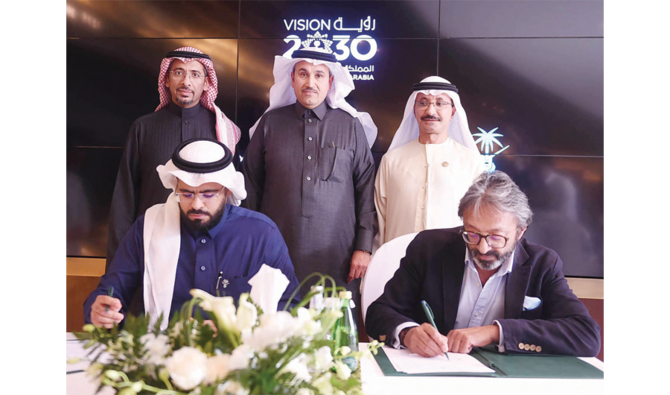
Officials witness the signing of an MoU in Riyadh. (AN photo/Basheer Saleh.)
Short Url
Updated 09 February 2020
Follow

Saudi Arabia, Virgin Hyperloop One to conduct world’s first national hyperloop study

  • It will examine viable routes, expected demand, explore socioeconomic impact

RIYADH: A groundbreaking study will be conducted to build the world’s longest hyperloop track,  the Ministry of Transport announced on Thursday.

It said an agreement with Virgin Hyperloop One (VHO), the world’s leading hyperloop company, would see a groundbreaking pre-feasibility study conducted on the use of hyperloop technology, laying the groundwork for a network of routes across Saudi Arabia.

The study is the first to be carried out anywhere in the world and will examine viable routes, expected demand, anticipated costs and explore the socioeconomic impact, such as the creation of jobs and environmental effects.

Speaking to Arab News, Harj Dhaliwal, VHO’s managing director for the Middle East, who signed the agreement with Khaled Al-Romaih, deputy minister for planning and information at the Ministry of Transport, said: “This is the first step, we want to create a solid foundation. The agreement with the ministry brings us one step closer to the realization of our vision for a connected Saudi Arabia and a connected Gulf.

“We have a vision for the Kingdom, and that vision is of connecting it and the Gulf with the ability to travel from Riyadh to Jeddah in 46 minutes, to Neom from Jeddah in 40 minutes, from Riyadh to Dammam and Jubail in 28 minutes, and to go beyond the Kingdom, from Riyadh to Abu Dhabi, in 48 minutes.      

“It’s not just about providing a future transportation system, it’s the ecosystem behind it. What we want to do is to be able to bring technology to the Kingdom to be able to share and develop that knowledge. We signed an agreement with King Abdullah Economic City in October last year specifically to look at manufacturing, how we can actually bring technology, and that is expected to create about 124,000 jobs.”

Saudi Minister of Transport Saleh Al-Jasser said: “Crown Prince Mohammed bin Salman has outlined the role of transport in shaping the future of the Kingdom’s economy within Vision 2030. As we enter a new decade, we intend to make rapid progress in building the infrastructure required to define mobility for the future, enabling the efficient movement of people and goods. With the transformative hyperloop technology, Saudi Arabia will not only unlock unparalleled benefits for its people and the economy but will continue to lead the region into an era of prosperity.”

Technology would play a pivotal role in the progress and transformation of the Saudi economy, added VHO Chairman Sultan Ahmed bin Sulayem.

Jay Walder, CEO of Virgin Hyperloop One, said: “The economic potential is enormous to connect passengers and cargo at unprecedented speeds with zero direct emissions. The system would be up to 10 times more energy efficient than short haul flights and 50 percent more efficient than high-speed trains. In fact, a hyperloop in the region could be powered entirely by solar panels which cover the tube, making the technology hugely attractive to the sun-abundant Kingdom.”


Prince Turki Al-Faisal reaffirms strong Saudi-UAE ties, urges reliance on official sources

Updated 4 sec ago
Follow

Prince Turki Al-Faisal reaffirms strong Saudi-UAE ties, urges reliance on official sources

  • Former intelligence chief is “hopeful” on Trump’s newly formed Board of Peace
  • Israel deploys double standards by supporting terror but then blaming others for it, he argues

SHURA ISLAND - RED SEA: Prince Turki Al-Faisal, chairman of the King Faisal Center for Research and Islamic Studies and former ambassador to both the UK and the US affirmed Saudi Arabia’s ‘brotherly relations’ with the UAE on Friday and urged people to “refer to official news sources from Saudi entities,” as opposed to posts on social media. 

“As we saw, Saudi officials reaffirmed the brotherly relations with the UAE. These ties are not only political but rooted in affection, family connections, and shared history,” he said. 

Speaking at the opening session during The Family Office's "Investing Is a Sea" summit, Al-Faisal said despite the noise on social media regarding the political disagreement between the UAE and Saudi Arabia on Yemen, the relationship between the countries is still strong he told told Arab News Editor-in-Chief, Faisal J. Abbas, who moderated the session. 

“Our relationship with the UAE is based on integration, not collision, and this principle applies across the GCC,” explained Al-Faisal.  

“Differences in opinion are natural, even within the European Union, but we hope social media users refrain from immorality in the dispute,” Abbas responded addressing those who resort to spreading hate and lies over social media platforms. 

Tensions between the two Gulf countries have escalated in December when the UAE backed and supplied the Yemeni Southern Transitional Council (STC) acted unilaterally in a secession bid by the Saudi border. The Saudi-led coalition to restore legitimacy in Yemen acted decisively, targeted what it says was an unauthorised military shipment to the STC, and demanded Abu Dhabi to withdraw all assets and personnel from Yemen. Shortly, after the UAE Defence Ministry issued a statement that it would comply, and that it supports Saudi security and stability. 

However, a social media war continued to be waged by commentators and social media users on both sides, leading many pundits to question whether there was any intention in either capital to end the rift. 

Speaking from Warsaw on Monday, Saudi Foreign Minister Prince Faisal bin Farhan said  despite the  “difference of view” between the two countries over Yemen, he insisted that their relationship was “critically important” but emphasised “that indeed is the case and the UAE has completely left the issue of Yemen.” 

“It is an important element of regional stability and therefore the Kingdom is always keen on having a strong, positive relationship with the UAE as a important partner within the GCC,” Prince Faisal told a press conference during his visit to Poland.

Two days later, Saudi Arabia’s Minister of Media Salman Al-Dossary denied in a social media post claims circulating online that the Kingdom had refused to receive Sheikh Tahnoun bin Zayed Al Nahyan, Deputy Ruler of Abu Dhabi and UAE National Security Adviser.

“Sheikh Tahnoun bin Zayed comes to the Kingdom whenever he wishes without the need for permission. Saudi Arabia is his home, and its leadership is his family,” Al-Dossary wrote.

The Family Office opening panel also discussed recent global developments. Prince Turki said he is hopeful the Board of Peace formed by US President Donald Trump will bring change.

“Saudi Arabia’s role in the Peace Council is continued support for Palestine, and Crown Prince Mohammed bin Salman’s statements in Washington all aim to convince the US that peace must be based on justice not selective principles,” said Al-Faisal.

Al-Faisal said one cannot grant Israel a “right to self-defense” while denying Palestinians the same right, when they are the ones under attack.

He added that Saudi Arabia’s position has always been establishing a Palestinian state before any normalization with Israel happens. 
Referring to Saudi Crown Prince Mohammed bin Salman’s visit to the White House in November of last year, Al- Faisal said the Kingdom’s position is grounded in justice and in the principles upon which the Kingdom of Saudi Arabia is founded.

On Israel, Prince Turki reiterated his views that Israel practices double standards both in its actions and rhetoric. 

Asked by Abbas to comment on a Times of Israel article, written by senior political correspondent Tal Schneider and published on 8 October 2023 which 
argued that Israel has paid the price on 7 October for Netanyahu’s 16 year policy of supporting Hamas and undermining the Palestinian Authority. 

“Don’t you think it is ironic that Israel publicly and hugely supports terrorism and then accuses others of doing the same?,” Abbas asked the former intelligence chief. 

Al-Faisal said there is a clear double standard portrayed by Israel when it accuses others of supporting Hamas and extremism as it is widely known to be one of Hamas’s biggest supporters.
“There is a saying in the Hijaz, where I was raised which says “He hit me, then cried and complained before I did.” Israeli leaders have mastered this tactic. Since Israel’s creation, it has portrayed itself as the victim whose rights were stolen. This propaganda machine has operated for eighty years,” he explained.
“I am not surprised when Netanyahu or his supporters claim today that Saudi Arabia is adopting an extremist stance toward Judaism or Israel. In reality, it is Israel’s actions, under Netanyahu’s leadership, that have led us to the current situation, where we witness genocide against Palestinians not only in Gaza but also in the West Bank,” said Al-Faisal.  
“Netanyahu recently stated that anyone wishing to normalize relations with Israel must acknowledge its “right to self-defense,” effectively granting Israel a license to sell out the Palestinians,” he added.