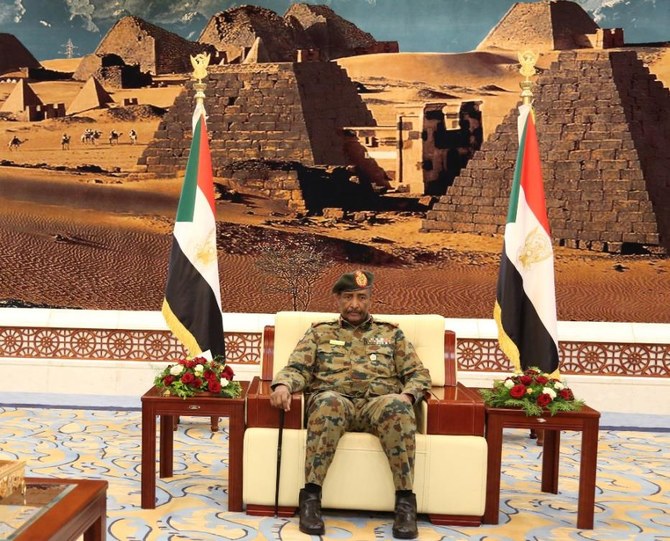
KHARTOUM: Sudan’s cabinet said Thursday that the country’s leader General Abdel Fattah Al-Burhan had made no promise to Israel’s prime minister of “normalizing ties” between the two countries.
Al-Burhan, who heads Sudan’s ruling sovereign council, met Israeli Prime Minister Benjamin Netanyahu for previously unannounced talks in Entebbe on Monday that appeared to signal an end to Sudan’s long-standing boycott of the Jewish state.
Soon after their meeting, Netanyahu announced that the two leaders had agreed to cooperate toward normalizing ties.
Sudan’s transitional cabinet said Thursday that meeting Netanyahu was Al-Burhan’s “personal initiative” and he had made no promises to the Israeli premier.
“The chief of the sovereign council told us ... he did not give any commitment and did not talk of normalizing relations,” government spokesman Faisal Mohamed Salih told reporters early Thursday.
“He did not give a promise of normalizing or having diplomatic relations.”
Salih said the issue of relations with Israel was something the current transitional government was not mandated to decide.
“This government has a very limited mandate. The issue of relations with Israel is beyond its mandate,” he said.
The transitional government headed by Prime Minister Abdalla Hamdok was formed months after the ouster of longtime despot Omar Al-Bashir amid nationwide protests in April last year.
Al-Burhan heads the ruling sovereign council, a joint civilian and military body tasked with overseeing the country’s transition to civilian rule.
Sudanese top brass have backed Al-Burhan’s initative in holding the meeting, saying it will help boost national security. The cabinet says it was not informed of the meeting in advance.
Sudan has long been part of a decades-old Arab boycott of Israel over its treatment of the Palestinians and its occupation of Arab lands.
After their meeting, Netanyahu’s office said the Israeli premier believed that post-Bashir Sudan was headed “in a positive direction.”
It said he and Al-Burhan had “agreed to start cooperation leading to normalization of the relationship between the two countries.”
The Palestine Liberation Organization called Al-Burhan and Netanyahu’s meeting “a stab in the back of the Palestinian people.”
On Thursday, veteran Sudanese politician Sadeq Al-Mahdi, who was prime minister when Al-Bashir seized power in a coup in 1989, spoke out against normalizing ties with Israel.
“We reject this meeting as it will impact our national interest negatively. We are against it strongly,” Al-Mahdi told reporters.
“We close the door completely for normalizing of relations with Israel.”


![]()

Sudan says Al-Burhan made no promises to Israel PM
Short Url
https://arab.news/4sdcq
Sudan says Al-Burhan made no promises to Israel PM
- Sudan’s transitional cabinet said Thursday that meeting Netanyahu was Burhan’s “personal initiative” and he had made no promises to the Israeli premier
- “The chief of the sovereign council told us ... he did not give any commitment and did not talk of normalizing relations,” a government spokesman said


Latest updates


© 2026 SAUDI RESEARCH & PUBLISHING COMPANY, All Rights Reserved And subject to Terms of Use Agreement.