

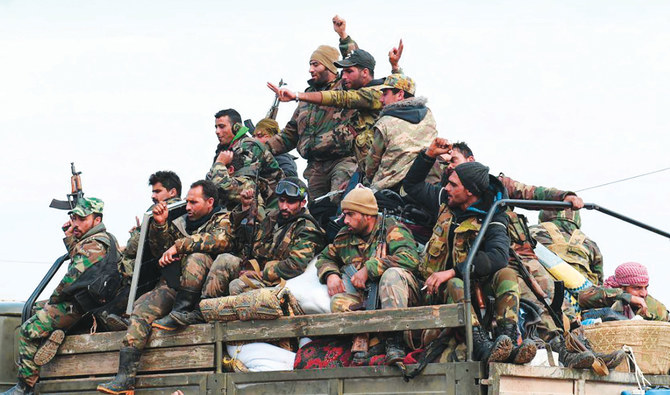

ANKARA: With Syrian regime forces surrounding the strategically significant town of Saraqib in Syria’s northwestern Idlib province, any decision by Ankara regarding its observation posts in and around the region will be critical.
The Turkish Army currently has 12 observation outposts in the province, set up in accordance with a 2018 agreement with Russia — and it recently built four observation points surrounding Saraqib, a town now encircled by regime troops. The majority of those posts are now behind enemy lines.
Saraqib is located at the junction of two main roads connecting Latakia and Damascus with Aleppo. If the town — which is also the outpost of the Jabhat Al-Nusra militant group in Idlib — falls under the control of Syrian forces, it will signal defeat for the armed rebel groups operating in the country’s north.
Halid Abdurrahman, a researcher and analyst on the Middle East and North Africa, said regime forces have not yet entered the town due to the presence of Turkish troops. “However, regime forces are still advancing in a comprehensive way,” he told Arab News. “I don’t think Turkey has many options at this point (beside military ones). There is a deep disagreement between Turkey and Russia because although Moscow backs regime troops on the ground, it shows a tactically calm attitude at the negotiation table.”
Regime forces encircled the town by traveling along the M4 highway and passing through western Saraqib. Dozens of rebels, along with officers from the Turkish army, are reportedly trapped inside the town.
On Monday, while reinforcing the observation points around Saraqib, Turkish troops came under fire, with eight killed.
The latest developments are likely to further escalate tensions between Turkey and the Assad regime. Russia’s support for regime forces in Idlib has also caused friction between Moscow and Ankara.
Oytun Orhan, coordinator of Syria studies at the Ankara-based think tank ORSAM, said Turkey is not likely to withdraw its observation posts from the zone because “they show the red lines of Ankara in Idlib after the fall of Maaret Al-Numan, another opposition stronghold.”
Orhan told Arab News: “(By encircling Saraqib), the regime forces want to trump … Turkey. Turkey can either use Russia as a mediator with the Assad regime to ask for withdrawal from the region, or use military means. I think Turkey will opt for the second option — try to create a military balance and retaliate against the regime offensive with artillery fire.”
But Orhan does not think Russia and Turkey will risk their mutual strategic benefits for the sake of their disagreement over Idlib.
“Diplomatic negotiations between Ankara and Damascus don’t seem a viable solution at this moment. Turkey may now use military means, despite Russian objections, because the cost of (failing to prevent) the advance of the regime is higher than the military risks it has,” he said.
Turkish President Recep Tayyip Erdogan has accused Russia of violating past agreements to reduce the fighting in Idlib, while the Kremlin blames Turkey for failing to fulfill several key commitments, including the withdrawal of armed groups from the region. Russian Foreign Minister Sergei Lavrov said on Tuesday that the death of Turkish soldiers a day before was partly Ankara’s fault.
Erdogan has kept the door of “military options” wide open. “We will not shy away from doing whatever is necessary, including using military force,” he recently said, although Damascus claims the presence of Turkish forces in the country is “illegal and a flagrant act of aggression.”
Aaron Stein, director of the Middle East program at the US-based Foreign Policy Research Institute, believes “Assad can overrun the Turkish military because they assume that Ankara will not bomb Russians.”
For Stein, “until Ankara signals it will change this, or risk killing lots of Russians, it has no leverage. Its best play, at this point, is to give up and focus on its own border.”
The UN Security Council held an emergency session about the situation in Idlib on Thursday, following requests from the US, Britain and France.
Regime troops seized more than 20 towns and villages from rebels on Tuesday and Wednesday alone, according to the UK-based Syrian Observatory for Human Rights.


