

Pakistan pledges to buy more Malaysian palm oil to compensate for India’s withdrawal

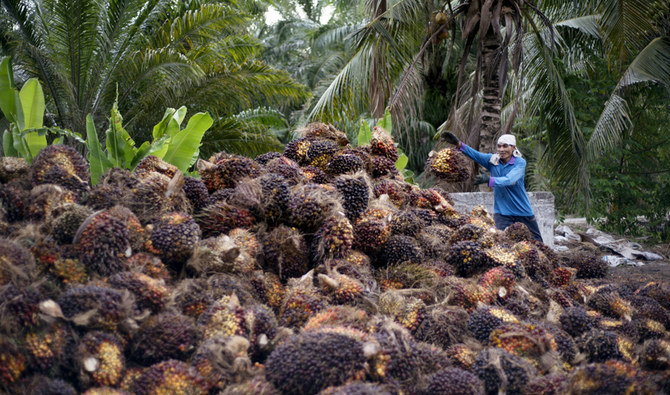
Pakistan will buy more palm oil from Malaysia, following controls imposed by the Indian government on refined palm oil imports. (Shutterstock)
Short Url
Updated 05 February 2020
Follow

Pakistan pledges to buy more Malaysian palm oil to compensate for India’s withdrawal

  • Aims to help offset lost sales after top buyer India put curbs amid a diplomatic row
  • Pakistan bought 1.1 million tons of palm oil from Malaysia last year

KUALA LUMPUR: Pakistan will buy more palm oil from Malaysia, Prime Minister Imran Khan said on Tuesday, aiming to help offset lost sales after top buyer India put curbs on Malaysian imports last month amid a diplomatic row.
India imposed restrictions on refined palm oil imports and informally asked traders to stop buying from Malaysia, the world’s biggest producer of the edible oil. Sources said the move was in retaliation for Malaysia’s criticism of India’s new religion-based citizenship law and its policy on Kashmir.
Malaysian Prime Minister Mahathir Mohamad said on Tuesday that he discussed palm oil with Khan who was on a visit to Malaysia and that Pakistan had indicated it would import more from Malaysia.
“That’s right, especially since we noticed India threatened Malaysia for supporting the Kashmir cause, threatened to cut palm oil imports,” Khan told a joint news conference, referring to India’s Muslim-majority region of Kashmir.
“Pakistan will do its best to compensate for that.”
India is a Hindu-majority country while Malaysia and Pakistan are mainly Muslim. India and Pakistan have been mostly hostile to each other since the partition of British India in 1947, and have fought two of their three wars over competing for territorial claims in Kashmir.
Pakistan may have bought around 135,000 tons of Malaysian palm oil last month, a record high, India-based dealers who track such shipments told Reuters on condition of anonymity.
The figure is close to estimates of 141,500 tons from Refinitiv, which show sales to India in January may have plunged 80% from a year earlier to 40,400 tons.
Malaysia will release official export data on Monday.
Pakistan bought 1.1 million tons of palm oil from Malaysia last year, while India bought 4.4 million tons, according to the Malaysian Palm Oil Council.
Malaysian palm oil futures rose on Tuesday after Khan’s comments and on expectations of a steep drop in production in January.

STRONG TIES
India has repeatedly objected to Mahathir speaking out against its move last year to strip Kashmir’s autonomy and make it easier for non-Muslims from neighboring Muslim-majority Bangladesh, Pakistan, and Afghanistan to gain citizenship.
At the news conference, Mahathir did not refer to Kashmir but Khan did.
“The way you, PM, have stood with us and spoken about this injustice going on, on behalf of Pakistan I really want to thank you,” Khan said.
He also said he was sad he had been unable to attend a summit of Muslim leaders in Malaysia in December. Saudi Arabia did not attend the summit, saying it was the wrong forum to discuss matters affecting the world’s Muslims and Khan belatedly pulled out.
Some Pakistani officials, unnamed because they were not authorized to speak to the media, said at the time that Khan pulled out under pressure from Saudi Arabia, a close ally, although local media reported his officials denied that was the reason for his absence.
“Unfortunately our friends, who are very close to Pakistan as well, felt that somehow the conference was going to divide the ummah,” Khan said, using the Arabic word for the Muslim community but not mentioning Saudi Arabia by name.
“It is clearly a misconception, as that was not the purpose of the conference.”


Islamabad says surge in aircraft orders after India standoff could end IMF reliance

Updated 22 min 17 sec ago
Follow

Islamabad says surge in aircraft orders after India standoff could end IMF reliance

  • Pakistani jets came into the limelight after Islamabad claimed to have shot down six Indian aircraft during a standoff in May last year
  • Many countries have since stepped up engagement with Pakistan, while others have proposed learning from PAF’s multi-domain capabilities

ISLAMABAD: Defense Minister Khawaja Asif on Tuesday said Pakistan has witnessed a surge in aircraft orders after a four-day military standoff with India last year and, if materialized, they could end the country’s reliance on the International Monetary Fund (IMF).

The statement came hours after a high-level Bangladeshi defense delegation met Pakistan’s Air Chief Marshal Zaheer Ahmed Baber Sidhu to discuss a potential sale of JF-17 Thunder aircraft, a multi-role fighter jointly developed by China and Pakistan that has become the backbone of the Pakistan Air Force (PAF) over the past decade.

Fighter jets used by Pakistan came into the limelight after Islamabad claimed to have shot down six Indian aircraft, including French-made Rafale jets, during the military conflict with India in May last year. India acknowledged losses in the aerial combat but did not specify a number.

Many countries have since stepped up defense engagement with Pakistan, while delegations from multiple other nations have proposed learning from Pakistan Air Force’s multi-domain air warfare capabilities that successfully advanced Chinese military technology performs against Western hardware.

“Right now, the number of orders we are receiving after reaching this point is significant because our aircraft have been tested,” Defense Minister Asif told a Pakistan’s Geo News channel.

“We are receiving those orders, and it is possible that after six months we may not even need the IMF.”

Pakistan markets the Chinese co-developed JF-17 as a lower-cost multi-role fighter and has positioned itself as a supplier able to offer aircraft, training and maintenance outside Western supply chains.

“I am saying this to you with full confidence,” Asif continued. “If, after six months, all these orders materialize, we will not need the IMF.”

Pakistan has repeatedly turned to the IMF for financial assistance to stabilize its economy. These loans come with strict conditions including fiscal reforms, subsidy cuts and measures to increase revenue that Pakistan must implement to secure disbursements.

In Sept. 2024, the IMF approved a $7 billion bailout for Pakistan under its Extended Fund Facility (EFF) program and a separate $1.4 billion loan under its climate resilience fund in May 2025, aimed at strengthening the country’s economic and climate resilience.

Pakistan has long been striving to expand defense exports by leveraging its decades of counter-insurgency experience and a domestic industry that produces aircraft, armored vehicles, munitions and other equipment.

The South Asian country reached a deal worth over $4 billion to sell military equipment to the Libyan National Army, Reuters report last month, citing Pakistani officials. The deal, one of Pakistan’s largest-ever weapons sales, included the sale of 16 JF-17 fighter jets and 12 Super Mushak trainer aircraft for basic pilot training.