Iran knew missiles downed Ukraine jet

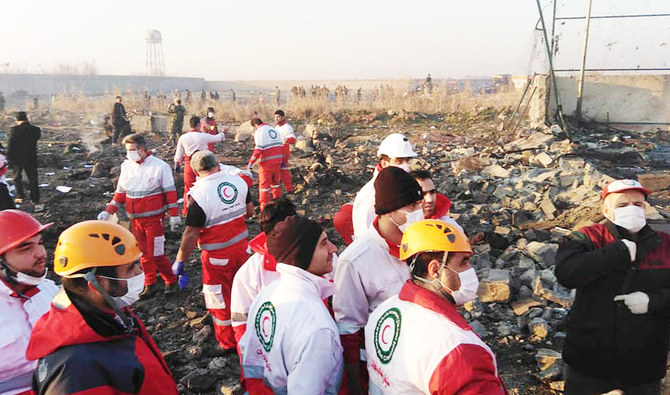
A handout picture provided by the Iranian Red Crescent on January 8, 2020 shows rescue teams working at the scene after a Ukrainian plane carrying 176 passengers crashed near Imam Khomeini airport in the Iranian capital Tehran. (AFP)
Short Url
Updated 05 February 2020
Follow

Iran knew missiles downed Ukraine jet

  • Appearing on Ukrainian television, President Volodymyr Zelenskiy confirmed the authenticity of the audio

LONDON: Despite early denials from Tehran, recently released leaked audio shows that officials must have been aware that a Ukrainian jet was hit by Iranian missiles as soon as it had happened.
Released on Sunday on Ukrainian television, the transcript exposes a damning conversation between air traffic control and the pilots of a separate Iranian plane that was in the area at the time and witnessed the events.
The Iranian pilots reported seeing missiles and an explosion, before asking whether the area was safe.
The transcript shows them asking: “Is this an active area? There’s lights like a missile. Is there anything?”
The controller replied: “Nothing has been reported to us. What’s the light like?” The pilot replied: “It’s the light of a missile.”
Minutes later, air traffic control lost all contact with the Ukrainian plane, and the Iranian pilots then reported seeing a “big light from an explosion.”
The Ukraine International Airlines jet was hit by two missiles, killing all 176 people on board.

HIGHLIGHT

Iran is said to have already been preventing Ukraine from probing black box recordings, and this move will make it more difficult for officials to piece together the facts.

In response to the release of the audio, Iran has said it will no longer share evidence with Ukraine to assist the investigation into the downing of the passenger plane.
Tehran initially denied any involvement in the incident, before admitting the plane was shot down by its missiles three days later.
Appearing on Ukrainian television, President Volodymyr Zelenskiy confirmed the authenticity of the audio and said it “proves that the Iranian side knew from the start that our plane had been hit by a missile.”
Iranian officials called the release of the audio a “secret” and a “strange move.”
Iran is said to have already been preventing Ukraine from investigating black box recordings, and this move will make it more difficult for officials to piece together the facts.
The handling of the incident within Iran prompted an outburst of anti-government rallies in cities and universities across the country.


Syria announces new currency framework, 2-zero redenomination

Updated 15 sec ago
Follow

Syria announces new currency framework, 2-zero redenomination

  • Under the plan, every 100 Syrian pounds will be converted into one unit of the new Syrian Arab Republic’s pound
  • Governor calls move ‘pivotal milestone within a comprehensive strategy’

DAMASCUS: Syria’s Central Bank announced executive instructions on Sunday to introduce a new Syrian currency, launching a monetary reform that includes removing two zeros from the pound and allowing a 90-day period of dual circulation.

The announcement was made during a press conference at the bank’s headquarters in Damascus.

Central Bank Gov. Abdulkader Husrieh said the step was part of a comprehensive institutional strategy to restore confidence and achieve sustainable economic stability.

He said: “The launch of the new currency is not a formal measure, but a pivotal milestone within a comprehensive strategy based on solid institutional foundations.”

Under the plan, every 100 Syrian pounds will be converted into one unit of the new Syrian Arab Republic’s pound. The old and new currencies will circulate together for 90 days, a period which may be extended.

All bank balances will be converted to the new currency at the beginning of next year, while the overall money supply will be maintained without increase or reduction.

Husrieh said the economic strategy was based on five pillars: monetary stability, a stable and transparent foreign-exchange market, effective and accountable financial institutions, secure digital transformation, and balanced international economic relations.

He said the move required updating financial laws and regulations, improving data systems, keeping pace with global digital developments, and ensuring sustainable financing and training for the financial sector.

The currency exchange will be provided free of charge, with no commissions, fees, or taxes.

All public and private entities must apply the official conversion standard to prices, salaries, wages, and financial obligations. Official exchange-rate bulletins will be issued in both currencies to ensure transparency and prevent speculation.

The governor said the central bank was closely monitoring markets to stabilize the exchange rate and would supply Syrian pounds if demand for foreign currency rises, adding that citizens will feel the impact more clearly after the exchange process is completed.

“Our policy is financial discipline, with no room for inflation,” Husrieh added.

He confirmed that the decree regulating the exchange limits the process to Syrian territory, and said the measures fell within the bank’s 2026-2030 strategy to align with international standards.

The new banknotes, he added, were being printed by leading international companies to prevent counterfeiting.