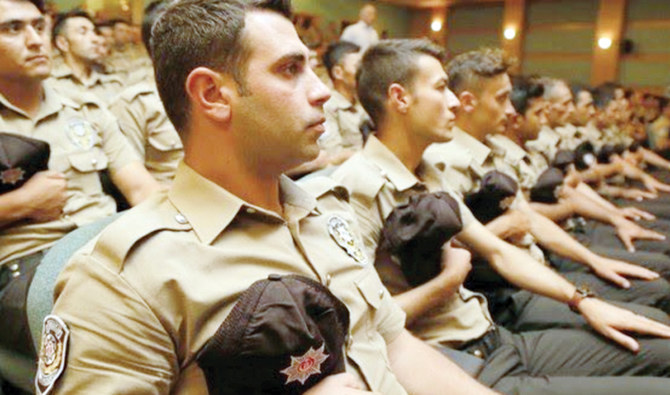
JEDDAH: Turkey is set to give extensive powers to neighborhood night watchmen to maintain public safety.
The move has stirred controversy over fears it might create an “unqualified” alternative police force with uncontrolled authority.
The use of night watchmen as armed, low-ranking police, known as bekçi in Turkish, has been in effect for decades, but their numbers and authority have risen since 2016’s failed coup as part of ever-increasing security measures.
In the past, watchmen were only assigned in southeastern Turkey, in the conflict zone between Turkish forces and the Kurdistan Workers’ Party (PKK).
Currently there are about 30,000 throughout the country. They are only required to have completed a middle school education in order to qualify for the post.
The ruling Justice and Development Party (AKP) recently submitted a draft bill to Turkey’s Parliament, granting night watchmen new powers to seek identification from people (including tourists), to possess firearms, raid houses, conduct body searches and detain people.
The bill is expected to be debated and voted on next week.
Although police forces are required to have “reasonable suspicion” to justify body searches, the current bill does not necessitate any criteria for watchmen, who do not benefit from the same professional training as police officers.
Queries have been raised over the jurisdiction of night watchmen, as well as the idea of unqualified individuals having the right to conduct body searches of women.
Emma Sinclair-Webb, director of Human Rights Watch Turkey, said the obvious concern was that equipping poorly trained night watchmen with extra powers to conduct identity checks and use firearms would result in abuse of those powers.
“What will be the oversight mechanisms to prevent such abuses being committed, and to discipline abusers? Weak and nontransparent oversight mechanisms are as much a concern as the actual powers the new law brings,” she told Arab News.
Human Rights Watch has documented examples of lack of oversight and lack of accountability for abuses committed by night watchmen in the past.
“I fear that we may be faced with a similar situation with night watchmen becoming an unaccountable force in big cities,” Sinclair-Webb said.
The watchmen will receive a five-month-long vocational training program, during which they will also learn how to use firearms.
They are mostly selected from the civilian population loyal to the AKP, and there is a growing concern that it might be used as a local militia against dissidents.
Former AKP lawmaker Mustafa Yeneroglu criticized the proposed bill, and said that such authority would result in severe human rights violations.


![]()

Turkey empowers night watchmen in the streets, but for what?
Short Url
https://arab.news/c47cs
Turkey empowers night watchmen in the streets, but for what?
- Queries have been raised over the jurisdiction of night watchmen, as well as the idea of unqualified individuals having the right to conduct body searches of women


Latest updates








© 2026 SAUDI RESEARCH & PUBLISHING COMPANY, All Rights Reserved And subject to Terms of Use Agreement.