

Saudi businesswomen in Forbes Middle East top five

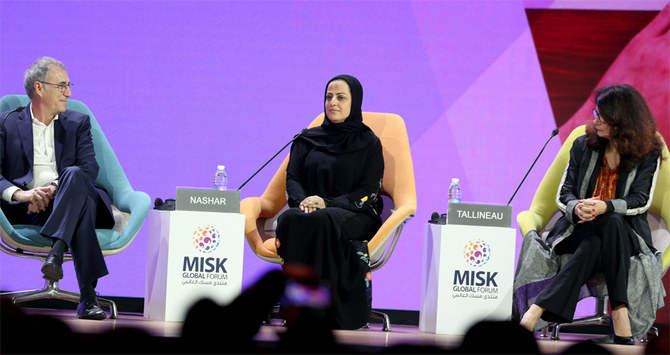
Samba Financial Group’s Rania Nashar, center, was ranked third on the Power Businesswomen in the Middle East list. (Supplied)
Short Url
Updated 05 February 2020
Follow

Saudi businesswomen in Forbes Middle East top five

  • Rania Nashar, Sarah Al-Suhaimi and Lubna Olayan find special place in the list of exceptional businesswomen

JEDDAH: Saudis dominate the Top 10 of Forbes annual Power Businesswomen in the Middle East list, with three of the country’s biggest names in the top five.

Samba Financial Group’s Rania Nashar is ranked third on the list, followed by Tadawul’s Sarah Al-Suhaimi and Saudi British Bank’s Lubna Olayan.

On the cusp of International Women’s Day next month, Forbes Middle East has unveiled its annual Power Businesswomen in the Middle East list, packed with 100 exceptional businesswomen at the head of many of the most influential and transformational companies in the region.

In the 2020 list, there are 22 new entries and 23 nationalities represented across 28 sectors. Emiratis are the most prevalent nationality with 23 entries. There are also nine Egyptians, eight Lebanese and eight Omani women.

The Forbes list was constructed via nominations and through in-depth research based on criteria including the size of the businesses that these women head, their accomplishments over the past year, the initiatives that they champion, and their overall work experience.

The majority (79) of the 100 women are self-made, 16 of whom have started their own businesses. And 21 women work in their family businesses, with many of them starting out when it was rare to find women in the workplace. There are 21 women from the banking and financial services sector, including four from stock exchanges and financial regulators.

FASTFACT

In the 2020 list, there are 22 new entries and 23 nationalities represented across 28 sectors. Emiratis are the most prevalent nationality with 23 entries. There are also nine Egyptians, eight Lebanese and eight Omani women.

The public sector is also well represented, with 13 women on the list heading government organizations, including Director General of Smart Dubai Aisha Bin Bishr, who is overseeing Dubai’s digital transformation. Sarah Al-Suhaimi chairs Tadawul, the region’s biggest stock exchange, which recently handled the IPO of the world’s most valuable company, Aramco.

Half of the list head large corporations, including Nadia Al-Saeed, who runs Jordan’s fourth biggest lender, Bank al Etihad, and Pakinam Kafafi, CEO of Egyptian energy company, Taqa Arabia, who is the only female leader in the oil and gas sector on the list.

The Middle East’s outstanding female leadership was reflected internationally in 2019 when Forbes’ list of the World’s 100 Most Powerful Women featured three women from this region — who now make up the top three. Raja Al Gurg (#84 on the Forbes list) manages her family’s business, which was first founded by her father. Indian national Renuka Jagtiani (#96 on the Forbes list) has built a retail empire in the UAE. And Rania Nashar (#97 on the Forbes list) became the first female CEO of Samba Financial Group in 2017, Saudi Arabia’s fourth-biggest bank by assets.

“These Arab women are not only driving economic growth in the region, but they are also representative of the Middle East’s strong female leadership and influence across all areas of life, from e-commerce to financial services,” said Khuloud Al-Omian, editor in chief of Forbes Middle East.

Industry leaders highlight Riyadh’s Metro, infrastructure as investment catalysts

Updated 29 December 2025
Follow

Industry leaders highlight Riyadh’s Metro, infrastructure as investment catalysts

RIYADH: Saudi Arabia’s capital, Riyadh, is experiencing a transformative phase in its real estate sector, with the construction market projected to reach approximately $100 billion in 2025, accompanied by an anticipated annual growth rate of 5.4 percent through 2029.

The Kingdom is simultaneously advancing its data center capacity at an accelerated pace, with an impressive 2.7 GW currently in the pipeline. This expansion underscores the critical role of strategic land and power planning in establishing national infrastructure as a cornerstone of economic growth.

These insights were shared by leading industry experts during JLL’s recent client event in Riyadh, which focused on the city’s macroeconomic landscape and emerging trends across office, residential, retail, hospitality, and pioneering sectors, including AI infrastructure and Transit-Oriented Development.

Saud Al-Sulaimani, Country Lead and Head of Capital Markets at JLL Saudi Arabia, commented: “Riyadh is positioned at the forefront of Saudi Arabia’s Vision 2030, offering unparalleled opportunities for both investors and developers. National priorities are continuously recalibrated to ensure strategic alignment of projects and foster deeper collaboration with the private sector.”

He added: “Recent regulatory developments, including the introduction of the White Land Tax and the rent freeze, are designed to stabilize the market and are expected to drive renewed focus on delivering premium-quality assets. This dynamic environment, coupled with evolving construction cost considerations in select segments, is fundamentally reshaping the market landscape while accelerating progress toward our national objectives.”

The event further underscored the transformative impact of infrastructure initiatives. Mireille Azzam Vidjen, Head of Consulting for the Middle East and Africa at JLL, highlighted Riyadh’s transit revolution. She detailed the Riyadh Metro, a $22.5 billion investment encompassing 176 kilometers, six lines, and 84 stations, providing extensive geographic coverage, with a depth of 9.8 km per 100 sq. km. This strategic development generates significant TOD opportunities, with properties in proximity potentially commanding a 20-30 percent premium. JLL emphasized the importance of implementing climate-responsive last-mile solutions to enhance mobility and accessibility, particularly given Riyadh’s extreme temperatures.

Gaurav Mathur, Head of Data Centers at JLL, emphasized the rapid expansion of the Kingdom’s AI infrastructure, signaling a critical area for technological investment and innovation.

Focusing on the construction sector, Maroun Deeb, Head of Projects and Development Services, KSA at JLL, explained that the industry is actively navigating complexities such as skilled labor availability, material costs, and supply chain dynamics.

He highlighted the adoption of Building Information Modeling as a key driver for enhancing operational efficiency and project delivery.