LJUBLJANA: Slovenia’s first mosque opened in the capital Ljubljana on Monday after surmounting financial hurdles and right-wing opposition, 50 years after the initial request to build was made.
Islamic community head Mufti Nedzad Grabus said the mosque’s opening was “a turning point in our lives.”
“Slovenia is the last former Yugoslav state to get a mosque, making Ljubljana a capital rather than a provincial town on the edge of the world,” he told a press conference.
Muslims in the predominantly Catholic Alpine country first filed a request to build a mosque in the late 1960s while Slovenia was still part of the former Communist Yugoslavia.
The community finally received permission 15 years ago, but ran into opposition from right-wing politicians and groups, as well as financial troubles.
Construction, which began in 2013, cost some 34 million euros ($39 million), out of which 28 million euros were Qatari donations, according to Grabus.
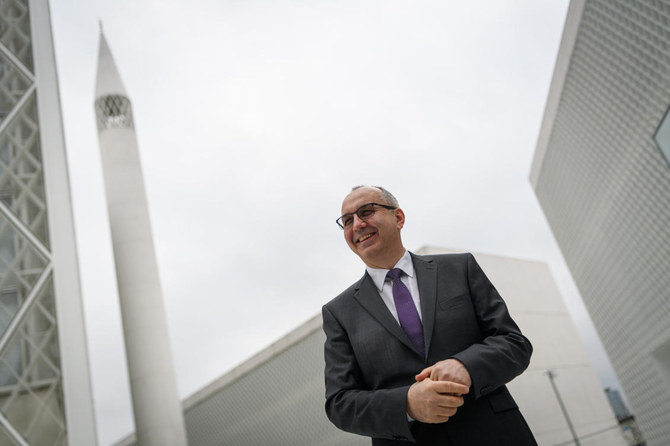
Situated in a semi-industrial area of Ljubljana, the mosque, which can hold up to 1,400 people, constitutes the core of the six-building Islamic Cultural Center.
The center also comprises the community’s offices; an education center, which includes a library; a restaurant; a basketball court; housing for the Muslim clerisy; and a 40-meter (131 feet) high minaret.
All the buildings are made from white concrete combined with steel, glass and wood. A large blue textile-made dome dominates the mosque’s interior, referring to heaven and reminiscent of famous mosques like Istanbul’s Blue Mosque.
“We wanted to link traditional Islamic architecture values with contemporary architecture,” architect Matej Bevk told AFP adding the center’s glass facades were meant to show its transparence and openness.
Until now, Muslims have been worshipping and holding ceremonies in rented sports halls or buildings.
They make up 2.5 precent of the country’s two million people, constituting the second biggest religious group, according to the last 2002 census. Grabus estimated there were around 80,000 Muslims currently.
Opponents of the project have twice tried to halt it, once in 2004 and again in 2009, by asking for a referendum. The constitutional court denied the requests both times.
Critics claim Qatar is one of the main financiers of terrorism.
Pig heads and blood were also tossed on the site in two incidents in 2016. Pigs are considered to be unclean and pork and its by-products forbidden under Islam.
Ljubljana’s long-time mayor Zoran Jankovic has supported the project.
Azra Lekovic, a Slovenian Muslim in her late 40s, described the mosque as “crucial,” saying her children, 22 and 24, had distanced themselves from the religion over the years.
“I hope it will allow my children to get in touch with the Islamic community again, to meet progressive people and find friends that share their religion,” the entrepreneur from Sezana in western Slovenia told AFP.


Slovenia’s first mosque opens after 50 years


https://arab.news/w75nd
Slovenia’s first mosque opens after 50 years


World of Coffee trade show capitalizes on Gulf’s strong coffee culture
DUBAI: Long regarded as the birthplace of coffee brewing, the Middle East is entering a new phase of cafe culture — and the fifth edition of World of Coffee, which takes place in Dubai from Jan. 18-20, will help drive that momentum.
Saudi Arabia alone is home to more than 5,100 branded cafes, with daily coffee consumption exceeding 36 million cups. Coffee is part of the social and cultural fabric, from traditional majlis gatherings to contemporary specialty cafes.
“Saudi Arabia’s coffee sector is evolving rapidly. There is increasing investment in quality, education, and presentation, alongside renewed interest in origin storytelling and cultural context,” said Shouq Bin Redha, exhibition manager for World of Coffee Dubai 2026, where Saudi Arabia will host a national pavilion.
“Saudi coffee has a very distinct identity rooted in heritage, ritual, and hospitality. Its profile is closely tied to traditional preparation methods and regional flavor preferences, which sets it apart on the global stage,” she told Arab News. “The national pavilion reflects this balance between tradition and modernization.”
Organized by DXB LIVE in partnership with the Specialty Coffee Association, World of Coffee Dubai has expanded dramatically, growing from 5,000 sq. meters in 2022 to more than 20,000 sq. meters in 2026. The event brings together producers, traders, roasters, cafe owners and innovators from around the world.
“At its core, the event is about bringing together the full coffee value chain in one place,” Redha said. “We want participants to leave not only having discovered new products or origins, but with stronger partnerships, clearer market insight, and a deeper understanding of how the industry is evolving.”
She added: “The Gulf has become an increasingly attractive market for producers because it combines strong consumer demand with a growing appreciation for quality, origin, and traceability.”
The UAE’s coffee market alone exceeds $3.2 billion, while Dubai continues to strengthen its position as one of the world’s most cafe-dense and diverse cities.
“Dubai, in particular, offers a unique gateway to multiple markets at once. For producers, World of Coffee Dubai provides direct access not only to local buyers, but to an international audience that uses the city as a regional and global trading hub,” Redha said.
When it comes to trends in the Gulf’s coffee scene, Redha said she expected to see “continued diversification in sourcing, with buyers exploring a broader range of origins and flavor profiles. There is also growing interest in coffees that offer greater transparency, whether through direct trade relationships, clearer traceability, or stronger sustainability credentials.”


