

Belgian court angers Turkey with PKK ruling

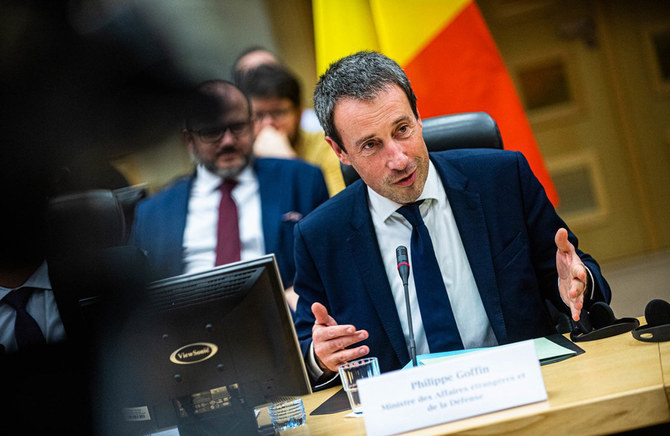
Belgium’s Foreign Minister Philippe Goffin said the government’s position was that the PKK was a terrorist organization. (Courtesy Twitter)
Short Url
Updated 30 January 2020
Follow

Belgian court angers Turkey with PKK ruling

  • The ruling from the country’s top appeal court blocked the prosecution of 36 suspects linked to the PKK
  • The PKK has waged an insurgency against Turkey for decades that has claimed the lives of around 40,000 people

JEDDAH: Turkey has condemned Belgium’s top appeal court for saying that the Kurdistan Workers’ Party (PKK) is not a terror group and that people affiliated to it cannot be prosecuted by anti-terror laws.

The Tuesday ruling from the country’s top appeal court, which ratified a ruling of a lower court from last March, blocked the prosecution of 36 suspects linked to the PKK and asserted that the group’s armed struggle was “Turkey’s own domestic dispute.”

The PKK has waged an insurgency against Turkey for decades that has claimed the lives of around 40,000 people. It is listed as a terror group by Turkey, the EU and the US. The Council of Europe also has the group on its terror list.

Belgium’s Foreign Minister Philippe Goffin said the government’s position was clear and that the PKK was a terrorist organization, but the ruling has upset Turkey.

The Turkish Foreign Ministry condemned the decision and said it was an “explicit attempt to undermine the law” and accused Belgium of “hypocrisy.” Foreign Minister Mevlut Cavusoglu tweeted that the decision was “hypocritical” and “political.”

Tens of millions of Kurds are scattered across Turkey, Iraq, Syria, Iran and Armenia but they do not have a state of their own. Attempts to set up their own state have been repressed, and the PKK was set up to fight for Kurdish independence in Turkey. 

“The decision of the court is the expression of the judiciary, which is strictly independent of the executive, and as such must be understood by all actors,” Goffin said. “Belgium will continue to defend the inclusion of the PKK and other Turkish terrorist groups on the European list of persons, groups and entities involved in terrorist acts and its judicial authorities will continue to cooperate with their European and other partners involved in the persecution of people at the PKK, as they have for years.”

Belgium’s ambassador to Turkey, Michel Malherbe, tweeted that the legal ruling was unconnected to the government’s position, and that the PKK “is and will continue to be” a terrorist organization.

Kurds in Belgium welcomed the court’s ruling, however, with community spokesman Orhan Kilic saying it would set new standards for further debate on the Kurdish issue and the actions of the Turkish state.

He also said Western governments and the EU may be in a better position to pressure Ankara for a peaceful solution.

Barin Kayaoglu, from the American University of Iraq Sulaimani, said the court decision would affect Belgium-Turkey relations.

“From now on, it is very unlikely that Belgium will receive any verbal or operational support from Turkey in counterterrorism,” he told Arab News. “Another side effect of this decision might be Turkey’s unwillingness to cooperate with the Belgian government in counterintelligence sharing to identify and track foreign fighters of Belgian nationality. Ankara has begun learning how to play hardball in recent years.”

The deadliest terror attack in Belgium was in Brussels in March 2016, when Daesh-claimed assaults killed 32 people and wounded hundreds of others.


India’s prime minister says it has reached a free trade deal with the EU

Updated 4 sec ago
Follow

India’s prime minister says it has reached a free trade deal with the EU

  • It touches a whopping 2 billion people and is one of the biggest bilateral engagements on commerce
  • The timing comes as Washington targets both India and the EU with steep import tariffs
NEW DELHI: Prime Minister Narendra Modi said Tuesday that India and the European Union have reached a free trade agreement to deepen their economic and strategic ties.
The accord, which touches a whopping 2 billion people, was concluded after nearly two decades of negotiations. It was dubbed the “mother of all deals” by both sides.
It is one of the biggest bilateral engagements on commerce. The timing comes as Washington targets both India and the EU with steep import tariffs.
“This agreement will bring major opportunities for the people of India and Europe. It represents 25 percent of the global GDP and one-third of global trade,” Modi said while virtually addressing an energy conference.
The deal comes at a time when Washington is targeting both India and the EU with steep tariffs, disrupting established trade flows and pushing major economies to seek alternate partnerships.
Modi was scheduled to meet with European Commission President Ursula von der Leyen later Tuesday to jointly announce the agreement.
India has stepped up efforts to diversify its export destinations as part of a broader strategy to offset the impact of higher US tariffs.
The tariffs include an extra 25 percent levy on Indian goods for its unabated purchases of discounted Russian oil, bringing the combined tariffs imposed by the United States on its ally to 50 percent.
The deal gives the EU expanded access to one of the world’s fastest-growing major economies, helping European exporters and investors to reduce their reliance on more volatile markets.
Bilateral trade between India and EU stood at $136.5 billion in 2024-25. The two sides hope to increase that to about $200 billion by 2030, India’s Trade Ministry officials said.
“Ultimately, the agreement is about creating a stable commercial corridor between two major markets at a time the global trading system is fragmenting,” said Indian trade analyst Ajay Srivastava.
The EU is still reeling from the aggressive approach of its once-stalwart ally across the Atlantic. There’s a widespread sense of betrayal across the 27-nation bloc from US President Donald Trump’s onslaught of higher tariffs, embrace of far-right parties, and belligerence over Greenland.
Brussels has accelerated its outreach to markets around the world: Over the past year, von der Leyen has signed deals with Japan, Indonesia, Mexico, and South America under the catchphrase “strategic autonomy,” which in practice is akin to decoupling from a US seen by most European leaders as erratic.
“We are showing a fractured world that another way is possible,” she posted on X after arriving in India on Sunday.