No coronavirus cases reported in the Middle East, say officials

A man wearing two face masks travels in the subway, as the country is hit by an outbreak of the new coronavirus, in Beijing, China January 26, 2020. (Reuters)
Updated 27 January 2020
Follow

No coronavirus cases reported in the Middle East, say officials

  • GCC airports introduce thermal screening of passengers arriving from countries where infections have been reported
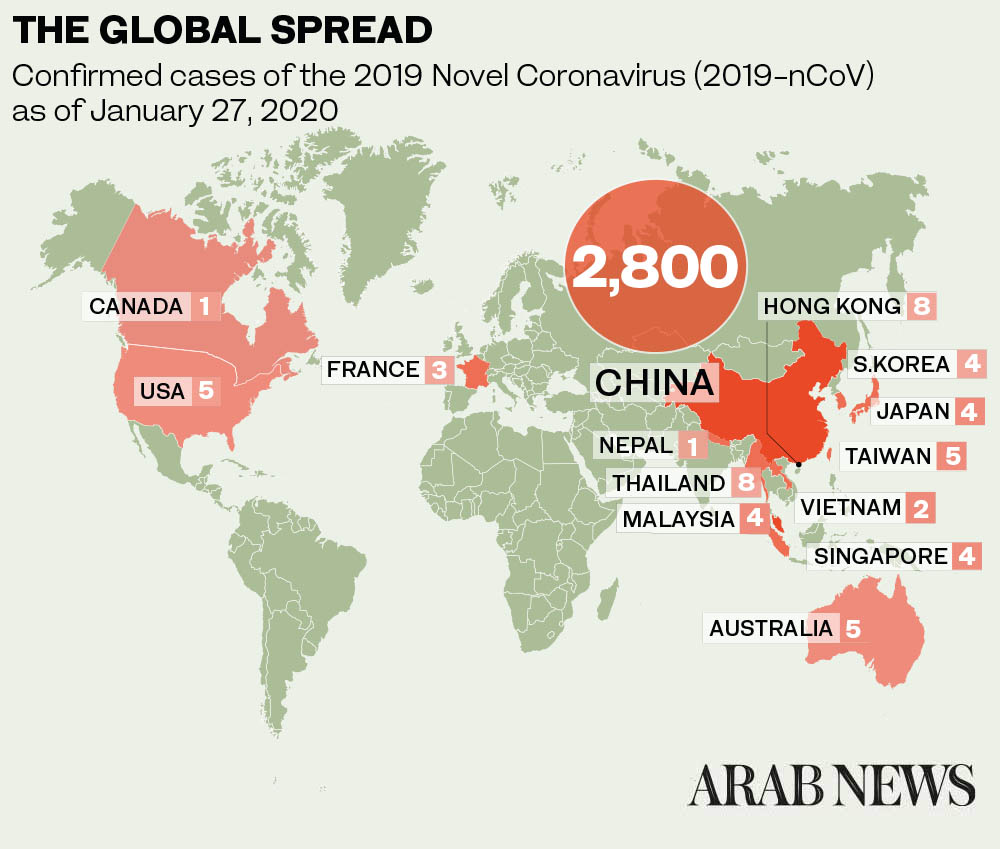
  • Close to 2,000 cases have been confirmed in China and 10 other countries, with 55 deaths reported so far

DUBAI: A coronavirus outbreak that has claimed the lives of at least 55 people in China and 10 other countries has not spread to the Middle East, according to government officials.

Although no cases have been detected in any of the GCC countries, governments are taking preventive measures, including mandatory screenings for passengers arriving from cities where infections have been reported.

Scientists have identified the new coronavirus strain as the 2019 Novel Coronavirus (2019-nCoV).

Officials have said passengers arriving from China will be screened for infections as a precautionary measure.

Like other coronaviruses, 2019-nCoV originated in animals but had not been identified in humans until the outbreak in Wuhan, in central China.

Coronaviruses are a large family of viruses that cause illness ranging from the common cold to more severe diseases such as Middle East Respiratory Syndrome (MERS-CoV) and Severe Acute Respiratory Syndrome (SARS-CoV).

As of Sunday, close to 2,000 2019-nCoV cases had been detected globally, with Canada confirming its first patient and Portugal declaring a “suspected” case of infection.

The outbreak in China came at a time where close to three billion trips were due to be made across the country – the “world’s largest annual human migration” - over a 15-day period, marking the occasion of the Lunar New Year on January 25.

On Sunday, Tawfiq Al-Rabiah, the Saudi Minister of Health, said steps to limit the spread of coronavirus were already in place, adding: “No cases of infection with the new coronavirus have been recorded in the Kingdom yet.”

Separately, Saudi Arabia’s National Center for Disease Prevention and Control (NCDC) has prepared a health guide to deal with suspected cases.
It has provided laboratory tests, set up a mechanism for collecting and transferring sample to its national laboratory and issued advice to passengers going to areas where the disease has appeared.

The Ministry of Health is coordinating with the country’s General Authority of Civil Aviation (GACA) and has advised those traveling to affected cities to avoid visiting any local markets where livestock is on display or products derived from animals are sold.

The ministry has said it is closely monitoring the epidemiological situation with the World Health Organization (WHO) and other available sources.

In another development, the Saudi Center for Disease Prevention and Control (Saudi CDC) debunked what it called infection rumors surrounding an Indian nurse working in a hospital in the Kingdom.

Saudi CDC confirmed via Twitter that no 2019-nCoV cases had been detected in the Kingdom, adding that new MERS infections had been reported by the Health Ministry, including three healthcare workers in Abha, in Asir region.

Separately, the UAE’s Health Ministry said on Sunday that no 2019-nCoV case has been reported in the country.

Nevertheless, thermal screening of passengers arriving from China has been introduced in both Dubai and Abu Dhabi airports to ensure the health and safety of travelers and residents in the country.

Airport authorities are said to be fully complying with the directive issued by the UAE’s Civil Aviation Authority, and also distributing informative booklets to travelers on the nature of the new virus and its symptoms.

Etihad Airways has also issued a circular waving fees for rebooking and cancelation of tickets to and from mainland China.

“Etihad Airways is closely monitoring the outbreak of the new coronavirus in China and coordinating its response with airport and health authorities in Abu Dhabi,” a statement issued by the carrier said.

Cleveland Clinic Abu Dhabi said it “can assure the community that, to date, no patients have been diagnosed with the 2019 Novel Coronavirus (2019-nCoV)," noting that “there are numerous forms of coronaviruses, including more prevalent human coronaviruses, and the majority of these are not considered public health risks.”

Two other GCC countries, Kuwait and Qatar, have begun screening passengers arriving from destinations where coronavirus infections have been reported.

In a statement, Kuwait’s Ministry of Health said: “Airport’s clinics and isolation rooms are well-equipped and thermal cameras have been added to border crossings.”

Infection with 2019-nCoV, which mimics symptoms similar to the common cold, can evolve to pneumonia.

However, medical experts believe the 2019-nCoV is less severe, contagious and deadly than the SARS virus, which first emerged in November 2002 and was contained by July 2003.

The SARS outbreak resulted in 8,098 infection cases and 774 deaths in 17 countries. Both SARS and MERS have no known cure as of today.


Zindani govt begins reshaping security leadership

Yemeni Prime Minister Shaya Al-Zindani. (File/SABA News Agency)
Updated 7 sec ago
Follow

Zindani govt begins reshaping security leadership

  • US backing for the Yemeni Presidential Leadership Council’s efforts

ADEN: Yemen’s government under Prime Minister Shaya Al-Zindani has begun implementing a series of decisions to restructure the leadership of the security services, in a move seen as a significant step toward reorganizing state institutions in the temporary capital, Aden.

It comes amid renewed US support for the Presidential Leadership Council’s efforts to bolster stability, combat terrorism and safeguard international maritime routes.

The chairman of Yemen’s Presidential Leadership Council, Rashad Al-Alimi, issued two presidential decrees appointing Brig. Gen. Abdulsalam Qaid Abdulqawi Al-Jamali as commander of the Special Security Forces and Brig. Gen. Abdulsalam Abdulrab Ahmed Al-Omari as head of the Civil Defense Authority, with both officers promoted to the rank of major general.

The decisions are part of a broader Yemeni effort to rebuild the leadership structure of security institutions, while strengthening the state’s capacity to enforce security and stability in liberated areas amid the country’s multiple security challenges.

Alongside the presidential decrees, Yemeni Interior Minister Ibrahim Haidan issued a series of leadership changes within Aden’s security services, including the reassignment of several security officials, as part of a plan aimed at improving operational efficiency and strengthening coordination among units.

The decisions included reassigning Brig. Gen. Jalal Al-Rubaie from his post as commander of the National Security Forces to lead the Special Security Forces in Aden, as well as appointing Brig. Gen. Mohammed Abdo Al-Subeihi as deputy director general of Aden Police and assistant for security affairs.

The appointments also included Brig. Gen. Jalal Fadl Al-Qutaibi as assistant director general of Aden Police for human resources and financial affairs; Brig. Gen. Mohammed Khaled Haidara Al-Turki as assistant director general for operations; Brig. Gen. Hassan Mohsen Saleh Al-Omari as director of the Criminal Investigation Department, with Col. Fouad Mohammed Ali appointed as his deputy; and Lt. Col. Mayas Haidara Al-Jaadani as director of the Anti-Narcotics Department.

The Yemeni Ministry of Interior said the measures are intended to reorganize field operations, raise security readiness levels, accelerate response time to threats and improve institutional discipline within security agencies. It believes the changes will help consolidate stability in the temporary capital of Aden and improve security and service performance in the city.

Yemeni-American Partnership

The government’s steps coincided with a meeting between Al-Alimi and US Ambassador to Yemen Steven H. Fagin, during which they reviewed the latest developments at the local level.

The two sides also discussed the US and international support required to strengthen Yemen’s capacity to confront security and terrorist threats, protect vital facilities and secure international shipping lanes, noting that this is an issue of regional and global priority amid escalating tensions

According to an official media source, Al-Alimi reiterated his appreciation of the Yemeni-American partnership and praised Washington’s role in supporting the implementation of resolutions to prohibit the smuggling of Iranian arms to the Houthi militia, drying up their funding sources and curbing destabilizing operations.

Al-Alimi highlighted the importance of reinforcing joint deterrence against regional threats, including the need to strictly enforce international sanctions and to pursue financing, smuggling and arms networks, in support of the government’s efforts to extend state control across all Yemeni territory.

He added that the security of the Red Sea and Bab Al-Mandab Strait is a global concern that requires broad international coordination.

Al-Alimi said that the Yemeni government is exerting efforts to normalize economic and service conditions, and to implement plans designed to integrate forces and unify security and military decision-making processes. He added that the Kingdom of Saudi Arabia supported these efforts, as it has played a pivotal role in advancing stability and rebuilding state institutions.