No coronavirus cases reported in the Middle East, say officials

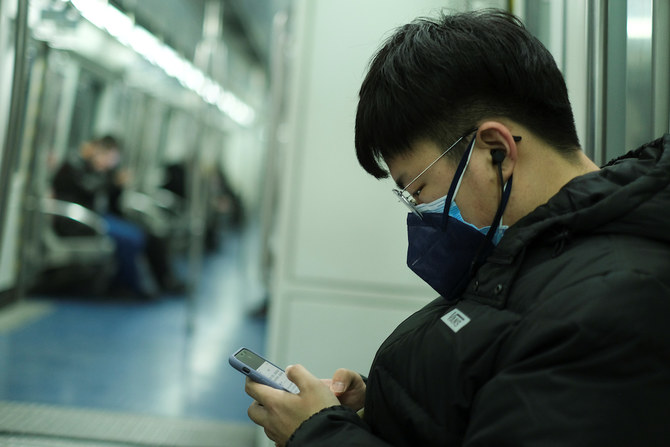
A man wearing two face masks travels in the subway, as the country is hit by an outbreak of the new coronavirus, in Beijing, China January 26, 2020. (Reuters)
Updated 27 January 2020
Follow

No coronavirus cases reported in the Middle East, say officials

  • GCC airports introduce thermal screening of passengers arriving from countries where infections have been reported
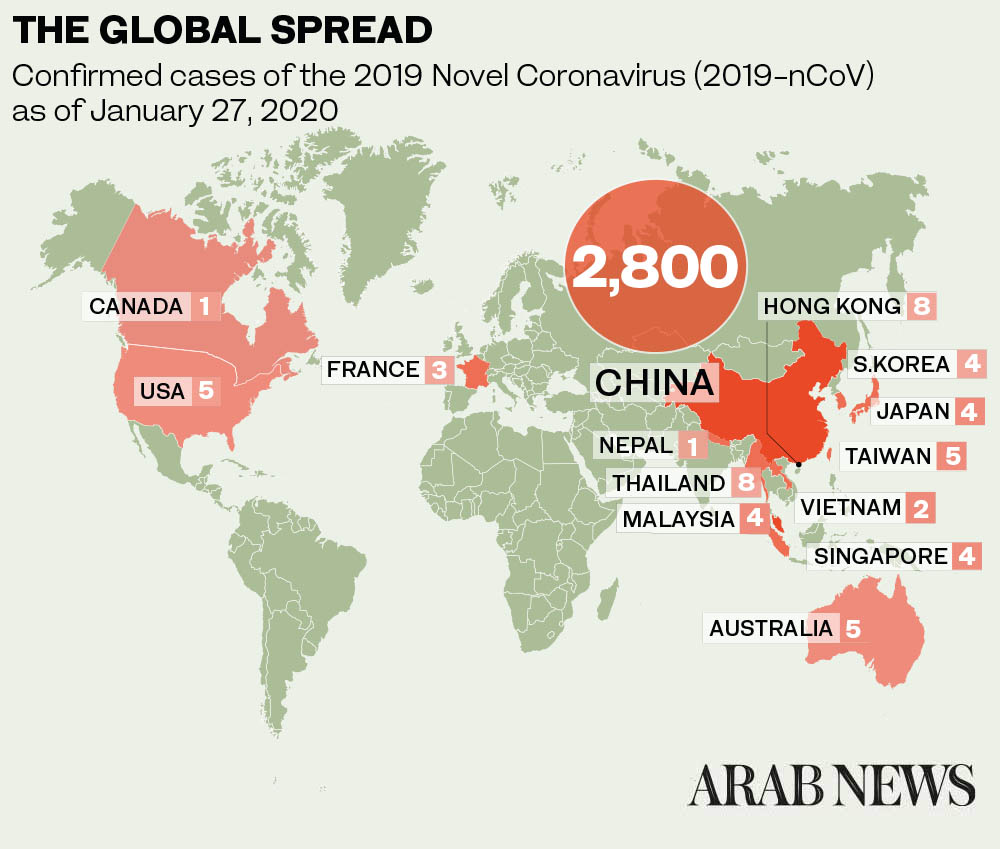
  • Close to 2,000 cases have been confirmed in China and 10 other countries, with 55 deaths reported so far

DUBAI: A coronavirus outbreak that has claimed the lives of at least 55 people in China and 10 other countries has not spread to the Middle East, according to government officials.

Although no cases have been detected in any of the GCC countries, governments are taking preventive measures, including mandatory screenings for passengers arriving from cities where infections have been reported.

Scientists have identified the new coronavirus strain as the 2019 Novel Coronavirus (2019-nCoV).

Officials have said passengers arriving from China will be screened for infections as a precautionary measure.

Like other coronaviruses, 2019-nCoV originated in animals but had not been identified in humans until the outbreak in Wuhan, in central China.

Coronaviruses are a large family of viruses that cause illness ranging from the common cold to more severe diseases such as Middle East Respiratory Syndrome (MERS-CoV) and Severe Acute Respiratory Syndrome (SARS-CoV).

As of Sunday, close to 2,000 2019-nCoV cases had been detected globally, with Canada confirming its first patient and Portugal declaring a “suspected” case of infection.

The outbreak in China came at a time where close to three billion trips were due to be made across the country – the “world’s largest annual human migration” - over a 15-day period, marking the occasion of the Lunar New Year on January 25.

On Sunday, Tawfiq Al-Rabiah, the Saudi Minister of Health, said steps to limit the spread of coronavirus were already in place, adding: “No cases of infection with the new coronavirus have been recorded in the Kingdom yet.”

Separately, Saudi Arabia’s National Center for Disease Prevention and Control (NCDC) has prepared a health guide to deal with suspected cases.
It has provided laboratory tests, set up a mechanism for collecting and transferring sample to its national laboratory and issued advice to passengers going to areas where the disease has appeared.

The Ministry of Health is coordinating with the country’s General Authority of Civil Aviation (GACA) and has advised those traveling to affected cities to avoid visiting any local markets where livestock is on display or products derived from animals are sold.

The ministry has said it is closely monitoring the epidemiological situation with the World Health Organization (WHO) and other available sources.

In another development, the Saudi Center for Disease Prevention and Control (Saudi CDC) debunked what it called infection rumors surrounding an Indian nurse working in a hospital in the Kingdom.

Saudi CDC confirmed via Twitter that no 2019-nCoV cases had been detected in the Kingdom, adding that new MERS infections had been reported by the Health Ministry, including three healthcare workers in Abha, in Asir region.

Separately, the UAE’s Health Ministry said on Sunday that no 2019-nCoV case has been reported in the country.

Nevertheless, thermal screening of passengers arriving from China has been introduced in both Dubai and Abu Dhabi airports to ensure the health and safety of travelers and residents in the country.

Airport authorities are said to be fully complying with the directive issued by the UAE’s Civil Aviation Authority, and also distributing informative booklets to travelers on the nature of the new virus and its symptoms.

Etihad Airways has also issued a circular waving fees for rebooking and cancelation of tickets to and from mainland China.

“Etihad Airways is closely monitoring the outbreak of the new coronavirus in China and coordinating its response with airport and health authorities in Abu Dhabi,” a statement issued by the carrier said.

Cleveland Clinic Abu Dhabi said it “can assure the community that, to date, no patients have been diagnosed with the 2019 Novel Coronavirus (2019-nCoV)," noting that “there are numerous forms of coronaviruses, including more prevalent human coronaviruses, and the majority of these are not considered public health risks.”

Two other GCC countries, Kuwait and Qatar, have begun screening passengers arriving from destinations where coronavirus infections have been reported.

In a statement, Kuwait’s Ministry of Health said: “Airport’s clinics and isolation rooms are well-equipped and thermal cameras have been added to border crossings.”

Infection with 2019-nCoV, which mimics symptoms similar to the common cold, can evolve to pneumonia.

However, medical experts believe the 2019-nCoV is less severe, contagious and deadly than the SARS virus, which first emerged in November 2002 and was contained by July 2003.

The SARS outbreak resulted in 8,098 infection cases and 774 deaths in 17 countries. Both SARS and MERS have no known cure as of today.


Syrian military tells civilians to evacuate contested area east of Aleppo amid rising tensions

Updated 15 January 2026
Follow

Syrian military tells civilians to evacuate contested area east of Aleppo amid rising tensions

  • Syria’s military has announced it will open a “humanitarian corridor” for civilians to evacuate from an area in Aleppo province
  • This follows several days of intense clashes between government forces and the Kurdish-led Syrian Democratic Forces

DAMASCUS: Syria’s military said it would open a corridor Thursday for civilians to evacuate an area of Aleppo province that has seen a military buildup following intense clashes between government and Kurdish-led forces in Aleppo city.
The army’s announcement late Wednesday — which said civilians would be able to evacuate through the “humanitarian corridor” from 9 a.m. to 5 p.m. Thursday — appeared to signal plans for an offensive in the towns of Deir Hafer and Maskana and surrounding areas, about 60 kilometers (40 miles) east of Aleppo city.
The military called on the Kurdish-led Syrian Democratic Forces and other armed groups to withdraw to the other side of the the Euphrates River, to the east of the contested zone.
Syrian government troops have already sent troop reinforcements to the area after accusing the SDF of building up its own forces there, which the SDF denied. There have been limited exchanges of fire between the two sides, and the SDF has said that Turkish drones carried out strikes there.
The government has accused the SDF of launching drone strikes in Aleppo city, including one that hit the Aleppo governorate building on Saturday shortly after two Cabinet ministers and a local official held a news conference there.
The tensions in the Deir Hafer area come after several days of intense clashes last week in Aleppo city that ended with the evacuation of Kurdish fighters and government forces taking control of three contested neighborhoods. The fighting killed at least 23 people, wounded dozens more, and displaced tens of thousands.
The fighting broke out as negotiations have stalled between Damascus and the SDF, which controls large swaths of northeast Syria, over an agreement to integrate their forces and for the central government to take control of institutions including border crossings and oil fields in the northeast.
Some of the factions that make up the new Syrian army, which was formed after the fall of former President Bashar Assad in a rebel offensive in December 2024, were previously Turkiye-backed insurgent groups that have a long history of clashing with Kurdish forces.
The SDF for years has been the main US partner in Syria in fighting against the Daesh group, but Turkiye considers the SDF a terrorist organization because of its association with the Kurdistan Workers’ Party, or PKK, which has waged a long-running insurgency in Turkiye. A peace process is now underway.
Despite the long-running US support for the SDF, the Trump administration has also developed close ties with the government of interim Syrian President Ahmad Al-Sharaa and has pushed the Kurds to implement the integration deal. Washington has so far avoided publicly taking sides in the clashes in Aleppo.
The SDF in a statement warned of “dangerous repercussions on civilians, infrastructure, and vital facilities” in case of a further escalation and said Damascus bears “full responsibility for this escalation and all ensuing humanitarian and security repercussions in the region.”
Adm. Brad Cooper, commander of US Central Command, said in a statement Tuesday that the US is “closely monitoring” the situation and called for “all parties to exercise maximum restraint, avoid actions that could further escalate tensions, and prioritize the protection of civilians and critical infrastructure.” He called on the parties to “return to the negotiating table in good faith.”
Al-Sharaa blasts the SDF
In a televised interview aired Wednesday, Al-Sharaa praised the “courage of the Kurds” and said he would guarantee their rights and wants them to be part of the Syrian army, but he lashed out at the SDF.
He accused the group of not abiding by an agreement reached last year under which their forces were supposed to withdraw from neighborhoods they controlled in Aleppo city and of forcibly preventing civilians from leaving when the army opened a corridor for them to evacuate amid the recent clashes.
Al-Sharaa claimed that the SDF refused attempts by France and the US to mediate a ceasefire and withdrawal of Kurdish forces during the clashes due to an order from the PKK.
The interview was initially intended to air Tuesday on Shams TV, a broadcaster based in Irbil — the seat of northern Iraq’s semi-autonomous Kurdish region — but was canceled for what the station initially said were technical reasons.
Later the station’s manager said that the interview had been spiked out of fear of further inflaming tensions because of the hard line Al-Sharaa took against the SDF.
Syria’s state TV station instead aired clips from the interview on Wednesday. There was no immediate response from the SDF to Al-Sharaa’s comments.