

Palestinians threaten to quit Oslo Accords over Trump peace plan

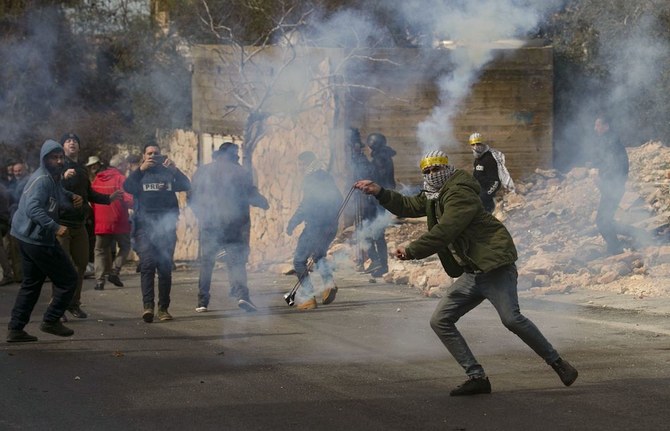
A Palestinian protester uses a sling shot to return a tear gas canister during clashes with Israeli troops in the occupied West Bank. (AFP)
Updated 27 January 2020
Follow

Palestinians threaten to quit Oslo Accords over Trump peace plan

  • Chief Palestinian negotiation Saeb Erekat told AFP that the Palestinian Liberation Organisation reserved the right "to withdraw from the interim agreement"

RAMALLAH: Palestinian leaders threatened Sunday to withdraw from key provisions of the Oslo Accords, which define arrangements with Israel, if US President Donald Trump announces his Middle East peace plan next week.
Trump was scheduled to unveil the plan ahead of his meeting in Washington this week with Israeli Prime Minister Benjamin Netanyahu.
Netanyahu, who has called Trump “the greatest friend that Israel has ever had,” said he hoped to “make history” in Washington this week.
But the Palestinian leadership was not invited to the talks and has rejected Trump’s initiative amid tensions with the US president over his recognition of Jerusalem as Israel’s undivided capital.
World powers have long agreed that Jerusalem’s fate should be settled through negotiations between Israel and the Palestinians.
Chief Palestinian negotiator Saeb Erekat told AFP that the Palestine Liberation Organization reserved the right “to withdraw from the interim agreement” of the Oslo pact if Trump unveils his plan.
The Trump initiative will turn Israel’s “temporary occupation (of Palestinian territory) into a permanent occupation,” Erekat said.
The Israeli-Palestinian Interim Agreement, signed in Washington in 1995, sought to put into practice the first Oslo peace deal agreed two years earlier.
Sometimes called Oslo II, the interim agreement set out the scope of Palestinian autonomy in the West Bank and Gaza.
The interim pact was only supposed to last five years while a permanent agreement was finalized but it has tacitly been rolled over for more than two decades.

Hamas leader Ismail Haniya warned Sunday Trump’s plan “will not pass” and could lead to renewed Palestinian resistance.
This “new plot aimed against Palestine is bound to fail” and could lead the Palestinians to a “new phase in their struggle” against Israel, the leader of the Gaza Strip’s Islamist movement said in a statement.
Haniya also called for talks in Cairo with other Palestinian factions, including Fatah — led by Palestinian president Mahmud Abbas — in order to form a common response to Trump’s plan.
Shortly after the release of Haniya’s statement, a rocket was fired from the Hamas-ruled Gaza Strip toward Israel, the Israeli army said.
Israel has occupied east Jerusalem and the West Bank since the 1967 Six-Day War.
More than 600,000 Israelis now live there in settlements considered illegal under international law.
The Trump administration last year announced that it no longer considered Israel’s settlement of civilians in the West Bank as “inconsistent with international law,” further outraging the Palestinians.
Trump’s peace initiative has been in the works since 2017, and its economic component was unveiled in June, calling for $50 billion in international investment in the Palestinian territories and neighboring Arab countries over 10 years.
Despite this apparent economic incentive, Palestinian leaders have made clear that they no longer recognize Washington’s historic role as mediator in the conflict, given Trump’s repeated backing of Israeli demands.
“The US administration will not find a single Palestinian who supports this project,” the Palestinian foreign ministry said in a statement on Sunday.
“Trump’s plan is the plot of the century to liquidate the Palestinian cause.”

Netanyahu’s political rival Benny Gantz has also received an invitation to attend the White House talks.
Gantz also showered Trump with praise during a news conference.
“I wish to thank President Trump for his dedication and determination in defending the security interests that both Israel and the US share,” Gantz said.
Trump’s planned separate meetings with Netanyahu and Gantz come a little more than a month before new Israeli elections, with polls showing Netanyahu’s right-wing Likud and Gantz’s centrist Blue and White party running neck-and-neck.
Israeli media speculated that Trump had chosen to unveil his plan in support of Netanyahu’s election bid — the third in a year, but the first since Netanyahu was charged with bribery, fraud and breach of trust in three separate corruption cases.
Netanyahu is seeking immunity from Israeli lawmakers through hearings due to start this week.
“Immediately after news of the [peace] plan was reported, it became plainly evident based on the reactions that this wasn’t a Trump plan, but a Bibi-Trump plot,” analyst Ben-Dror Yemini wrote in Sunday’s Yedioth Ahronoth newspaper.
“Yet another election ploy that was designed to extricate Netanyahu from the clutches of his immunity hearings.”


Ramadan lanterns: A symbol of celebration

Updated 3 sec ago
Follow

Ramadan lanterns: A symbol of celebration


Fady Francis

CAIRO: Muslims around the world are observing Ramadan, a month of dawn-to-dusk fasting, intense prayer and charity.

The holy month has long been associated with a rich tapestry of customs and traditions that define its unique celebrations.

Among the most prominent symbols of these festivities is the Ramadan lantern, a cherished emblem that illuminates streets and homes, reflecting the spiritual and cultural essence of the season.

In the historic districts of Cairo — such as Al-Hussein, Al-Azhar and Sayyida Zeinab — millions of Egyptians gather to celebrate Ramadan.

These neighborhoods are transformed into vibrant scenes of light and color, adorned with elaborate illuminations and countless Ramadan lanterns that hang across streets and balconies.

Vendors line the bustling alleys, offering a wide array of goods associated with the sacred month.

Foremost among these cherished items is the Ramadan lantern, which remains the most iconic and sought-after symbol of the season, embodying both tradition and festivity.

The lantern, in its earliest form, served as a vital source of illumination in ancient times.

Initially, torches crafted from wood and fueled with oils were used to light homes and pathways.

During the Middle Ages, Egyptians advanced their methods of lighting, developing oil lamps and decorative lanterns. In the Mamluk era, streets were illuminated on a wider scale, and artisans excelled in architectural innovation, producing intricately designed lanterns adorned with refined artistic motifs.

Gamal Shaqra, professor of modern history, told Arab News: “The story of the Ramadan lantern is widely traced back to the Fatimid era, with several narratives surrounding its origin. One account links it to Jawhar Al-Siqilli, the general who founded Cairo and built Al-Azhar Mosque, and to the arrival of Caliph Al-Muizz li-Din Allah in 969 A.D.

“According to this, Egyptians welcomed the Fatimid caliph by carrying lanterns to light his path, using them as both illumination and a gesture of celebration.”

He added: “Following this historic scene, lanterns began to be used to light streets and public spaces. Over time, the lantern evolved into a defining symbol of Ramadan festivities, as children took to the streets carrying their brightly lit lanterns and chanting traditional songs celebrating the holy month.

“The tradition continued to flourish during the Ayyubid and Mamluk periods, with lantern designs becoming increasingly diverse. In the era of Mohammad Ali, the craft saw further development, as lanterns were manufactured from metal sheets and fitted with colored glass, marking a significant evolution in both design and production.”

Methods of manufacturing the Ramadan lantern have diversified over time, alongside the evolution of its artistic designs in the modern era.

With the advancement of tools and technology, merchants have increasingly introduced wooden lanterns crafted using laser-cut techniques, offering intricate patterns and contemporary styles.

Despite these innovations, handcrafted lanterns continue to retain their distinctive value and authenticity. Made by skilled artisans, these traditional pieces remain deeply cherished, preserving the spirit of heritage and craftsmanship associated with the holy month.

Artist Mohamed Abla told Arab News that the design of the Ramadan lantern was inspired by the form of the mishkat — the ornate niche found in mosques that embodies Islamic art and traditionally serves as a source of illumination.

He added that the lantern had long been a subject for visual artists, who had depicted it in their paintings as a symbol of folk heritage and the enduring traditions associated with celebrating the holy month.

During a tour of popular marketplaces, a clear variation in lantern prices was noted, reflecting the craftsmanship and effort invested in their production.

In the tourist markets along Al-Moeaz Street, brass and bronze lanterns are prominently displayed in antique shops, showcasing elaborate designs that appeal to both visitors and collectors seeking traditional Ramadan decor.