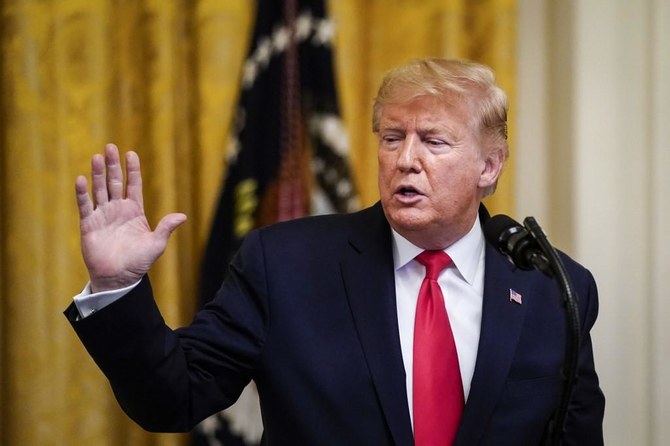
DUBAI: The United States will not lift sanctions on Iran in order to negotiate, US President Donald Trump tweeted late on Saturday, seemingly in response to a Der Spiegel interview with Iran’s foreign minister.
“Iranian Foreign Minister says Iran wants to negotiate with The United States, but wants sanctions removed. @FoxNews @OANN No Thanks!” Trump tweeted in English on Saturday and later in Farsi.
Iran’s Foreign Minister Mohammad Javad Zarif responded on Sunday by tweeting an excerpt from the interview with Der Spiegel published on Friday, where he said Iran is still open to negotiations with America if sanctions are lifted.
“@realdonaldtrump is better advised to base his foreign policy comments & decisions on facts, rather than @FoxNews headlines or his Farsi translators,” Zarif said in the tweet with the interview excerpt.
Tensions between Iran and the United States have reached the highest levels in decades after the US killed top Iranian General Qassem Soleimani in a drone strike in Baghdad on Jan. 3, prompting Iran to fire missiles days later at bases in Iraq where US troops are stationed.
Tensions between the two have been increasing steadily since Trump pulled the United States out of Iran’s nuclear pact with world powers in 2018 and reimposed sanctions that have driven down Iran’s oil exports and hammered its economy.
The deputy head of Iran's nuclear agency said in a report published on Saturday that Iran has the capacity to enrich uranium at any percentage if Iranian authorities decide to do so.
"At the moment, if (Iranian authorities) make the decision, the Atomic Energy Organization, as the executor, will be able to enrich uranium at any percentage," Ali Asghar Zarean said.
Iran said earlier this month it would scrap limitations on enriching uranium, taking a further step back from commitments to a 2015 nuclear deal with six major powers, but pledged to continue cooperating with the U.N. nuclear watchdog.
Since Iran took the latest step in reducing commitments to the accord, the country's stock of uranium produced has passed 1,200 kilograms and it will quickly be added to the stock of enriched uranium, Zarean said.
The United States says it aims to force Tehran to agree a broader deal that puts stricter limits on its nuclear work, curbs a ballistic missile program and ends regional proxy wars. Iran says it will not negotiate while sanctions remain in place.
Tehran has steadily been reducing its compliance with the deal, which prompted Britain, France and Germany to formally accuse it in mid-January of violating the terms and activating a dispute mechanism in the deal, which could eventually lead to the reimposition of U.N. sanctions.
Iranian Foreign Minister Mohammad Javad Zarif said last week that if Iran's nuclear file is sent to the U.N. Security Council, the country will withdraw from the Non-Proliferation Treaty (NPT), according to the official IRNA news agency.
Iran denies any intent to acquire nuclear weapons and says its breaches of the deal would be reversed if Washington lifts sanctions.


![]()

US will not lift sanctions to negotiate with Iran
Short Url
https://arab.news/5ff67
US will not lift sanctions to negotiate with Iran
- Zarif said Iran is still open to negotiations with US if sanctions are lifted
- Exchange comes after Iran says it has the capacity to enrich uranium at any percentage it likes


Latest updates


© 2026 SAUDI RESEARCH & PUBLISHING COMPANY, All Rights Reserved And subject to Terms of Use Agreement.