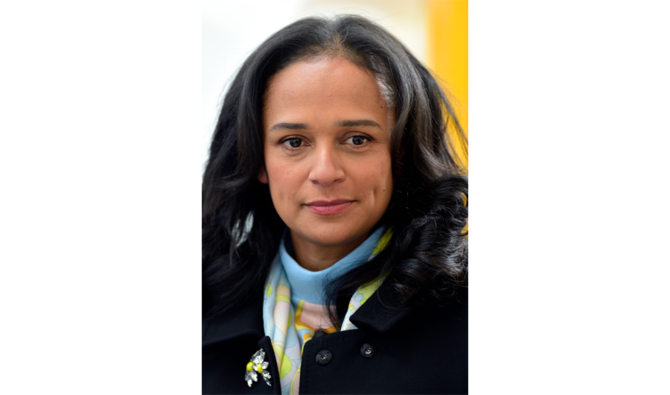

LUANDA: Allegations of corruption swirling around his predecessor’s daughter have set a crucial test for Angolan President Joao Lourenco in his vow to reform a country rich in oil and tainted by graft.
Isabel dos Santos, the 46-year-old billionaire daughter of ex-president Jose Eduardo dos Santos, is being probed for allegedly siphoning off millions from state companies and stashing the funds overseas.
Analysts say the mounting scandal raises the stakes — not just for the dos Santos family and elites who prospered during the ex-president’s 38-year rule, but also for Lourenco himself.
“A lot rests on this case,” said Berlin-based Transparency International’s southern Africa adviser, Mokgabo Kupe.
Dos Santos “is a symbol of the fight against corruption,” said Oxford University fellow and Angolan law professor Rui Verde.
“If (she) is charged, of course, everyone could be charged.”
Dos Santos was indicted this week for a host of financial crimes, including money laundering, influence peddling, harmful management and forgery of documents.
On Friday, Angolan Chief Prosecutor Helder Pitta Gros said funds that she invested in Portugal, the former colonial power, were transferred “by illicit means.”
FASTFACT
2.3bn
Forbes magazine estimates the wealth of Isabel dos Santos at $2.3 billion.
Lourenco’s adminstration is now looking into ways to bring her back home to face justice.
But how it intends to do that is unclear.
Dos Santos has been living in Europe since Lourenco fired her as head of the state oil company Sonangol in 2017, soon after he took over from her father.
The powerful businesswoman strongly denies the allegations, which she characterises as a witch hunt, and says her wealth is legitimate and earned the hard way.
On Thursday she vowed she was “ready to fight through the international courts to defend my good name” — an indication she would fight attempts to bring her to face trial.
To many in Angola, Isabel dos Santos became an emblem of the nepotism, cronyism and dissipated resources in her father’s decades in office.
She earned the nickname of “The Princess” for her wealth and lifestyle. Forbes magazine estimates her wealth at $2.3 billion.
Most of the country’s 30 million people are mired in poverty, failing wretchedly to benefit from the flood of dollars from crude oil and diamonds.
Angola is ranked at 146 out of 180 countries on Transparency International’s corruption perceptions index.
Today Lourenco’s government is under mounting pressure to attract foreign investment, and for this it needs to be seen as having well-functioning and corruption-free institutions.
But commentators say that if Lourenco wobbles and fails to secure a conviction against dos Santos, that could weaken his much-touted anti-corruption campaign.
Another closely-scrutinized question is how far the campaign will reach.
Isabel’s brother Filomeno dos Santos, who was the head of the country’s sovereign wealth fund, is currently on trial in Angola for corruption.