

Commercial truck art enters Pakistani drawing rooms

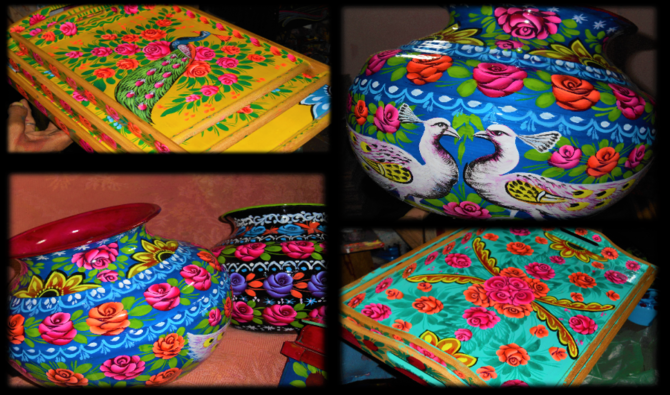
Shahzad Hussain's truck art on everyday objects. (AN photo)
Short Url
Updated 25 January 2020
Follow

Commercial truck art enters Pakistani drawing rooms

  • Truck art is trending in interior design and gift industries
  • Its charm lies in imperfection, says artisan

KARACHI: In a small room of a building located in Saddar neighborhood in the heart of Karachi, Shahzad Hussain, 46, is making final touches to a brightly colored teapot, a wedding present painted with famous Pakistani truck art patterns.

“I have got an order to color 500 kettles from a family that is planning to present it as a wedding gift to their guests,” Shahzad told Arab News while his three assistants were busy painting other orders with vivid colors.

Pakistan’s famous truck art continues to flourish not only on freight vehicles, but also as unique ornaments that attract much recognition worldwide.

Lively hand-painted patterns – often inscribed with poetry verses – drawings of Pakistan’s native flora and fauna, or caricatures of popular personalities, have for decades caught attention, especially on the country’s roads.

“We paint truck art designs on a variety of products that are not limited to only truck models. People come up with different items such as trays, pots, key chains, shoes to give them different colors,” Hussain said. “In fact, we have over 200 items on our list that are painted with truck art.”
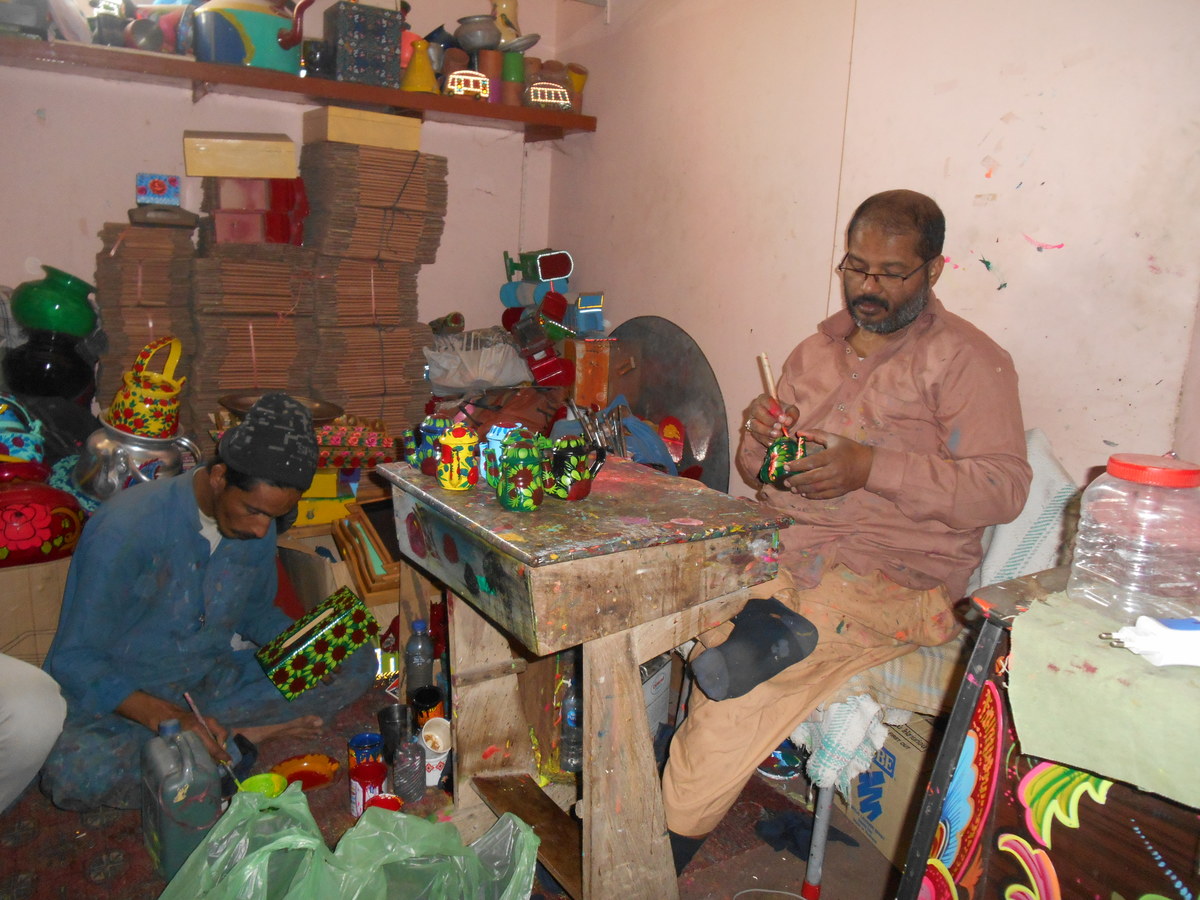


Truck artist Shahzad Hussain is painting a teapot with truck art ornaments at his shop in Saddar, Karachi on Jan. 22, 2020. (AN photo)

His customers are seasonal. In summers, he paints models of buses of all sizes, trucks and rickshaws, which are popular among foreign tourists. He also paints suitcases for between Rs1,500 and Rs10,000, wooden cases, lanterns, and photo frames.

The art is trending. In many Pakistani households, drawing rooms are considered incomplete without truck art-decorated objects.

Hussain’s works are also sold abroad, purchased mostly by handicraft sellers.

“We keep the aesthetic sense of customers in mind while painting. To survive in the business an artist must know the taste his clients,” the artisan argues and dismisses the impression that commercial artists are underpaid.

According to him, truck art should be promoted among the young and taught as a form of profession. “It takes at least five years to learn it. We need professional schools to promote the art,” he said, explaining that it must be handmade as machines, computers would lose its feel. It needs human imperfection.

“When you would try to make this work with all perfection, it will not look good,” he said.


Pakistan’s president defends ongoing strikes in Afghanistan, urges Kabul to dismantle militants

Updated 02 March 2026
Follow

Pakistan’s president defends ongoing strikes in Afghanistan, urges Kabul to dismantle militants

  • Afghanistan on Thursday launched attacks in retaliation for Pakistani airstrikes the previous Sunday
  • Pakistan’s military says it is only targeting Afghan military installations to avoid civilian casualties

ISLAMABAD: Pakistan’s president on Monday defended his country’s ongoing military strikes in neighboring Afghanistan, saying Islamabad tried all forms of diplomacy before targeting militants operating from Afghan territory, and called on the Taliban government in Kabul to disarm groups responsible for attacks in Pakistan.

Pakistan earlier said it is in “open war” with Afghanistan, alarming the international community. The border area remains a stronghold for militant organizations including Al-Qaeda and the Daesh (Islamic State) group.

“(The Afghan Taliban) must choose to dismantle the terror groups that survive on conflict and its war economy,” Asif Ali Zardari said during a speech to lawmakers, adding that “no state accepts serial attacks on its soil.”

Afghanistan on Thursday launched attacks in retaliation for Pakistani airstrikes the previous Sunday. Since then, Pakistan has carried out operations along the border, with Information Minister Attaullah Tarar claiming the killing of 435 Afghan forces and the capture of 31 Afghan positions.

Kabul has denied such claims.

In Afghanistan, the deputy government spokesman Hamdullah Fitrat said Pakistan’s military fired mortar shells at a refugee camp in eastern Kunar province, killing three children and injuring three others.

Afghanistan’s defense ministry said Afghan forces carried out strikes targeting a Pakistani military facility near Paktia province, causing “substantial losses and heavy casualties.”

Pakistan’s military did not respond to questions. It has said Pakistan is only targeting Afghan military installations to avoid civilian casualties.

Pakistan has witnessed a surge of violence in recent months and blames it on the outlawed Pakistani Taliban, known as Tehreek-e-Taliban Pakistan or TTP. It operates both inside Pakistan and from Afghan territory.
Islamabad accuses Afghanistan’s Taliban government of providing safe havens for the TTP, which Kabul denies.

The latest cross-border fighting ended a ceasefire brokered by Qatar and Turkiye in October. The two sides failed to reach a permanent agreement during talks in Istanbul.

Zardari reiterated Pakistan’s call for talks, saying, “We have never walked away from dialogue.”

The Pakistani leader again accused Afghanistan of acting as a proxy for India by sheltering militant groups.

“Stop being used by another country as a battlefield for their ambitions,” he said.

Zardari cited a recent report from the United Nations Security Council’s monitoring team that described the presence of militant groups in Afghanistan as an extra-regional threat.