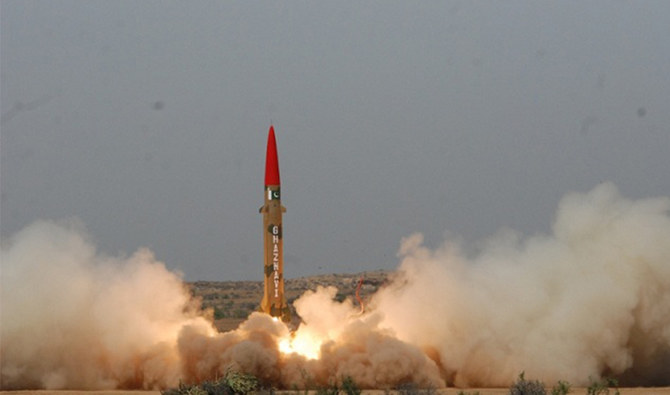
Pakistan tests surface-to-surface ballistic missile

Pakistan has conducted a “successful” training launch of the Ghaznavi, a surface-to-surface ballistic missile capable of carrying conventional and nuclear warheads up to a range of 290 kilometer on Jan 23, 2020. (File photo by ISPR)
Short Url
Updated 23 January 2020
Follow

Pakistan tests surface-to-surface ballistic missile

  • Ghaznavi is capable of carrying both conventional and nuclear warheads
  • Troops commended for handling the potent weapon system — says ISPR

ISLAMABAD: Pakistan on Thursday conducted a “successful” training launch of the Ghaznavi, a surface-to-surface ballistic missile that is capable of carrying both conventional and nuclear warheads up to a range of 290 kilometers, according to a statement released by the army’s media wing, Inter-Services Public Relations (ISPR).

“The training launch was part of Field Training Exercise of Army Strategic Forces Command aimed at rehearsing operational readiness procedures during day and night,” the statement said.

Strategic Plans Division Force (SPD) director general Lt. Gen. Nadeem Zaki Manj and other senior officials, including scientists and engineers, oversaw the launch on Thursday.

Gen. Manj appreciated the operational preparedness of the Army Strategic Forces Command and “expressed full confidence in the robust Strategic Command and Control System and the capability of Strategic Forces,” the statement read.



Security forces kill four militants in Pakistan’s volatile southwest, military says

Updated 13 January 2026
Follow

Security forces kill four militants in Pakistan’s volatile southwest, military says

  • Balochistan, Pakistan’s largest province by land area bordering Iran and Afghanistan, has long been the site of a low-level insurgency
  • The Balochistan government has recently established a threat assessment center to strengthen early warning, prevent ‘terrorism’ incidents

ISLAMABAD: Pakistani security forces gunned down four militants in an intelligence-based operation in the southwestern Balochistan province, the military said on Tuesday.

The operation was conducted in Balochistan’s Kalat district on reports about the presence of militants, according to the Inter-Services Public Relations (ISPR), the Pakistani military’s media wing.

The “Indian-sponsored militants” were killed in an exchange of fire during the operation, while weapons and ammunition were also recovered from the deceased, who remained actively involved in numerous militant activities.

“Sanitization operations are being conducted to eliminate any other Indian-sponsored terrorist found in the area,” the ISPR said in a statement.

There was no immediate response from New Delhi to the statement.

Balochistan, Pakistan’s largest province by land area bordering Iran and Afghanistan, has long been the site of a low-level insurgency involving Baloch separatist groups, including the Balochistan Liberation Army (BLA) and the Balochistan Liberation Front (BLF).

Pakistan accuses India of supporting these separatist militant groups and describes them as “Fitna Al-Hindustan.” New Delhi denies the allegation.

The government in Balochistan has also established a state-of-the-art threat assessment center to strengthen early warning and prevention against “terrorism” incidents, a senior official said this week.

“Information that was once scattered is now shared and acted upon in time, allowing the state to move from reacting after incidents to preventing them before they occur,” Balochistan Additional Chief Secretary Hamza Shafqaat wrote on X.

The development follows a steep rise in militancy-related deaths in Pakistan in 2025. According to statistics released by the Pakistan Institute for Conflict and Security Studies (PICSS) last month, combat-related deaths in 2025 rose 73 percent to 3,387.

These included 2,115 militants, 664 security forces personnel, 580 civilians and 28 members of pro-government peace committees, the think tank said.