Who’s afraid of the big bad wolf? Not Rami, the Saudi who has seven as pets

1 / 9
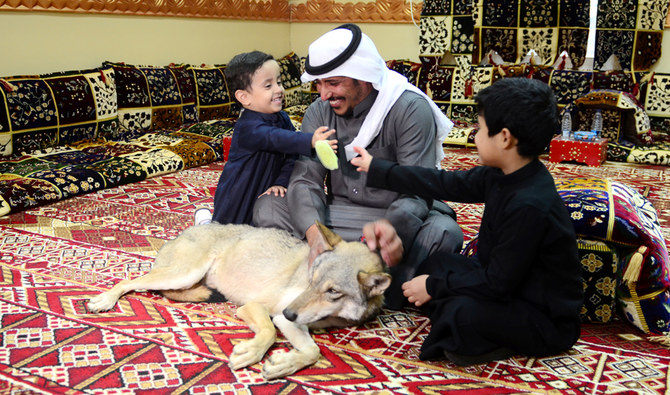
Rami Al-Sarhan, an employee of a money transfer company, sits with his sons and his wolf ‘Adeem’ in the traditional majlis at his farm in Al-Jouf. (Reuters)
2 / 9
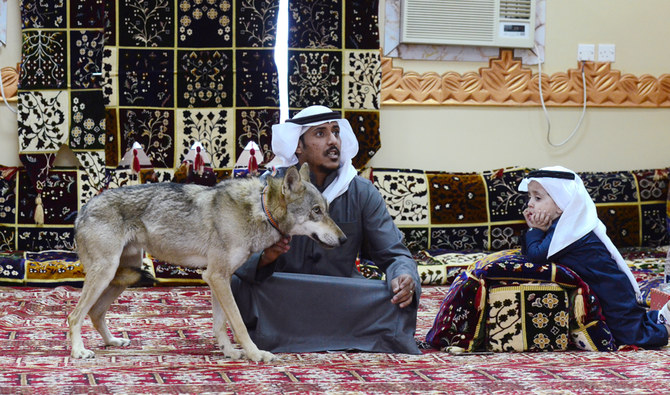
The carnivores as being kept as family pets. (Reuters)
3 / 9
The carnivores as being kept as family pets. (Reuters)
4 / 9
The carnivores as being kept as family pets. (Reuters)
5 / 9
The carnivores as being kept as family pets. (Reuters)
6 / 9
The carnivores as being kept as family pets. (Reuters)
7 / 9
The carnivores as being kept as family pets. (Reuters)
8 / 9
The carnivores as being kept as family pets. (Reuters)
9 / 9
The carnivores as being kept as family pets. (Reuters)
Updated 23 January 2020
Follow

Who’s afraid of the big bad wolf? Not Rami, the Saudi who has seven as pets

  • At home with the Saudi man who has four young children … and a pack of ferocious carnivores as the family pets

AL-JOUF: Guests visiting Rami Al-Sarhan’s home in Al-Jouf are understandably concerned when he asks if they would like to stroke the family pets.

These “pets” are not Tiddles the cat and Fido the dog — they are seven fully grown adult wolves.

The normally ferocious creatures make ideal domestic companions, Rami, 30, assured Arab News. And he has no fears for the safety of his young children, aged 8, 6, 4 and 3.

“The wolves literally live with us in the same home,” he said. “They eat with us and follow us when we go to the farm, and even sit with us in the same room when we have guests over.

“They have grown accustomed to our life and do not attack anyone who sits with us, even if they are a stranger.”

His friendship with wolves started about 11 years ago when an uncle started taking them into his home. Rami began studying them and their behavior, which he can now predict with considerable accuracy. The wolves are friendly and pose no danger to humans if handled properly with the correct precautions, he said.

Although they are wild animals, wolves can adapt to a domestic environment and one of the best ways to gain their trust was to share food and eat with them, Rami said.

FASTFACT

Food should be given to wolves without getting too close or interacting directly with them.

However, he is careful not to feed them raw meat, and he keeps his distance from the wolves during the winter mating season, which can last for two weeks.

Food should be given to wolves without getting too close or interacting directly with them, Rami said. “They are naturally ferocious but can be hostile and defensive if someone gets close to them. A wolf eats its prey but gets defensive if it gets attacked.”

Rami is also dismissive of the many superstitions that surround the animals, such as the one about wolves eating jinn. “What is funny is that many people come to me and ask me to give them strands of wolf hair so they can put it on the body of a ‘jinn-haunted’ person for healing” he said. “These are superstitions and do not make any sense.”

However tame a wolf might appear, Rami said, people should always remain cautious around them, study their every move, and avoid doing anything to scare them.

“Most importantly, show your respect to wolves and let them know that you recognize and respect them in order to be friends with you.”

Despite his assurances, if Rami ever invites you to his home “for dinner,” it might be as well to seek confirmation: “Am I eating … or am I the first course?”


Saudi chef wins culinary competition

Updated 18 December 2025
Follow

Saudi chef wins culinary competition

  • Event aimed to empower chefs’ ability to showcase talent on global scale 
  • Bayan Abdullah Al-Sudani: It (has) encouraged me to participate in more challenging spaces

RIYADH: A Saudi has won the Saudi Elite Chefs competition at Horeca Riyadh.

The event, which was organized by the Culinary Arts Commission of the Ministry of Culture, in alignment with the ministry’s long-term goals, aimed to empower Saudi chefs’ ability to showcase their talent and creativity on a global scale.

Speaking to Arab News, the winner, Bayan Abdullah Al-Sudani, shed light on how the competition equipped her with confidence for the future, saying: “It was a big challenge, and I faced off against strong chefs. It (has) encouraged me to participate in more challenging spaces.”

On her future plans, Al-Sudani wants to give back to the industry, and added: “I look forward to opening the Bayan Academy soon so that I can support chefs and help them with the pastry sector specifically.”

Celebration and achievement were echoed throughout, and it was evident at the event that the culinary industry in the Kingdom is hungry for growth, recognition, and global competition.

Seba Zarea, general manager of strategy and program delivery at the Culinary Arts Commission, told Arab News of the many facets of the industry that the ministry was prioritizing.

Zarea said: “This competition is just one of the initiatives that the Culinary Arts Commission is working on. There are also local scholarships (and) vocational training. We are also working on attracting the best culinary schools to Saudi. For example, Le Cordon Bleu is opening next year in Misk City.”

Zarea stressed the rewards of events like the Saudi Elite Chefs competition, adding that the winner had a fast track to Bocuse d’Or and the World Pastry Cup — representing global opportunities to place both competitors and Saudi cuisine on the map.

Zarea added: “Food is a soft power and, in terms of tourism, food is a universal language so we codified the Saudi cuisine, an initiative started four years ago, and we came up with more than 1,300 codified recipes, items, and local produce from the Kingdom.”

Zarea went into depth on some of the behind-the-scenes efforts that have helped create the food that the Kingdom is able to showcase.

She shared the example of the Wild Plant Initiative, a program designed to explore plants of various regions in the Kingdom to discover new ingredients that can be integrated into Saudi cuisine.

These efforts go into helping to build an industry that is rooted in culture, creativity, and passion. 

In the same way that the Saudi Elite Chefs competition provides its winners and participants with the tools to bring their success to global attention, the Culinary Arts Commission works to elevate the Kingdom’s cuisine through tourism and hospitality.

Zarea said: “This sector is the easiest way to showcase the culture.”