

Energy companies must manage their own transition to lower carbon sources, says Aramco director

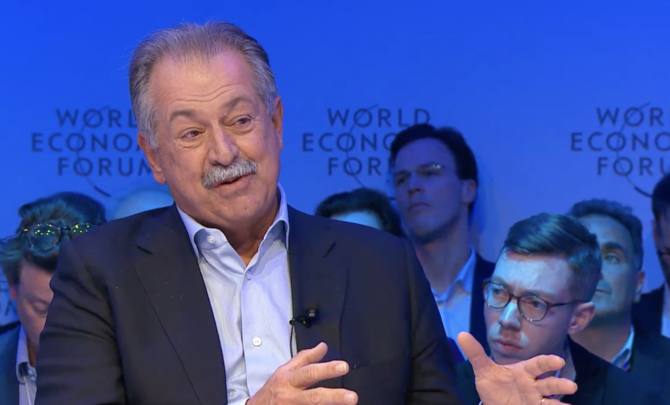
Speaking at the World Economic Forum during a panel on the growth of green energy, Aramco board member Andrew Liveris said the world “could do without” fossil fuels but that energy firms would need help in transitioning to cleaner fuels. (Screenshot: WEF)
Short Url
Updated 21 January 2020
Follow

Energy companies must manage their own transition to lower carbon sources, says Aramco director

  • Aramco board member Andrew Liveris said the world “could do without” fossil fuels
  • Also highlighted need for so-called “Big Oil” companies to think of themselves as energy companies

LONDON: Energy companies must move from fossil fuels to lower carbon sources but should be allowed to manage their own transitions, a Saudi Aramco director said in Davos on Tuesday

Speaking at the World Economic Forum during a panel on the growth of green energy, Aramco board member Andrew Liveris said the world “could do without” fossil fuels but that energy firms would need help in transitioning to cleaner fuels.

“The ecosystem that we’re living in — this planet — is strained to the limit. We have only one planet, the last time we checked, that we can live on. So, we have to do something about the humanity we have inhabited the planet with,” he said.

“Fossil fuels, the fuels of the 20th century, its days are numbered. They are not over, but they are transitioning to be over.”

Liveris said there were many ways to help that transition come about, including extensive financing, correct global regulation and legislation, as well as harnessing innovation. He also said climate accords, such as the Paris Agreement, had to be given more power.

------

READ MORE: Saudi Arabia joins club of Middle East’s ‘green energy’ leaders

------

“The swathe of available technologies to humanity today are building to put policies in place, from efficiency to alternatives to carbon, the hydrogen economy, all of these are things we can do to transition away from coal and oil, to natural gas and ultimately to electrification.

“What lacks (at the moment) is an alignment, a will and a purpose for all the various groups to get together and make that happen, in my new life (and role) I’m putting a lot of time into that,” he said.

The former chairman and CEO of Dow Chemical Company also highlighted the need for so-called “Big Oil” companies to think of themselves as energy companies.

“The term ‘Big Oil’ is almost a neanderthal term, I think we have to realise these companies are energy companies and these companies, like Saudi Aramco, have realised this is a time and a place that humanity is speaking,” he said.

“Communities are speaking and audiences around the world — including hopefully more shareholders — are basically voting with their feet and we are going to have to respond to that.”

“Let’s help ‘Big Oil’ truly become energy companies and manage their own transitions. They can afford it and they should be able to afford it.

“We can’t get there overnight, but there are ways to get there and we can.”

His views were echoed by another panelist Jennifer Morgan, executive director of Greenpeace, who said: “The private banks should stop investing in fossil fuels, they have been investing trillions into them, and move into investments in a low carbon, or zero carbon, infrastructure and renewable energies — you would have to put laws in place that do that.

“You would be powering the world with 100 percent renewable energy and you would put in place incentives and infrastructure to do that,” she said.

Outgoing Bank of England governor Mark Carney said he believed large-scale investment would be able to help the transition thanks to a shift in mindset about the need for greener energy in the financial sector.

“I think they are (listening), they’re listening to the realities, so these issues have moved very swiftly from being corporate responsibility issues or more niche issues within finance to become fundamental value drivers. I think we’re seeing a fundamental reshaping of the financial system,” he said.


Saudi Arabia, Japan trade rises 38% between 2016 and 2024, minister says

Updated 11 January 2026
Follow

Saudi Arabia, Japan trade rises 38% between 2016 and 2024, minister says

RIYADH: Trade between Saudi Arabia and Japan has increased by 38 percent between 2016 and 2024 to reach SR138 billion ($36 billion), the Kingdom’s investment minister revealed.

Speaking at the Saudi-Japanese Ministerial Investment Forum 2026, Khalid Al-Falih explained that this makes the Asian country the Kingdom’s third-largest trading partner, according to Asharq Bloomberg.

This falls in line with the fact that Saudi Arabia has been a very important country for Japan from the viewpoint of its energy security, having been a stable supplier of crude oil for many years.

It also aligns well with how Japan is fully committed to supporting Vision 2030 by sharing its knowledge and advanced technologies.

“This trade is dominated by the Kingdom's exports of energy products, specifically oil, gas, and their derivatives. We certainly look forward to the Saudi private sector increasing trade with Japan, particularly in high-tech Japanese products,” Al-Falih said.

He added: “As for investment, Japanese investment in the Kingdom is good and strong, but we look forward to raising the level of Japanese investments in the Kingdom. Today, the Kingdom offers promising opportunities for Japanese companies in several fields, including the traditional sector that links the two economies: energy.”

The minister went on to note that additional sectors that both countries can also collaborate in include green and blue hydrogen, investments in advanced industries, health, food security, innovation, entrepreneurship, among others.

During his speech, Al-Falih shed light on how the Kingdom’s pavilion at Expo 2025 in Osaka achieved remarkable success, with the exhibition receiving more than 3 million visitors, reflecting the Japanese public’s interest in Saudi Arabia.

“The pavilion also organized approximately 700 new business events, several each day, including 88 major investment events led by the Ministry of Investment. Today, as we prepare for the upcoming Expo 2030, we look forward to building upon Japan’s achievements,” he said.

The minister added: “During our visit to Japan, we agreed to establish a partnership to transfer the remarkable Japanese experience from Expo Osaka 2025 to Expo Riyadh 2030. I am certain that the Japanese pavilion at Expo Riyadh will rival the Saudi pavilion at Expo Osaka in terms of organization, innovation, and visitor turnout.”

Al-Falih also shed light on how Saudi-Japanese relations celebrated their 70th anniversary last year, and today marks the 71st year of these relations as well as how they have flourished over the decades, moving from one strategic level to an even higher one.