

Barty fights to title victory at Adelaide International

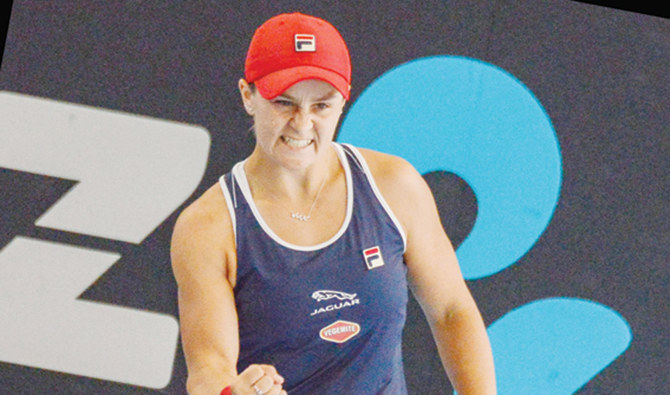
Ashleigh Barty reacts after defeating Dayana Yastremska on Saturday. (AFP)
Updated 19 January 2020
Follow

Barty fights to title victory at Adelaide International

  • Barty beat 24th-ranked teenager Yastremska in 87 minutes at Memorial Drive to gain a boatload of confidence heading into Monday’s start of the Australian Open in Melbourne, where she is top seed

ADELAIDE: Ashleigh Barty ended a nine-year Australian home title drought on Saturday with a 6-2, 7-5 victory over Ukraine’s Dayana Yastremska at the Adelaide International.
The world No. 1 became the first Aussie woman to lift a trophy on a home court since Jarmila Wolfe won Hobart in 2011.
Barty beat 24th-ranked teenager Yastremska in 87 minutes at Memorial Drive to gain a boatload of confidence heading into Monday’s start of the Australian Open in Melbourne, where she is top seed.
She was presented the carved wood trophy by a painted Aboriginal elder who blessed it with a chant it before it was handed over.
“The best part about this week is I fought and scrapped my way through and got better and better in each situation, in each match,”
Barty said.
“I just put myself in the position to play for another title, which is really exciting. It’s been incredible to play at home ... I can’t wait to get started in Melbourne next week.”
Barty will take to the court at Rod Laver Arena on Monday night.

FASTFACT

Ashleigh Barty beat 24th-ranked teenager Dayana Yastremska in 87 minutes to gain a boatload of confidence heading into Monday’s start of the Australian Open in Melbourne, where she is top seed.

“It’s going to be exciting and a fresh tournament ... I have to start with my clean slate for the Australian Open, I’m looking forward to that first round,” she said.
Barty won the opening set against her 19-year-old opponent, losing just two points on serve and breaking
three times.
After starting the second set with a break, the Australian momentarily lost her edge, dropping serve for
two all.
But Barty kept up the pressure, earning three break points in the 11th game. One was enough after Yastremska put a backhand wide.


How international academies are shaping Saudi football’s next generation

Updated 19 sec ago
Follow

How international academies are shaping Saudi football’s next generation

  • Building a unified national footballing philosophy in Saudi Arabia is no simple task

Saudi Arabia’s football transformation has been impossible to ignore since the arrival of Cristiano Ronaldo at the end of 2022. An influx of global stars followed, and with it, unprecedented attention on the Saudi Pro League.

Yet beneath the spotlight, a more pressing question emerged amongst domestic fans: “What is the long-term strategy for developing local players?”

Building a unified national footballing philosophy in Saudi Arabia is no simple task. The sheer size of the Kingdom presents logistical challenges unlike those faced by smaller neighbouring nations, making grassroots development harder to centralize. In this landscape, the work of individual institutions can contribute significantly to the broader football ecosystem.

One such contributor is Juventus Academy Saudi Arabia, an official extension of one of world football’s most historic clubs, operating under the umbrella of Al-Shoaibi Group. Arab News spoke to head of public relations at Juventus Academy, Malak Al-Awami, based in Alkhobar, to understand how the academy fits into the Kingdom’s long-term football vision.

“Saudi Arabia is experiencing a transformational moment under Vision 2030, prioritizing youth development and active lifestyles,” Al-Awami explained. “The  academy arrives at a perfect time to contribute to a world-class methodology while helping nurture the next generation of Saudi footballers.”

At Juventus Academy, success is deliberately defined beyond results and trophies.

“We’re not just training players,” Al-Awami said. “We’re shaping future leaders for the Kingdom.”

That philosophy has been reflected in how the academy balances Juventus’ global philosophy with local Saudi culture. While all coaches undergo Juventus’ training standards, cultural understanding remains a priority.

“All of our coaches are guided to respect Saudi values, culture and communication styles,” Al-Awami said. “Technical excellence matters, but the coach’s character is just as important as their certification.”

One of the academy’s defining features has been its inclusivity and cultural awareness. Players can join as young as four years old and continue until the age of 18, with programs open to both boys and girls.

That inclusivity has had a tangible impact. Juventus Academy played a role in the formation of Khobar FC, a women’s team that competed in the inaugural season of the SAFF Women’s Second Division League.

“We even used the same kit style as Juventus, getting approval from the club itself,” revealed Al-Awami.

Operating as an extension of the academy, the team finished just a few points behind established clubs like Al-Nahda and Al-Fateh in their regional group.

Al-Awami noted that the group is also exploring complementary initiatives aimed at elite player development beyond the academy itself. Among them is the planned Superior Striker Project, a specialized program designed to bring international attacking expertise to Saudi Arabia through short-term clinics for youth and professional players.

It is this broader contribution that highlights the growing importance of international academies in Saudi Arabia. Beyond providing structured training, they are helping build communities, instil values and strengthen the foundations of the domestic football pyramid. 

When asked about what success would look like for Juventus Academy in 5-10 years, Al-Awami was clear. “It is definitely not about trophies or big contracts,” he said, before adding, “it is the legacy we leave behind. If, in 10 years we see confident young Saudi players competing at elite levels, local coaches growing through our programs, and families trusting football as a tool for personal development, then we will know that we have truly succeeded.”

Juventus Academy Saudi Arabia builds on Al-Shoaibi Group’s original ambition in 2018: to create meaningful football opportunities for families in the Kingdom. Today, that ambition has evolved into a structured pathway contributing to Saudi football future, blending global expertise with local identity to help shape the next generation.