Qureshi in Washington for Middle East peace talks

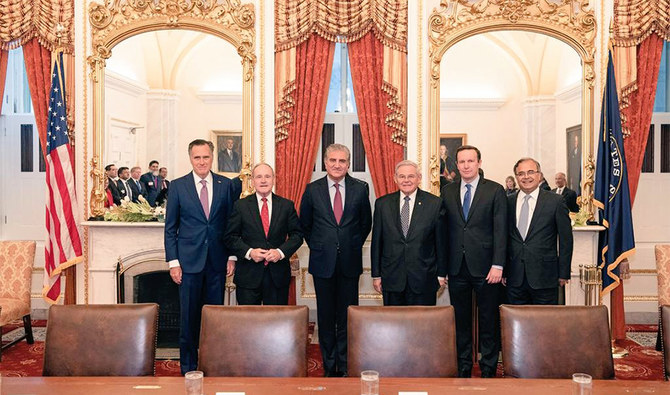
Foreign Minister Shah Mehmood Qureshi with leadership of Senate Foreign Relations Committee at Capitol Hill on Jan 17, 2020. (Photo courtesy: Foreign Minister's official twitter account)
Short Url
Updated 17 January 2020
Follow

Qureshi in Washington for Middle East peace talks

  • Islamabad’s efforts have contributed to reducing tensions in the region, Pakistan Foreign Office claims
  • Pakistan foreign minister earlier visited Iran and Saudi Arabia as part of his Middle East peace mission

ISLAMABAD: Pakistani Foreign Minister Shah Mehmood Qureshi arrived in Washington on Thursday, on the third leg of his Middle East peace mission, to hold talks with top officials, including US Secretary of State Mike Pompeo, the Foreign Office said.
Pakistan’s efforts have contributed to reduction in regional tensions, said foreign office spokesperson, Aisha Farooqui, in a weekly press briefing in Islamabad.
“The foreign minister during his engagements in Tehran and Saudi Arabia put forward Pakistan’s point of view that war is in nobody’s interest and that we are a partner for peace,” Farooqui said.
According to a statement by the Foreign Office, Qureshi will meet Pompeo, National Security Adviser Robert O’ Brien and other senior US administration officials during his US visit.
He will also have meetings with members of the US Congress and the Pakistani diaspora.
Farooqui said that Qureshi will also highlight the deteriorating situation in Indian-administered Kashmir.
While talking to the media in New York, after attending a UN Security Council session on Kashmir on Wednesday, Qureshi said that he had also briefed the UN secretary general on “Pakistan’s ongoing efforts to defuse the dangerous tensions between Iran, Saudi Arabia and the US following recent events.”
“Pakistan has affirmed that it will not participate in any conflict in the region. It will be a partner for peace. To defuse tensions and promote peace, I visited Tehran and Riyadh earlier this week,” Qureshi said.
Earlier this week, the foreign minister visited Saudi Arabia and Iran as part of his tri-country diplomatic tour for Middle East peace efforts.
Qureshi embarked on his Middle East mission on the instruction of Prime Minister Imran Khan who asked him to travel to Iran, Saudi Arabia and the United States to convey Pakistan’s willingness to play a constructive role for peace in the region.
Khan’s announcement came after the Middle East found itself on the brink of another conflict when the US killed a top Iranian military commander, Maj. Gen. Qassem Soleimani, in an attack authorized by US President Donald Trump.


At UNSC, Pakistan warns competition for critical minerals could fuel global conflict

Updated 54 min 58 sec ago
Follow

At UNSC, Pakistan warns competition for critical minerals could fuel global conflict

  • The demand for critical minerals has surged worldwide due to rapid expansion of electric vehicles, advanced electronics and clean energy technologies
  • Pakistan’s representative says all partnerships in critical minerals sector must be ‘cooperative and not exploitative’ and respect national ownership

ISLAMABAD: Ambassador Asim Iftikhar Ahmad, Pakistan’s permanent representative to the United Nations (UN), has warned that intensifying global competition over critical minerals could become a new driver of global conflict, urging stronger international cooperation and equitable access to resources vital for the world’s energy transition.

The warning comes as demand for critical minerals and rare earth elements surges worldwide due to the rapid expansion of electric vehicles, advanced electronics and clean energy technologies, with governments and companies increasingly competing to secure supply chains while raising concerns that this may lead to geopolitical rivalries in the coming years.

Speaking at a Security Council briefing on ‘Energy, Critical Minerals, and Security,’ Ahmad said experience showed that the risks of instability increased where mineral wealth intersected with weak governance, entrenched poverty and external interference.

“Access to affordable, reliable and sustainable energy is essential for development, stability and prosperity. The global transition toward renewable energy, electric mobility, battery storage and digital infrastructure has sharply increased the demand for critical minerals,” he said.

“This upsurge has generated new geopolitical and geo-economic pressures. If not managed responsibly, competition over natural resources can affect supply chains, aggravate tensions, undermine sovereignty and contribute to instability.”

In several conflict-affected settings, he noted, illicit extraction, trafficking networks and opaque financial flows have fueled armed conflict and violence, weakened state institutions and deprived populations of legitimate revenues.

“The scramble for natural resources and its linkage to conflict and instability is therefore not new,” Ahmad told UNSC members at the briefing. “Pakistan believes that natural resources must serve as instruments of economic development and shared prosperity, and not coercion or conflict.”

He urged the world to reaffirm the right of peoples to permanent sovereignty over their natural resources, saying all partnerships in the critical minerals sector must be cooperative and not exploitative, respect national ownership, ensure transparent contractual arrangements and align with host countries’ development strategies.

“In order to prevent the exploitation of mineral-producing countries and regions, particularly in fragile and conflict-affected settings, support their capacity-building for strengthening domestic regulatory institutions, combating illicit financial flows, ensuring environmental safeguards, and promoting equitable benefit-sharing with local communities,” he asked member states.

“Promote equitable participation in global value chains. Developing countries must be enabled to move beyond extraction toward processing, refining and downstream manufacturing. Technology transfer, skills development and responsible investment are essential to avoid perpetuating structural imbalances.”