

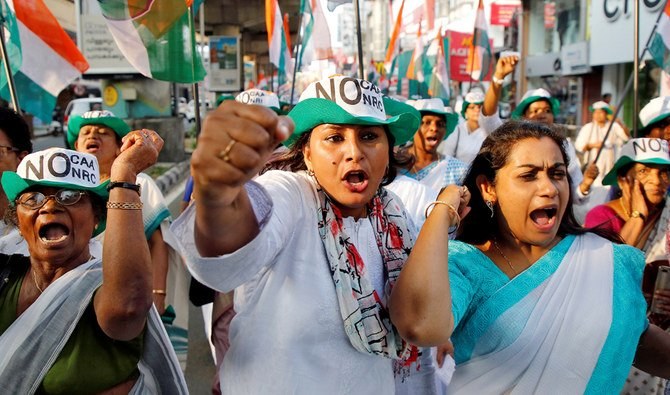

NEW DELHI: India’s main opposition parties on Monday met to devise a joint strategy against the controversial new citizenship law which had brought “unprecedented turmoil” to the country.
The initiative for the united campaign was taken by the Congress party, the chief opposition group supporting a more secular India, which mobilized eight like-minded parties from different parts of the country.
Nationwide protests have been taking place for the last month against the Indian Prime Minister Narendra Modi government-backed Citizenship Amendment Act (CAA) that grants citizenship to Hindus, Sikhs, Parsis, Jains, Buddhists and Christians from neighboring Bangladesh, Pakistan and Afghanistan, but excludes Muslims.
Protesters see the legislation as discriminatory and anti-Muslim, attacking the basic secular preamble of the constitution.
Public anger has also been directed at the proposed National Register of Citizens (NRC), an exercise to identify genuine Indian citizens, which demonstrators fear would again alienate Muslims, India’s largest minority group.
Many university campuses and several cities across India have witnessed protests against the ruling Bharatiya Janata Party (BJP) demanding the law be withdrawn.
For the opposition parties, popular resistance against the BJP would offer an opportunity to wrest political narrative from the Modi regime.
“The government has let loose the reign of oppression and is spreading hatred in order to divide people along sectarian lines,” said Congress president Sonia Gandhi addressing the opposition meeting. “There’s an unprecedented turmoil. The constitution is being undermined and instruments of governance being misused.”
She added: “The real issue facing India today is the collapse of economic activity and slowing growth and development affecting all sections of society, especially the poor and disadvantaged.
“The prime minister and home (affairs) minister have no answers and want to divert the nation’s attention from this grim reality by raising one divisive and polarizing issue after another.”
Modi however blamed the opposition for inciting protests.
“Questions regarding this (CAA) have been slowly implanted in the minds of the youths by people. The youths are, by and large, alert. But there are some who have fallen prey to these misconceptions and rumors,” said the PM in Kolkata on Sunday.
Minister of Home Affairs Amit Shah, Modi’s close aide, blamed the Congress for the crisis. “I am saying it loudly. You Congress leaders, listen carefully. Oppose it as much as you can … Hindu, Sikh, Buddhist and Christian refugees from Pakistan have as much right over India as you and I have.”
The BJP’s belligerence has not gone down well with some of its political allies with regional partner Janta Dal (United), in the crucial eastern state of Bihar, urging the BJP to rethink the CAA.
“There should be a debate on the CAA. If people want, then there will be a discussion in this house. As for the NRC, there is no question of the NRC and no justification for it,” said the BJP’s oldest ally Nitish Kumar, the chief minister of Bihar.
So far 11 opposition-ruled Indian states have announced that they would not implement the CAA and the NRC in their provinces.
Delhi-based political analyst, Nilanjan Mukhopadhyay, said: “The opposition is trying to find their own place in the spate of anti-government agitation that is going on. It is not only Muslims but other sections of society too that are on the streets.
“Protest is much beyond religion. It is the ordinary people who are agitating. Opposition parties want to tap this anger.”
Mukhopadhyay added: “This is the first ideological contestation of people against the BJP. People are saying that what you (the BJP) have done is not good for the country.
“The Congress party has finally decided to take a very clear ideological position. This is not individual but ideological contestation. The world view that the BJP has been projecting has been challenged for the first time at a popular level. It’s being questioned.”


