Philippine authorities brace for Taal eruption

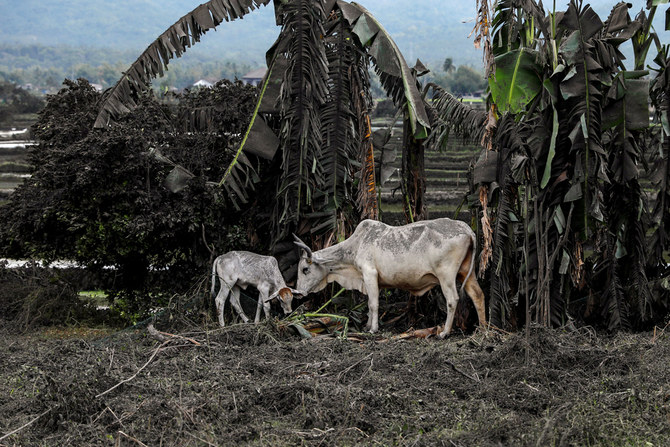
Cows partly covered by ashes eat grass in a land nearby the erupting Taal Volcano in Talisay, Batangas, Philippines. (Reuters)
Short Url
Updated 14 January 2020
Follow

Philippine authorities brace for Taal eruption

  • Alert level 4 remains in effect over the volcano, which means that a hazardous explosive eruption is possible within hours to days
  • Authorities said the total evacuation of Volcano Island, and high-risk areas within a 14-km radius of the main crater, must be enforced

MANILA: Philippine authorities are bracing for an eruption of Taal volcano, south of the capital Manila, after it began to spew lava on Monday.

The Philippine Institute of Volcanology and Seismology (Phivolcs) said a lava fountain from the volcano was recorded less than 24 hours after it entered a period of intense unrest, blasting ash and steam up to 15,000 meters into the air on Sunday.

The Philippine Seismic Network has recorded 144 volcanic earthquakes in the Taal region since 1 p.m. on Sunday.

Alert level 4 remains in effect over the volcano, which means that a hazardous explosive eruption “is possible within hours to days.”

Phivolcs said the total evacuation of Volcano Island, and high-risk areas within a 14-km radius of the main crater, must be enforced. 

Motorists are advised to drive with extreme caution as poor to zero visibility due to ash has been reported in some affected areas. Civil aviation authorities have advised aircraft to avoid the airspace around Taal volcano.

Department of National Defense Secretary Delfin Lorenzana said the worst-case scenario is that it will erupt at a scale similar to the June 1991 eruption of Mount Pinatubo that killed 800 people and rendered 200,000 homeless.

“The entire mountain collapsed during the (Pinatubo) eruption,” he added. “That’s what we’re fearing, that the eruption would cause the entire island to rise and scatter debris on the nearby areas. Hopefully this won’t happen. We can never predict the actions of this volcano.”

Lorenzana, who also heads the National Disaster Risk Reduction and Management Council (NDRRMC), said he had talked to Phivolcs chief Renato Solidum, who said there is no danger of a tsunami as Taal Lake is too small.

The NDRRMC said at least 5,458 families, or 24,508 individuals, in the provinces of Batangas and Cavite have been evacuated.

There are reports of areas in the immediate vicinity of the volcano being deserted and covered in ash, and of several houses having been destroyed.

Meanwhile, thousands of passengers remain stranded at Ninoy Aquino International Airport even as it resumed partial operations from 10 a.m. on Monday.

President Rodrigo Duterte’s office said the ash had prevented him from flying back to Manila from Davao City on Sunday.


US will respond to Rwanda’s violation of peace pact, says Rubio

Secretary of State Marco Rubio. (AP file photo)
Updated 4 sec ago
Follow

US will respond to Rwanda’s violation of peace pact, says Rubio

  • Waltz told the Security Council meeting that the US “is deeply concerned and increasingly disappointed” by this resurgence of violence

WASHINGTON: Top US diplomat Marco Rubio said on Saturday that Rwanda had clearly violated the peace agreement it signed with the Democratic Republic of Congo in Washington last week and vowed unspecified “action” in response.
The Rwandan-backed M23 armed group advanced in eastern DRC and seized the key border city of Uvira, just days after the leaders signed the “Washington Accords” on Dec. 4.
“Rwanda’s actions in eastern DRC are a clear violation of the Washington Accords, and the US will take action to ensure promises made to the President are kept,” Secretary of State Rubio wrote on X.

FASTFACT

UN peacekeeping chief Jean-Pierre Lacroix warned the new offensive ‘has revived the specter of a regional conflagration with incalculable consequences.’

The capture of Uvira, along the border with Burundi, has raised fears that the conflict could escalate into a regional war.
As part of an offensive launched at the beginning of December in South Kivu province, the armed group’s takeover follows its earlier this year capture of Goma and Bukavu, other major cities in the DRC’s mineral-rich east.

Mike Waltz, US ambassador to the UN. (REUTERS)

On Friday, US Ambassador to the UN Mike Waltz accused Rwanda of “leading the region toward more instability and toward war.”
“The Rwandan defense forces have provided materiel, logistics, and training support to M23 as well as fighting alongside M23 in DRC with roughly 5,000 to 7,000 troops,” not including possible reinforcements during the latest offensive, Waltz told the UN Security Council.
The Rwandan firepower has included surface-to-air missiles, drones, and artillery, he added.
Since taking up arms again in 2021, the M23 has seized swaths of territory, displacing tens of thousands and leading to a spiraling humanitarian crisis.
Earlier this month, UN experts said Rwanda’s army and the M23 had carried out summary executions and forced mass displacements of people in the region.
Waltz told the Security Council meeting that the US “is deeply concerned and increasingly disappointed” by this resurgence of violence. 
The envoy denounced “the scale and sophistication” of Rwanda’s involvement in eastern DRC.
UN peacekeeping chief Jean-Pierre Lacroix warned the new offensive “has revived the specter of a regional conflagration with incalculable consequences.”
“Recent developments pose a serious risk of the progressive fragmentation of the Democratic Republic of Congo, particularly its eastern part,” he said.
Burundi on Friday accused Rwanda of bombing its territory, and its ambassador, Zephyrin Maniratanga, told the council it “reserves the right to use self-defense.”
He warned that if the attacks continue, it would be extremely difficult to avoid an escalation between the two African countries.
“Rwanda is not waging war against the Republic of Burundi and has no intention of doing that,” Ambassador Martin Ngoga said.
Meanwhile, Congolese Foreign Minister Therese Kayikwamba Wagner criticized the Security Council for its “lack of action” and called for sanctions against Rwanda.

Despite a resolution adopted in February demanding the withdrawal of Rwandan troops and a ceasefire, “the situation is undeniable: another city has fallen, a parallel administration has consolidated itself, thousands more families have fled, and others have been killed, raped, and terrorized,” she said.