

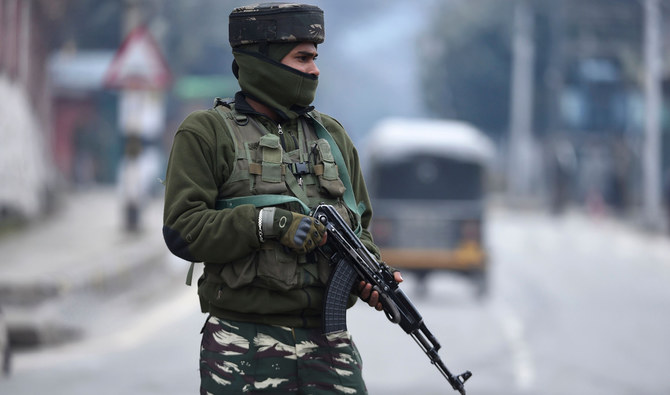

NEW DELHI: India is to review a months-long internet blackout in its portion of Kashmir following an order from the country’s Supreme Court.
The territory has been without the internet since August, when New Delhi revoked its semi-autonomous status and divided the state into two centrally governed union territories.
A three-judge Supreme Court bench said on Friday that the temporary suspension of internet and curtailment of basic freedoms of citizens should not be arbitrary and was open to judicial review.
It ruled that the freedom to use the internet was a “fundamental right” and took the government to task for the frequent use of “restrictive orders under Section 144 (of the Code of Criminal Procedure),” which banned the gathering of more than four people at a place. The judges said it should not be used at whim.
The intervention brought relief to those living and working in Kashmir.
“I am a law student and after finishing my degree I want to pursue my master’s in law at some university outside,” Srinagar-based student Deeba Ashraf told Arab News.
“For five months, I was hamstrung. I could not look for a job, nor explore any academic options because of the internet shutdown. My sister who has an online business lost all her money due to the ban,” she said, as trade was down and health care was also suffering due to the blackout. She welcomed the court’s decision, but did not trust the government to abide by it.
BACKGROUND
The BJP has yet to comment on the ruling, but Information and Broadcasting Minister Prakash Javadekar said that ‘what the BJP government did in Kashmir has been welcomed all over the world. Things are already normal.’
Srinagar-based video journalist Manzoor-ul-Haq said that sending stories had been difficult without the internet. “We were feeling as if we were living in the stone age,” he told Arab News. “I hope the government (will) honestly try to restore internet services.”
Another journalist, Pulwama-based Javid Sofi, said some reporters had lost their jobs since the blackout.
Political activist Tehseen Poonawala, who is one of the main petitioners challenging the internet blackout said the court’s ruling was a big step forward.
“It is going to open up more transparency, and citizens can challenge the government when it arbitrarily puts out an internet ban,” he told Arab News. “At a time when people across India are fighting for their fundamental and constitutional rights, the reiteration of the constitutional values by the apex court is a big relief.”
He added that the government would find excuses to restrict the internet in Kashmir again, but that the only option for activists was to “fight legally and politically.”
The ruling Bharatiya Janata Party (BJP) has yet to comment on the ruling, but Information and Broadcasting Minister Prakash Javadekar said that “what the BJP government did in Kashmir has been welcomed all over the world. Things are already normal.”
But the opposition Congress party called the court ruling “a rebuff” for the government.
“The Supreme Court’s order is a rebuff to the unconstitutional and arrogant stance of the central government and the J&K administration,” senior Congress leader P. Chidambaram tweeted.
Kashmir is India’s only Muslim-majority state and scrapping its special status was New Delhi’s bid to integrate it fully with India and to rein in militancy.


