

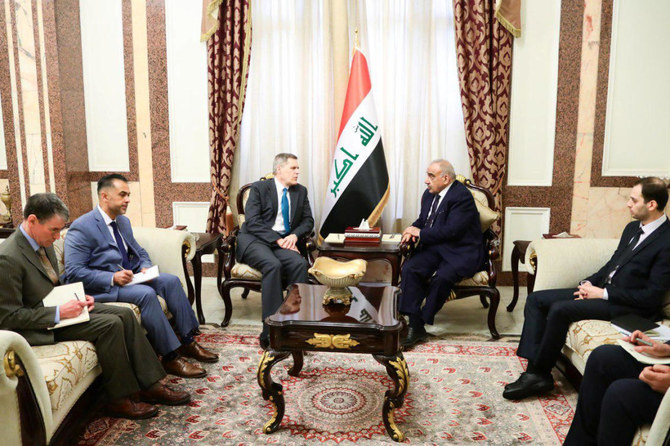

BAGHDAD: The US said Friday it would not discuss pulling troops from Iraq after its caretaker prime minister asked Washington to send a delegation to begin withdrawal arrangements.
"At this time, any delegation sent to Iraq would be dedicated to discussing how to best recommit to our strategic partnership -- not to discuss troop withdrawal, but our right, appropriate force posture in the Middle East," State Department spokeswoman Morgan Ortagus said.
Iraq’s caretaker prime minister had asked Washington to start working out a road map for an American troop withdrawal, his office said Friday, signaling his insistence on ending the US military presence despite recent moves to de-escalate tensions between Iran and the US
The request came in a telephone call Thursday night between Secretary of State Mike Pompeo and Adel Abdul-Mahdi, a statement from his office said. He also told Pompeo that recent US strikes in Iraq were an unacceptable breach of Iraqi sovereignty and a violation of the two countries’ security agreements.
He asked Pompeo to “send delegates to Iraq to prepare a mechanism to carry out the parliament’s resolution regarding the withdrawal of foreign troops from Iraq,” according to the statement.
“The prime minister said American forces had entered Iraq and drones are flying in its airspace without permission from Iraqi authorities, and this was a violation of the bilateral agreements,” the statement added.
Iraqi lawmakers passed a resolution Sunday to oust US troops, following the Jan. 3 US drone strike that killed top Iranian Gen. Qassem Soleimani and senior Iraqi militia commander Abu Mahdi Al-Muhandis at Baghdad’s airport. The nonbinding vote put the responsibility on the government to formally request a withdrawal. Abdul-Mahdi, addressing lawmakers at the time, called for “urgent measures” to ensure the removal of the troops.
Speaking to Pompeo, Abdul-Mahdi stopped short of requesting an immediate withdrawal and appeared to give the US time to draw up a strategy and timeline for departure. Still, the comments suggested he was standing by the push for the American forces to go despite recent signals toward de-escalation between Tehran and Washington after Iran retaliated for Soleimani’s death with a barrage of missiles that hit two Iraqi bases where US troops are based but caused no casualties.
There are some 5,200 US troops in Iraq assisting and providing training to Iraqi security counter-parts to fight the Daesh group. An American pullout could deeply set back efforts to crush remnants of the group amid concerns of a resurgence amid the political turmoil.
The State Department acknowledged that Pompeo had called Abdul-Mahdi but made no mention of US troops in a readout of the call released late Thursday.
The push to remove the US forces comes amid widespread Iraqi anger over being caught in the middle of fighting between Baghdad’s two closest allies. Abdul-Mahdi has said he rejects all violations of Iraqi sovereignty, including both the Iranian and US strikes.
Still, the demand for withdrawal is not universal. Sunni and Kurdish lawmakers opposed the Parliament resolution. The Sunnis see the US presence as a bulwark against domination by the majority Shiites and Iran, while the Kurdish security forces had benefited from American training and aid.
The latest escalation between Tehran and Washington on Iraqi soil was set off when a rocket attack blamed on the Iranian-backed militia group Kataeb Hezbollah, or Hezbollah Brigades, caused the death of an American contractor at a base in Kirkuk province in late December. The US replied with a barrage of strikes on the militia’s bases, killing at least 25 people.
Meanwhile, Grand Ayatollah Ali Al-Sistani urged rival Iraqi political factions to unite and put private interests aside, saying their attempts to outbid each other in the political process had led to the current crisis and risked creating more unrest.
Rival political factions have yet to agree on a nominee to replace the outgoing Abdul-Mahdi, who resigned in December under pressure from mass protests.
Large demonstrations were planned in Baghdad on Friday, as anti-government protesters sought to recover momentum following the fast-escalating regional tensions that overshadowed their uprising. Protesters also gathered in the southern provinces of Najaf, Diwanieh and Dhi Qar.
“The serious attacks and repeated violations of Iraqi sovereignty that occurred in recent days with the apparent weakness of the concerned authorities in protecting the country and its people ... are part of the repercussions of the current crisis,” Al-Sistani said.
“Everyone is required to think carefully about what this situation will lead to if there is no end to it,” he added.


